

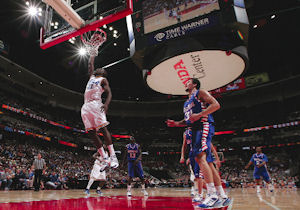
As another college basketball tournament wraps up, Anaheim’s Honda Center is gearing up for its own piece of March Madness next year.
In 2011, Honda Center is set to host the Big West Conference’s basketball tournaments, which since 2001 have been held across town at the Anaheim Convention Center’s arena.
“When you say your tournament is in Anaheim, many people right away assumed that we were at the Honda Center,” said Rob Halvaks, the Big West’s senior associate commissioner. “It was confusing. We’re eliminating that confusion.”
The shift is a boost for Honda Center’s basketball ambitions, which ultimately rest on landing a National Basketball Association team.
For now, the center is promoting the Big West tournaments as part of a college basketball package that includes the John R. Wooden Classic, which hosts four of the nation’s best teams, and the 2011 NCAA West Regional “Sweet 16” semifinals and championship, dubbed the Elite Eight.
“It’s one of those things where one plus one plus one equals more than three,” said Tim Ryan, chief executive of Honda Center. “That’s our hope.”
Ryan said he hopes the college games will boost Honda Center’s credibility as a home for an NBA team. The arena, best known as home to hockey’s Anaheim Ducks, hosts some Los Angeles Lakers exhibition games and some regular season games of the Los Angeles Clippers.
In 2008, Anaheim was in the running to land the Seattle SuperSonics before that team became the Oklahoma City Thunder. Now some speculate Honda Center could be a longshot consideration for Oakland’s Golden State Warriors.
Landing an NBA team is a key goal of Broadcom Corp. cofounder Henry Samueli and wife Susan, who own the Ducks and Anaheim Arena Management LLC, which manages the city-owned Honda Center.
Filling the Seats
For now Honda Center has its work cut out filling its 17,608 seats with college basketball fans.
Since the Big West moved its tournaments to the Anaheim Convention Center’s arena from Reno in 2001, it never approached the arena’s capacity of 7,734.
This year’s men’s final between California State University Long Beach and University of California, Santa Barbara, drew 3,113 fans. The 2008 championship between county rivals California State University, Fullerton, and University of California, Irvine, attracted just 4,234.
Honda Center is betting it can do a better job marketing the games.
“There are over 500,000 Big West alumni living in Southern California and close to 50,000 current students,” Ryan said, referring to Cal State Fullerton, UC Irvine and Cal State Long Beach, three of the Big West’s nine members.
“An audience exists locally for us to build on,” he said. “It’s our job to find them and to get them excited.”
During this year’s tournament, sales staffs from the Big West and Honda Center promoted all-tournament passes for next year.
On Honda Center’s Web site, a new tournament emblem encompassing the Big West’s logo and a rendition of the arena links to an order form for tickets.
Anaheim Arena Management also is advertising the tournament during Ducks radio and television broadcasts and on social networking sites. Advertisements are set to go up on the arena’s outdoor marquee along the Orange (57) Freeway and on video screens inside Honda Center.
“We’ve already had presence in the Ducks’ telecasts this year promoting next year’s tournament,” Halvaks said. “We might be able to increase the volume of doors that the sales staff of Anaheim Arena Management is getting into.”
More Resources
The arena’s full-time staff offers more resources than CBS College Sports, a cable channel that’s part of CBS Corp. It has handled sales, marketing and sponsorships for the Big West tournaments but has just one representative for the West Coast, Halvaks said.
“We have a five-year plan to get this event to where we think it can be in terms of attendance,” said Ryan, recalling a conversation with Big West Commissioner Dennis Farrell. “I asked Dennis, ‘What would we like to see at the end of five years?’ Both of us said that we’d like to see two or three teams go into the NCAA tournament. We’d like to look up in the stands and see every seat filled, and we’d like to re-engage a number of students and alumni with their universities.”
The move to Honda Center is allowing the Big West to change up the tournament’s format. Instead of granting byes to the top four seeds, all eight teams that qualify will play each other in the first round starting next year.
“Fans would wait to buy either a ticket for their (school’s) first game or an all-session pass because they didn’t know when their team would be playing,” said Mike Daniels, the Big West’s operating manager for basketball tournaments. “Now that everybody knows when their teams are playing, they’re more apt to buy an all-session pass.”
The Big West hopes the move will bring more revenue. The conference will receive more than $2 million for having an automatic qualifier in this year’s NCAA tournament—and it could get $240,000 per year for each victory or each appearance by a Big West at-large team.
But the conference hasn’t placed a second team in the NCAA tournament since 2005—and has done so only once since 1994.
Meanwhile, other mid-major conferences are taking steps to increase their visibility. The West Coast Conference plays its tournaments at the Orleans Arena in Las Vegas, though it doesn’t have a school in Nevada. The Western Athletic Conference will follow suit in Sin City next year.
D’Hippolito is a freelance sports writer who lives in Fullerton.
