

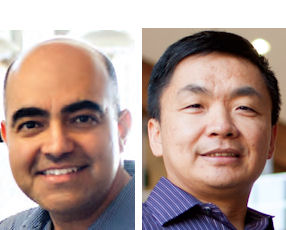
SRCH2 Inc., a spinout of University of California, Irvine, has struck a licensing deal with HTC Corp. that’s expected to add millions in revenue and put the startup on the map.
The company’s search engine software will be embedded in several next-generation phone models slated to begin shipping next year from Taiwan-based HTC.
“We’re talking millions of phones here,” said Chief Executive Dev Bhatia. “You can get a sense of the magnitude of a deal like this.”
It’s not uncommon in the industry for software makers to rake in upward of $2 per unit on licensing operating-system-class software.
Consider SRCH2’s offering a notch or two below that grade.
The company’s universal search software was created in UCI labs about five years ago by computer science professor and former Google Inc. engineer Chen Li.
The software allows users to simultaneously rifle through emails, music databases, contacts and the Internet in milliseconds.
The system doesn’t rely on mobile networks, so passing through tunnels or long, desolate stretches on the Highway 101 or the 15 Freeway won’t disrupt feeds. It’s billed to provide several other coveted features for phone makers and consumers, such as “search-as-you-type” prompts; rapid geosearch on local places of interest; error tolerance, which mitigates search typos; real-time data updates; and the capability to weigh ranked results without custom coding.
“We’re talking about making every search as good as Google’s,” Bhatia said. “There’s a real gap in what search is on a phone to what is on the desktop right now.”
The SRCH2 technology can be embedded in any Android smartphone and other devices with limited memory, such as set-top, or cable boxes, according to the company.
Android
Android-based operating systems dominated market share in the recently ended quarter, accounting for 81% of the 244 million smartphones purchased, according to Allied Business Intelligence Inc. in Oyster Bay, N.Y. Apple’s IOS was No. 2 with 14%, followed by Windows at 4%, and BlackBerry at 2%.
Other potential applications for the SRCH2 software include e-commerce sites, automotive dashboards and cloud-based data systems.
SRCH2’s product in many cases is replacing search software that’s more than a decade old, according to Bhatia.
SRCH2 has kept a low profile since its inception in 2008.
The company generally doesn’t discuss its client list due to nondisclosure agreements common in the tight-lipped world of consumer electronics.
HTC appears to see a benefit to getting word out about its plans for SRCH2’s software.
“This is the first handset deal we’re able to announce,” Bhatia said.
HTC was an early innovator in the mobile phone market, introducing touch-screen functions in 2000 and its first smartphone two years later, powered by Microsoft. The company peaked in the third quarter of 2011 when it became the largest smartphone maker in the U.S., with nearly a 25% market share, according to Singapore-based market tracker Canalys.
It held the No. 4 spot among global phone makers at the time, but its position has weakened since then as consumers continue to flock to Samsung and Apple smartphone models.
HTC sold more than 6.6 million smartphones in the second quarter of this year, falling to No. 11 globally with a 2.8% share, according to ABI.
Its latest earnings report prompted more concerns amid rumors that Lenovo Group Ltd. is weighing a takeover.
HTC in the recently ended quarter posted an operating loss of $101 million on sales of $1.6 billion.
That compares to $42 million in operating income and $2.35 billion in revenue a year ago.
Investors
SRCH2 has secured funding from a prolific group of technology investors, including Data Collective in San Francisco, Los Angeles-based TenOneTen, and Stanford University professor and tech pioneer Jeffrey Ullman.
The company is quiet on funding but said it raised “seven figures” this year, which helped it make a move in August to a 2,000-square foot office with floor-to-ceiling glass walls overlooking the tarmac at John Wayne Airport. The company had been operating out of a shared incubator at UC Irvine.
Angel investor and Data Collective equity partner Bruno Bowden was impressed with SRCH2’s technology that can quickly handle and organize large data sets in mobile devices and with the company’s management team.
“Chen has been working on some of this stuff for more than a decade at UCI,” he said. “It’s a rare thing when you have that much of an expert that’s willing to take a risk and go on an adventure of starting a company.”
“Tech Visionary”Bowden is considered a tech visionary for his groundbreaking work on the EarthViewer 3D software at Mountain View-based Keyhole Corp., which was acquired by Google in 2004. He was instrumental in developing the core technology into what became Google Earth.
TenOneTen was founded by David Waxman and Gil Elbaz. Waxman cofounded Firefly Network Inc. with fellow MIT Media Lab graduates.
The company was bought by Microsoft Corp. in 1988 for its flagship product, which became Microsoft Passport.
Elbaz cofounded Applied Semantics in Santa Monica, which was acquired by Google in 2003.
Its core technology became Google AdWords, the company’s main advertising product and primary source of revenue.
Google posted revenue of $50.17 billion last year.
Ullman, who has served on Google’s technical advisory board, was Li’s adviser during his doctorate studies at Stanford and now serves on SRCH2’s board. The expert on data systems and algorithms also advised Google cofounder Sergey Brin at Stanford during a historic era in Silicon Valley that produced some of the best minds in search technology.
