

Corporate spending on phone, Internet and data services is starting to level out after a tough 2009, according to a handful of telecommunications service providers in Orange County.
Telecom companies here and across the country are expected to see a modest recovery this year as corporate spending on technology improves.
The overall telecom market, which shrank by 3% in 2009, is expected to grow 5% this year to about $2 trillion, according to a forecast earlier this year by Stamford, Conn.-based market researcher Gartner Inc.
The information technology services market, which overlaps with the operations of several telecom companies here, is expected to grow 6% to $821 billion this year, according to Gartner.
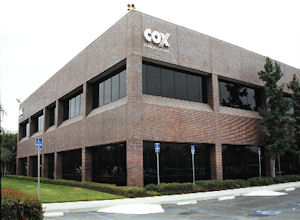
“We’ve seen a lot of improvement in business activities, particularly during the second quarter,” said Tim Hinson, vice president at Cox Business in Rancho Santa Margarita, part of Atlanta-based Cox Communications Inc.
The top three telecom companies here by local workers—Dallas-based AT&T Inc., New York-based Verizon Communications Inc. and Sprint Nextel Corp. of the Kansas City area—have been shedding jobs in the past year or so.
Roughly 1,000 telecom jobs were cut here in the past 12 months (see story, page 8).
Cox, which offers phone and Internet service to businesses and residents as part of its larger cable TV business here, has been an exception—it’s added some 100 jobs locally.
“We have added customer support and sales positions as demand has grown, so we can better serve our market,” Hinson said.
Cost-Cutting
For the most part, telecom customers still are in cost-cutting mode.
They are eking out efficiencies by taking advantage of wireless services that allow them to cut down on their costs, according to Ken Muche, a spokesman for Verizon Wireless, the wireless arm of Verizon Communications, which has operations around the county and a phone service hub in Huntington Beach.
Customers are using Skype Mobile and other Internet-based phone applications to “increase the productivity of the workforce they do have left,” Muche said.
Some business customers are starting to add back services they cut during the worst of the downturn, according to Muche.
“One of the things customers are learning as they go through these difficult times is that your wireless service is really a critical piece of the business,” he said. “Dropping or scaling back ultimately is not helping the bottom line.”
Sales to business customers “are more on the upswing than the downswing,” Muche said.
The biggest shift seen by telecom companies is the transition from traditional phone service to making calls via Internet lines.
“There’s been quite a shift from traditional phones toward voice-over-Internet protocol, which introduces a lot of new features and is more efficient,” said Chris Muller, a spokesman for New York’s Paetec Commun-ications Corp., a provider of data, voice and Internet services with operations in Irvine.
Internet-based phone systems allow workers to make calls between different offices on a private network, so they don’t rack up long-distance charges.
The networks are cheaper to get up and running and cost less to maintain than traditional phone systems.
“Some of the older systems take a tremendous amount of resources just to maintain them,” Muller said. “You can offload a lot of that maintenance (with) a newer system.”
Another biggie: outsourcing the maintenance and monitoring of corporate networks.
“Businesses now can find ways of outsourcing a lot of the infrastructure that was once in their suite,” Muller said. “They can now push it off to service providers who can maintain it 24 hours a day and save them a lot of management expense.”
Spending within the telecom industry is shifting toward more spending on mobile devices, according to market tracker Gartner.
Spending on smart phones for business is expected to grow from 11% of all telecom spending to 14% in the next three years.
Verizon’s business customers have sought out better ways for their field workers to get connected to the Internet while out on the road, according to Muche.
The company’s been pushing global positioning system services to corporations with large fleets.
One is Verizon’s MiFi, a card that allows up to five mobile devices to hook up to a “personal” wireless hotspot.
“A lot of businesses are looking at this to increase productivity for their sales forces,” Muche said. “At the heart of it all is mobility, reliability and speed.”
