

Aliso Viejo’s Smith Micro Software Inc. is making it easier for consumers and corporations to share information.
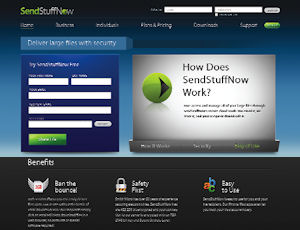
The software maker for cell phones and other mobile devices recently debuted SendStuffNow, which allows a sender to upload big files to Smith Micro’s servers where they can be downloaded by others, in compressed form, to any type of device.
After files are uploaded, Smith Micro’s service sends an e-mail to the intended recipient with a link to retrieve them.
The technology comes from one of Smith Micro’s oldest offerings, dubbed StuffIt, which allows big data files to be compressed and shared online or over wireless networks.
“The compression technology that we are leveraging in this service is the ability to optimize the storage and the transport of files over the air,” said Tom Matthews, Smith Micro’s chief strategy officer. “You can also send files to a mobile device, smartphone or the iPad.”
The company plans to market SendStuffNow on a tiered subscription model.
A limited version is free. The premium version, which offers more space to send and store files, goes for about $10 a month. A professional version goes for about $15 per month.
Higher-end versions, marketed toward businesses of all sizes, are sold on a per-employee basis.
Smith Micro’s selling point to companies is that using a file-sharing service “removes the burden off your e-mail system,” said Robert Elliott, chief marketing officer.
“So many companies have problems with receiving big attachments in e-mails because there are too many things stored in e-mail,” he said.
Next-Generation Technology
Smith Micro developed the product with an eye toward third- and fourth-generation telecommunications networks, known as 3G and 4G, which likely will charge by the megabyte for data plans.
“Moving files around, we think, will be a critical element to mobile computing,” Matthews said. “As we move to 3G and 4G, you will see users subscribing to wireless service plans that are paid per megabyte. If we can assist them in reducing the costs of sending and receiving files, we think there will be a demand for the product.”
Another biggie on the horizon—increased video files.
“It will become, in the next years, more important for presentations and distributing ideas,” Matthews said. “It’s a huge growth driver in terms of being able to send files. E-mail systems weren’t really designed to be able to carry that burden.”
Wall Street analysts like Smith Micro’s prospects for being a player in next-generation networks.
“Smith Micro is well-positioned to benefit from the forthcoming transition to 4G networks,” said Lawrence Harris, an analyst at CL King & Associates in New York. “Even if subscribers continue with their present carriers, they will need to obtain new software.”
Harris boosted his rating on the stock to “accumulate” from “neutral” during the first quarter.
Last week, he raised his 2010 profit estimate to $28 million, up from a previous estimate of $27 million.
On average, analysts expect Smith Micro to see 2010 profits of $28 million on sales of $133 million.
Competitors, Customers
With the company’s file-sharing offering, Smith Micro’s entering a market that’s already crowded.
San Francisco’s Dropbox Inc., San Jose-based YouSendIt Inc., Chicago-based 37Signals LLC’s Backpack, Google Inc.’s GoogleDocs and others all compete in the same category.
Some use the tiered subscription model, as well.
Where Smith Micro hopes to distinguish itself is by offering heftier file encryption for better security and a sleeker user interface.
“We have one of the best patent portfolios in compression globally,” Matthews said. “We think this gives us a competitive advantage where the end user will want the service and be willing to pay for it.”
Smith Micro’s bread and butter is selling software that’s used by big cell phone service providers and telecommunication companies. Some of its software does over-the-air updates and helps mobile devices connect to a carrier’s network.
Big customers include Verizon Wireless, part of New York’s Verizon Communications Inc., Sprint Nextel Corp., AT&T Inc., Motorola Inc. and others.
The company also does what’s called connection management software for computer makers Dell Inc. and Hewlett-Packard Co.
A much smaller part of its business—roughly 10% of its $113 million in yearly sales—is selling a variety of software to consumers online and in stores.
Smith Micro has some 22 different products geared toward consumers.
It offers specialty software for drawing Japanese animation and comics, cleaning up and diagnosing computer problems and designing custom avatars for use in social networks. n
