

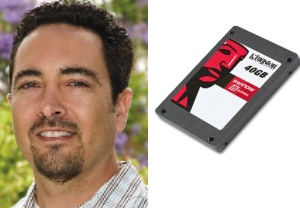
Fountain Valley’s Kingston Technology Co. is looking to spur sales of a new type of data storage drive with a low-cost version that is targeted at niche users.
Kingston, the largest maker of computer memory products, is selling a drive that stores 40 gigabytes of data in flash memory chips. The drive is going for less than $100 after promotions at some online stores.
Similar but smaller drives sell for about $120. Intel Corp. sells one that’s nearly $400.
The move is part of Kingston’s push for what are known as solid state drives, which, unlike traditional disk drives, have no moving parts.
“We want to drive awareness of solid state drives to a wider base,” said Ariel Perez, Kingston’s solid state drive business manager.
Solid state drives are seen as the biggest development in data storage in years. They use memory chips instead of spinning disks to store data. They’re seen as faster and more re-liable, and they use less power than disk drives.
Kingston is one of several players going after the market for solid state drives. Others include disk drive makers Seagate Technology LLC, Western Digital Corp., Hitachi Ltd. and Samsung Electronics Co.
Santa Ana’s STEC Inc. has an early lead in solid state drives for servers and data storage computers used by corporations.
By lowering the price for its latest solid state drive, Kingston is trying to get around a problem that’s slowed adoption—the drives still are as much as five times more expensive than traditional disk drives.
“Part of Kingston’s business model has always been to drive down costs,” Perez said.
Kingston’s main business is buying memory chips and assembling them as memory modules and cards for computers and consumer electronics. It has a quarter of the market for memory products with yearly sales of about $4 billion.
“With the size of the company, the buying power of this company is huge,” Perez said. “That’s one way we can bring prices a little lower.”
Kingston is going after a targeted market with its latest drive. It’s marketing it as a “boot drive” designed to make a computer start and shut down faster and speed up the use of some software.
Tech-savvy users could buy the drives to run operating systems, e-mail and other clunky programs, which would free up their computers’ disk drives, according to Kingston.
“We are seeing on average a 50% faster boot time with our solid state drives over traditional disk drives,” spokesman David Leong said.
Kingston’s also going after business users. It is hosting events for technology managers at big companies to demonstrate how to do the upgrade.
“IT managers have brought in well-used systems that normally take three minutes to boot,” Leong said. “We’ve helped them install a solid state drive and the boot time was cut down to one and a half minutes or less.”
The new drive builds on Kingston’s release earlier this year of solid state drives with 64 and 128 gigabytes worth of storage.
The solid state drives are sold alone or bundled with special cloning software, cables, computer parts and instructions that allow users to copy files from a disk drive.
The idea is that the operating system and other software will run off the solid state drive, leaving a computer’s disk drive to store music, photos, movies and other files.
Kingston’s looking to appeal to consumers and small businesses that can’t afford new computers but might opt for do-it-yourself upgrades instead.
“The upgrade market we are going after still exists and is growing,” Perez said. “Helping to extend the life of systems is still very valid.”
Corporations “still are looking at ways they can maximize their technology investments,” he said.
The new, smaller drives are primarily geared toward “novice solid state drive users” looking to extend the life of desktop PCs, according to Kingston.
That’s a niche market, but one that’s expected to grow as prices for solid state drives come down over time.
Solid state drives are “considerably more expensive; however, this differential is shrinking,” according to a recent report by Stamford, Conn.-based market tracker Gartner Inc.
Gartner pegged solid state drives as one of its top 10 strategic technologies for 2010.
Sales of the drives are seen as doubling in the next few years, according to Gartner.
Last year, Kingston teamed up with Intel to sell solid state drives to companies for use in servers and data storage computers.
Charging into an unproven market is a strategy shift for privately held Kingston. It traditionally has taken a wait-and-see approach to new products.
It waited years to get into flash memory cards for consumer electronics, which now make up about a quarter of Kingston’s sales.
