

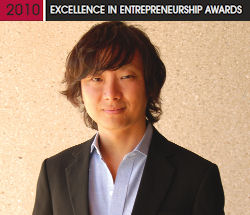
Four years ago, the founder and chief executive of Irvine’s K2 Network Inc., a publisher of online video games, was at a crossroads.
Joshua Hong could either sell his company to an Asian buyer, or keep on trucking through an uncharted market.
“At the time, I thought to myself, ‘It’s really hard to build a great company,’” Hong said. “At that moment, I decided to build a company that could outlive my own life. Why not take it all the way?”
Hong was one of five entrepreneurs honored at the Business Journal’s annual Excellence in Entrepreneurship award luncheon held March 17 at the Hyatt Regency Irvine.
K2 Network runs an online network, gamersfirst.com, where game players face off with each other on the Web in what’s known by industry insiders as a massive multiplayer online role-playing game.
Thousands of game enthusiasts can play simultaneously and often interact in online forums about strategies and characters.
K2 Network bills itself as a game publisher, rather than a developer. The company doesn’t create the games from scratch, like bigger neighboring competitor Blizzard Entertain-ment Inc. of Irvine. Rather, it seeks out developers in the U.S., Asia and Europe and strikes licensing deals to distribute their games online.
K2 Network provides customer service and game masters, processes online payments and hosts Web sites.
The games are free to download and free to play, unlike those of Blizzard, which charges a monthly subscription fee.
K2 Network gets revenue by selling “premium memberships,” which are essentially prepaid packages of special currency to be used in its online stores.
A membership gives players “enhancements” to the game, such as currency, weapons and other tools that have value within the role-playing world. Most players are not members, according to Hong. They spend an average of $20 a month buying items a la carte for a few dollars here and there.
Pioneer
K2 Network pioneered the business model, called “free-to-play micro transactions,” in the U.S., according to Hong.
It’s a concept that was big in Asia before K2 Network set up shop in Irvine in 2001.
“We practically wrote the book on how to sell virtual items from games,” Hong said. “That concept was brought here from Asia nine years ago by me and my partner.”
The model became more accepted in the U.S. largely because of Facebook.com, where users can buy virtual items as gifts (music files, a virtual cocktail or even a pet) for their friends.
K2 Network applied a Western retailing model to the promotion and merchandizing of its virtual items.
“The way we do merchandizing is through special events, promotions, holiday sales and limited-time discounts,” Hong said. “It’s like something you might see at Wal-Mart or Target.”
A game might have a giveaway of a certain item that is “perishable”—meaning it will simply disappear after a period of time. By then, the player is used to having the item and will likely go purchase it.
“We create this sense of scarcity in the game,” Hong said.
K2 Network’s game portal has some 30 million users in 100 countries, according to Hong.
The company has four games out and is expecting another four to be launched this year.
Its most popular title is a first-person shooter game called “War Rock.”
The company, which doesn’t disclose sales, is estimated by the Business Journal at $50 million to $100 million in yearly revenue.
K2 Network has raised some $25 million in venture funds to date from a slew of big-name investors, including Intel Capital, the investment arm of Intel Corp., Easton Capital Investment Group, Menlo Ventures and Novel TMT Ventures Ltd., among others.
K2 Network has around 70 workers in Irvine and 130 in all, including at sites in India, Turkey and Brazil.
The local office handles network operations, hosting, payments, marketing, management, programming and business development.
Most of the quality testing and customer service is done in India.
K2 Network, being the first company of its kind to set up shop in Irvine, has inspired a wave of other free-to-play video game companies to flock here.
Among them are NHN USA Inc., a unit of South Korea’s NHN Corp., and True Games Interactive Inc., which was started by a
handful of K2 Network veterans and moved its offices from Irvine to Austin, Texas, this year.
Others include MGame USA Inc. and YNK Interactive Inc., a unit of Korea’s YNK Corp.
“A lot of these companies came here because of us,” Hong said. “We became a catalyst for this big movement.”
Having so many competitors in one place is good and bad, he said.
“It’s a very incestuous community we built here,” Hong said. “We are all frenemies, but generally we coexist well. Competition is good for growth of the entire community.”
Hong’s long-term goal is to make K2 Network a well-recognized brand name, to the tune of an IBM Corp. or Johnson & Johnson.
“I have always been fascinated by the huge companies out there,” he said. “What drives me is to build a business that lasts far beyond the founder’s life. It takes a long time. You can’t hurry something great.”
