

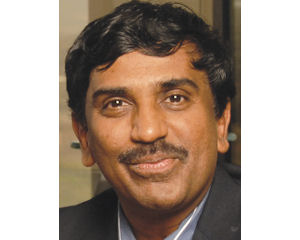
Conexant Systems Inc.’s Sailesh Chittipeddi—recently promoted to the chipmaker’s No. 2 spot—is set to play an expanded role with the company’s pending sale to New York’s Standard Microsystems Corp.
Chittipeddi is set to run Conexant as a unit of Standard Microsystems and head up the parent company’s global engineering and product lines.
He will report to Standard Chief Executive Christine King and hold an executive vice president title.
“Sailesh will be running all the product lines and engineering for the combined company, not just the Conexant piece,” King said.
Last week, Standard said it was paying $284 million in cash, stock and assumed debt for Conexant. The deal is expected to close in the middle of the year.
Conexant makes chips for multifunction office printers, digital picture frames, PC speakers, Bluetooth headphones and other devices.
It has yearly sales of about $200 million.
Standard Microsystems makes chips for disk drives, keyboards, Universal Serial Bus ports, networking devices, portable electronics and other products with industrial uses.
It has yearly sales of about $400 million.
Conexant’s engineers are set to stay in place, according to King.
Chittipeddi is slated to take on less of an operations role to focus on engineering and product development.
Resume
A native of India, Chittipeddi, 48, came to the U.S. in 1981.
Before Conexant, he spent nearly two decades in senior engineering and operations positions with Agere Systems Inc., now part of Milpitas-based LSI Corp. He also worked for New Jersey’s Alcatel-Lucent and research units of AT&T Inc.
Chittipeddi—who’s named on 61 chip patents—has master’s degrees in physics and business as well as a doctorate in physics. He lives in Tustin Ranch with his wife and twin toddlers.
The sale brings an end to Conexant’s nearly three years of turnaround efforts, headed by director turned Chief Executive Scott Mercer.
In the past two years, Conexant has reworked debt, sold stock and debt, sold a chunk of land near its headquarters and made a handful of patent sales.
Mercer also nixed underperforming products, shed units that weren’t profitable or growing and made small buys to get into growing markets.
Conexant has some 250 workers locally, down from about 600 a few years ago.
“Until we fixed many of our own problems, we weren’t a viable acquisition candidate,” Mercer said. “Once we really cleaned up our act, got the balance sheet fixed and started seeing the benefits of the investments we’ve made, it started to make us look more attractive.”
Conexant now is a smaller chipmaker and is more focused on consumer electronics, Chittipeddi said.
“We have completely repositioned the product portfolio to be much more consumer centric,” he said. “The question then becomes how long the company will take to start generating growth again.”
Being part of Standard gives Conexant a fighting chance, according to Mercer, who’ll take a second stab at retirement after the deal closes.
“Through our restructuring we had to get a lot smaller as a company,” he said. “The smaller you get, the tougher it can be to execute in the long term. And we have gotten pretty small.”
Conexant mulled a deal for some time, Chittipeddi said.
“We always asked ourselves the question, ‘Are we better off being alone or are we better off being a part of somebody else?’” he said. “We are not so protective of our jobs that we wouldn’t do what’s best for shareholders.”
Common Director
The two companies have complimentary product lines and customers in common.
They also share a director.
Steven Bilodeau has been on Conexant’s board since 2004. He’s the former chief executive of Standard and is its chairman.
The Conexant buy could bring a high-level female technology executive to the area in Standard’s King. She said she “works from a plane” and plans to spend time in Newport Beach.
Standard made another local chip buy in November when it picked up Laguna Niguel-based chip startup Symwave Inc. for undisclosed terms.
In 2010, Standard invested in Symwave, a maker of Universal Serial Bus port chips, with an initial $5 million investment that included an option to buy the company.
Conexant History
In some ways, the buyout ends Conexant with a whimper.
The company got its start as the chip unit of aerospace contractor Rockwell International Corp.
It spun off from Rockwell in 1999 and spawned a handful of other chip companies in the area.
It had a couple of years of robust growth and once was seen as a rival to the area’s biggest chipmaker, Irvine’s Broadcom Corp.
At Conexant’s peak, before the tech bust, it had a market value of about $13 billion.
Conexant was worth about $175 million on Wall Street last week after rising about 15% on Standard’s offer.
The company went on to spin off Newport Beach’s Mindspeed Technologies Inc. in 2003 and Newport Beach’s Jazz Semiconductor Inc. in 2002.
In 2008, Jazz was bought by Israel’s Tower Semiconductor Ltd. for $170 million.
Conexant also had a hand in the creation of Woburn, Mass.-based Skyworks Solutions Inc., which has operations in Irvine.
Skyworks was born when Conexant spun off its wireless chip business and combined it with Alpha Industries Inc. in 2002.
