

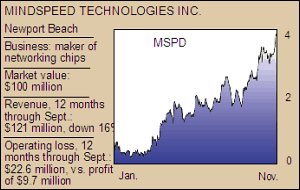
Newport Beach-based chipmaker Mindspeed Technologies Inc. has worked its way out of a funk faster than many on Wall Street expected.
For the three months through September, Mindspeed got out of the red a few months before company watchers had anticipated.
And last month, Mindspeed gave a sales outlook for the current quarter that topped what analysts had been expecting on average.
“We are really at an inflection point,” Chief Executive Raouf Halim said. “We think we are at a really good place. We’ve turned the corner roughly a quarter ahead of expectations.”
For the three months through December, Mindspeed said it expects sales of $36.1 million to $37.5 million. It didn’t give a profit outlook.
Analysts now are expecting Mindspeed to post adjusted profits of $1 million on sales of $37 million for the quarter.
Mindspeed’s chips are used in routers, switches, gateways and other equipment found in corporate wide-area networks and networks that span parts of cities.
The company also makes chips used in devices that allow telephone calls over Internet lines.
Mindspeed’s seen a big boost in sales from large contracts with networking gear makers in Asia for its chips that convert phone calls to digital signals so they can be sent over fiber-optic lines.
“We have invested and done a really excellent job on growing our business with a particular emphasis on China and Japan,” Halim said. “It’s paid big dividends for us.”
Sales to China make up roughly 50% of Mindspeed’s revenue.
China is building fiber-optic networks to bring high-speed communications to a third of its population.
“The voice service, Internet protocol television and data service gives rise to a tremendous semiconductor opportunity,” Halim said.
Mindspeed’s biggest customers are large Chinese networking companies, including China Unicom Ltd. and Huawei Technologies Co., as well as Japan’s Nippon Telegraph and Telephone Corp.
Others include Kirkland, Wash.-based wireless Internet provider Clearwire Corp., networking gear makers Alcatel-Lucent of Paris and Finland’s Nokia Siemens Networks BV, and New York-based Verizon Communi-cations Inc., which offers cable TV-style service over fiber-optic lines.
In the past year, Mindspeed has done a lot of work restructuring and cleaning up of its books.
Earlier this year, it raised nearly $9 million in a stock offering and plans to use the proceeds to pay down some $10.5 million in short-term debt that’s due this month.
After that, Mindspeed is set to have $15 million in long-term debt.
The company’s “management has addressed the balance sheet, and fundamentals improved,” said Daniel Morris, an analyst at Oppenheimer & Co. “With the (convertible debt) to be paid in November, investors can focus on the still underappreciated value in the underlying business.”
Wall Street also likes that Mindspeed has been focused on reining in costs.
“We have been managing expenses very tightly and taking out costs wherever we could,” Halim said. “We have held operational expenses flat while at the same time making it a richer mix with focused research and development dollars.”
In the September quarter, Mindspeed’s operating expenses were $21.1 million, down from $21.2 million in the June quarter and $24.1 million a year earlier.
The company expects to wind down its restructuring and plans to keep operating expenses at around $21 million per quarter next year.
Some analysts view Mindspeed, although a small player, as a diamond in the rough.
Analyst Christian Schwab of Craig Hallum Capital Group LLC said he sees a lot of profit growth ahead, owing to the company’s cushy gross margins, cost control and backlog of design wins.
“We believe the company is positioned to show materially higher earnings per share for two simple reasons—they have a considerable portfolio of design wins that are still ramping, and management is adamant that operating expenses will not increase for quite some time,” he said. “This combination in a company with gross margins north of 60% will produce surprisingly strong results, even assuming modest revenue growth.”
The chipmaker’s stock has seen a big runup this year. Shares are up more than 300% since the start of the year on a recent market value of around $100 million.
Newport Beach chipmaker Conexant Systems Inc. spun off Mindspeed in 2003.
The move made Mindspeed a niche player. But it also made it stronger, according to Halim.
“The rationale of the spinout has proven to be spot-on,” he said. “By standing alone we have been able to reach a much higher degree of focus on our specific networking customers than would have been the case under the Conexant umbrella. Business has more than doubled since then.”
