

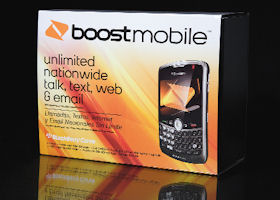
Irvine’s Boost Mobile LLC is trying to shed the remnants of its low-end image by introducing the BlackBerry Curve into its lineup of lower-cost phone plans.
Although the phone isn’t quite cutting edge, the addition has the potential to expand the smartphone market and Boost’s business to a new set of customers.
For Boost, a marketer of no-contract cell phones that’s part of Sprint Nextel Corp.’s prepaid business unit, getting a BlackBerry is “huge,” said John Voltava, spokesman for Sprint’s prepaid group.
“In the past, the biggest knock on Boost Mobile was a weak handset offering,” he said.
Boost previously only sold inexpensive phones made by Motorola Inc.
The phones had a blocky, rugged look and all of them had Sprint’s “push-to-talk” feature that functions like a walkie-talkie.
For the past year or so, Boost has been aggressively marketing a plan that allows for monthly unlimited text, voice and data pre-paid plans for a $50 flat rate.
The catch is that the Motorola phones only worked on a less robust Sprint network, known as the “integrated digital enhanced network,” or iDEN for short.
IDEN was developed by Motorola in the 1990s.
Boost, amid a push to attract more customers, knew it needed a bigger variety of phones that were more stylish and had better data capabilities.
Last month it jumped onto Sprint’s higher-bandwidth mainstream network and expanded its products to include the BlackBerry along with some other sleeker, more stylish phones.
The BlackBerry “is the most popular device out there right now,” said Jeff Flynn, director of business for Sprint’s prepaid group. “I consider it somewhat a table stakes in the game. This device brings more credibility to a wireless provider because it is so popular and it is in such high demand.”
BlackBerry Rate
The company has extended its flat-rate monthly promotion to the BlackBerry.
Boost offers unlimited BlackBerry voice, text, Web and e-mail services for $60 per month. It doesn’t offer any corporate network or e-mail services.
The catch? Customers have to pay the full price—around $250—for the Black-Berry Curve (an older model).
Other contract carriers, such as Verizon Communications Inc.’s Verizon Wireless, practically give away their BlackBerry phones in exchange for contracts.
Verizon offers the Blackberry Curve for $50 with a two-year contract.
Boost counters that its price for the Curve, which could go lower when coupled with promotions, is cheaper than the price offered by other direct competitors.
MetroPCS Communications Inc. sells it for $350 and Deutsche Telekom AG’s T-Mobile USA Inc. sells it for as low as $99 all the way up to $650, depending on the plan option.
“$249.99 is a very attractive price within our own competitive set,” Voltava said. “Others carry this for a much higher (price) and we offer the monthly plan at $60 a month—that’s the selling point.”
Boost is looking to appeal to consumers who want a do-all device on a budget.
“For us, it’s answering the customer need and finding what’s right for our segment of the market,” Flynn said. “There is a growing segment that can afford to pay a little bit more beyond what we are already offering at the fixed dollar price point. It’s still a consumer that is very interested in being connected with voice and text but also likes the form factor and integrated e-mail services that BlackBerry provides.”
Other Changes
Other big changes are afoot at Boost after parent Sprint bought Virgin Mobile USA Inc., a prepaid competitor, for $483 million last year.
The deal made Sprint the second-biggest prepaid carrier, after Florida’s TracFone Wireless Inc., a unit of Mexico’s América Móvil SAB de CV.
Sprint formed the prepaid group as the umbrella for all of its no-contract brands.
It includes Boost, Virgin and a new brand dubbed Assurance Wireless aimed at people who meet certain low-income criteria.
The new structure allows each business to “take a larger share of the market but have the right business model for each brand,” Voltava said.
Boost has a lot of unlimited monthly customers, while Virgin leads the market in selling pay-as-you-go packages of minutes.
Dan Schulman, who was chief executive of Virgin Mobile, heads Sprint’s prepaid group from Virgin’s headquarters in Warren, N.J.
Matt Carter, who was Boost’s president and general manager, left last month and took a post heading Sprint’s 4G group.
Carter came to Boost in 2008 from Sprint, where he was senior vice president of base management.
It’s been said that he will keep living in Orange County but will work remotely and report to Sprint’s headquarters in Overland Park, Kan.
Boost is set to keep its offices near the Irvine Spectrum, where it has around 250 workers. The company’s two top local officials are Chief Marketing Officer Neil Lindsay and Jeff Auman, who is vice president of sales and distribution.
Boost has its roots in Australia and New Zealand, where it launched in 2000.
The company started in California and Nevada in 2002 and was bought by Nextel Communications Corp. in 2003. Sprint bought Nextel the following year.
