

They say the way to a person’s heart is through their stomach.
Irvine’s BlueCava Inc. is taking that to heart in its recruiting efforts.
The maker of device recognition and anti-fraud software—which split off from Irvine’s Uniloc USA Inc.—is adding hundreds of jobs.
It’s top-secret recruitment tool?

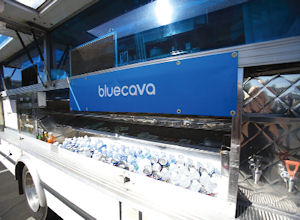
A BlueCava-branded food truck doling out free gourmet lunches.
BlueCava is planning a road trip in which the lunch truck rolls up to offices of technology companies in a bald-faced effort to poach talented employees. The tour will travel from Orange County to the Bay Area.
“We think this is will be a fun sort of competitive thing,” Chief Executive David Norris said. “We are going throughout OC and identifying the places where talented people might be.”
The BlueCava truck serves a mix of Thai, Chinese and Mexican food, Norris said.
Followers can register for a free lunch on BlueCava’s website and also via Twitter. They are alerted when the truck is rolling into their area.
One company BlueCava has set its sights on: Google Inc.
“We will get up in Google’s face,” Norris said. “Most people wouldn’t be gutsy enough to poach people directly from Google.”
BlueCava hired some 40 workers in the past two months. It has plans to hire “a couple hundred” in the coming years, Norris said.
“We have gone through thousands of candidates,” Norris said. “It’s an exciting time for us. We are growing like crazy.”
BlueCava handles sales of Uniloc’s software, which helps online retailers and other website operators protect against fraud and improve targeted online advertising.
It split off from Uniloc last year. It takes Uniloc’s technology for protecting against software piracy and tailors it for use by online retailers and other website operators.
Uniloc still owns a stake in BlueCava, which until this year shared the company’s space.
BlueCava is gearing up for a move to its new headquarters in University Research Park near the University of California, Irvine.
Another HID Buy
The Swedish parent of Irvine-based HID Global Corp., a maker of security cards and readers and related products, continued to consolidate share in its corner of the market by striking another purchase deal late last month.
HID Global is set to fold Mountain View-based LaserCard Corp., a maker of security cards for building access and verifying identities, into its operations.
Swedish parent Assa Abloy AB agreed to pay about $80 million for LaserCard.
The deal, which follows last month’s buy of Northern California’s ActiveIdentity Corp. for about $162 million, is expected to close in the current quarter.
LaserCard sees yearly sales of about $60 million and had a recent market value of about $75 million.
It makes a range of cards that contain magnetic strips, contactless chips, radio frequency identification tags, holograms and other security features.
Its technologies are used in government ID programs, auto registration, student campus cards and drivers licenses.
Assa Abloy, which is publicly traded in Sweden, bought HID Global in 2000 for $250 million.
‘World of Warcraft’ Effect
Irvine-based Blizzzard Entertainment Inc.’s record-breaking expansion pack “World of Warcraft: Cataclysm”—released in December to much fanfare—has done more than rack up sales.
It’s also boosted playtime among millions of fans.
“Cataclysm” eclipsed the previous record of more than 2.8 million copies sold in 24 hours.
It topped the mark set by “Wrath of the Lich King,” an earlier expansion pack by Blizzard, in 2008.
“World of Warcraft,” Blizzard’s flagship game, involves millions of players facing off in epic battles on the Internet. Blizzard’s customers pay roughly $15 a month to play the game, which has some 12 million players and counting.
Mountain View’s Raptr Inc., which tracks video game statistics, recently released data that shows how “Cataclysm” has driven up overall “World of Warcraft” playtime.
Findings include:
• Playtime has grown five-fold since last summer, pushed in part by lapsed subscribers flocking back to the game.
• Weekly playtime has grown to an average of 20 hours—almost double what it was in the summer of 2010.
• “World of Warcraft” stole most of the additional playtime hours from other popular games, including Blizzard’s “StarCraft II: Wings of Liberty,” which went on sale in July, Activision Blizzard Inc.’s “Call of Duty: Black Ops” and Riot Games Inc.’s “League of Legends.”
