

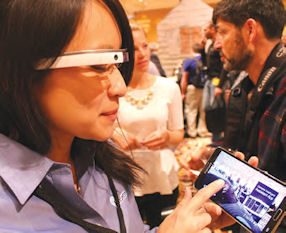
Evangelina La needs only a few swipes across the arm of Google Glass to rifle through some applications featured in Hyundai’s latest infotainment system.
A Samsung smartphone displays the images she sees on the wearable computer, which wraps around her head like a visor without the bill cap.
A few short verbal commands prompts Google Glass to send a remote message to a car to find the nearest gas station or restaurant or to start its engine.
“This is our exploration into wearables,” said La, an assistant manager at Fountain Valley-based Hyundai Motor America Inc.’s connected car and owner applications division.
Tech gizmos and big-ticket electronics, such as TVs and robotics, typically dominate headlines during the International Consumer Electronics Show in Las Vegas.
This year brought a change to that tradition.
Connected cars arguably stole the thunder at this month’s mega convention, which drew a record crowd of more than 150,000 people, and Orange County’s trio of automakers helped fuel the buzz.
Mazda
Irvine-based Mazda North American Operations, the U.S. arm of Mazda Motors Corp., helped its Japanese parent introduce its next-generation connectivity system in the company’s first appearance at the show.
Mazda Connect, showcased in the recently released Mazda 3, was developed to provide drivers with a slew of entertainment options and controls while minimizing distractions, according to Dave Matthews, a vehicle line manager for the model.
Every detail of the system—from its tablet-like, 7-inch monitor centrally positioned on the console, to the floating virtual projector that displays speed and upcoming turns in the windshield just above the dash on the driver’s side—is steeped in research.
That’s why seven tabs are on the display screen—in a certain font and size for minimal driver distraction—that allow users to toggle through music, navigation controls and communication, such as emails or phone lists, by way of voice recognition or a quick screen tap. The three applications, typically the most popular, also can be accessed through a three-button system between the front seats.
“We’re trying to minimize time where the driver’s eyes are off the road,” Matthews said.
The company promoted several new and expanded safety features, including radar cruise control that ensures a safe following distance; lane departure warnings; headlight high-beam control that dims when the car senses oncoming traffic; and a smart-brake support system that activates at less than 19 miles per hour if the car anticipates a collision and sends an obstruction warning at high speeds to take evasive action.
“Car safety is the first priority,” said Hideki Okano, a staff manager in the electrical and electronics development department at Mazda’s Hiroshima headquarters.
But he acknowledged customers are paying more and more attention to connectivity.
The ongoing shift playing out across the automotive industry led South Korea-based Hyundai Motor Corp. to introduce its cloud-based Blue Link platform at CES. It allows users to find their vehicles, lock and unlock vehicle doors, and access a host of mobile apps to access information.
Its points-of-interest feature is powered by Google, which sends detailed search results to a vehicle via an app or Google Glass.
The Blue Link Glassware application, which rolls out next year in the 2015 Genesis sedan, builds on the Car Care app Hyundai introduced last year that allows owners to schedule services, track maintenance schedules, and access quick reference guides, all from the comfort of the driver’s seat.
Irvine-based Kia Motors America Inc. showcased its parent company’s “user centered driver” technology that powers controls with hand gestures. The concept, still in development, drew plenty of attention at CES with its 18-inch display that provides information on speed, navigation and traffic.
The U.S. unit of Seoul-based Kia Motors Corp. also debuted a concept infotainment system with a 20-inch multitouch screen and smart radio functions.
And it unveiled the KND-7 model, which made its U.S. debut a week before the North American International Auto Show in Detroit.
The four-door, pillarless coupe features Kia’s information system that provides visual and auditory warnings on potential collisions and lane departures, and mirrored screens that allow backseat passengers to see that information or customize their entertainment options.
Soul EV
The automaker also exhibited its first all-electric car, dubbed the Soul EV, with Kia’s tailored UVO telematics system, which provides real-time battery status and mileage distance-to-power loss, plus searches for charging stations.
Travelers can preset charging times and levels and control heating and air conditioning presets via a smartphone app.
Kia also trumpeted UVO’s voice-recognition technology, a popular trend among automakers this year at CES that allows users to dictate messages, select favorite music, and ask directions, among other tasks.
Some 2015 Kia models will include the ability to download additional apps, including iHeart radio and music identifier Sound Hound, as well as integrate Yelp to help drivers find restaurants, bars and other places of interest.
“Everything you need will be done through vehicle integration controls,” said Henry Bzeih, chief technology strategy officer for Kia’s connected car and technology planning division. “In the future, we expect customers to be really concerned about what kind of connectivity they have.”
