

The Tustin-based company that owns the Jewelry Exchange retail chain has added a gold mine and boosted its link to the world’s leading diamond supplier in a strategy to offset price fluctuations on its raw materials.
Goldenwest Diamond Corp. operates 16 of the stores in major U.S. cities. The retail chain employs about 250 full-time workers and had an estimated $100 million in sales in 2013.
Goldenwest recently raised its stake in Espeka BVBA in Israel, one of 80 companies in the world that are authorized by London-based De Beers Group to purchase diamonds directly from the cartel’s mines.
“We acquired (a) 25% share [of Espeka] in 2012, with an option, which we are exercising, to acquire the entire company,” said Bill Doddridge, Goldenwest’s owner. “We are going to increase our holdings to about 40% this [month] and probably [secure] the majority ownership the following year.”
Espeka purchases rough diamonds in bulk through its subsidiary EZ Diamonds Ltd. Its Switzerland-based Voegeli & Wirz division focuses on watchmaking. Espeka’s total revenue is estimated at about $400 million annually.
The deal for Goldenwest to boost its stake in Espeka was sealed on ski slopes in Europe with a handshake between two longtime business associates and friends—Doddridge has been buying diamonds from Espeka’s owner, Sami Pruwer, since the 1980s.
“It’s only natural that when he wanted to retire, I acquire his company,” Doddridge said.
The negotiations were quick.
“They threw out a figure for goodwill that I thought was ridiculously low, so I said I’d buy it,” he said. “Now I’m vertically integrated. I have a company that buys directly from DeBeers. We cut and polish our own goods. We manufacture our own jewelry. And we pass all these savings onto the consumer.”
Gold
The most recent investment in diamond operations followed a move by Doddridge toward gold mining. He saw an opportunity to get ahead of the game in 2011, when the price of gold reached an all-time high of $1,800 an ounce.
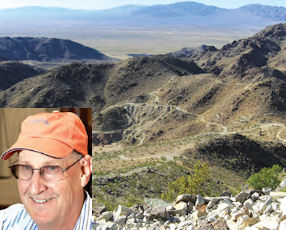
That’s when Goldenwest bought the Desert Gold mine near Twentynine Palms for roughly $200,000.
“At the time, the price of gold made it difficult to do business,” he said. “People stop buying jewelry, I’m pressured—I’m not making any money in my core business. [I decided] … I’m going to focus on making money through mining—it allows me to shift. That was my thought initially—forget the jewelry business, I’ll just put it on autopilot and put all of our resources into mining. I thought I’m going to make a killing at $1,800 an ounce.”
He invested $40,000 to explore the potential of the mine, which sits on three parcels totaling 60 acres. It was first mined in 1942 but shut down shortly after by the War Production Board, a government agency that supervised industrial production during World War II.
Gold mining was viewed as “nonessential,” and workers were directed to mines involved in the production of metals needed for the war effort.
Potential
The mine never reopened, but preliminary work done in the 1940s suggested big potential to Doddridge.
“The vein they started was very rich, a 1.5 ounce of gold per ton of ore,” he said. “I think it’s a bargain. I estimate just in the one easy-to-get vein, in one shaft, there is an easy $15 million of gold.”
It took awhile to clear the title, though, and gold had dropped to $1,200 an ounce when the deal closed last October.
That changed Doddridge’s timeline as a gold miner.
“Two years ago I was ready to really go—now I’ve kind of moved on to other things,” he said. “We’ll still do it, but the amount of energy I put in it will depend on the price of gold. So if gold spikes again—boom!—we’ll throttle-up real quick.”
Doddridge is treading cautiously because restarting the gold mine will require another substantial investment. He figures it will cost about $600,000 to bring in electricity from six miles away. He’ll also have to build roads, truck in water, develop mining processes and transport ore. Rattlesnakes and 110-degree weather wouldn’t make things any easier.
“Now it’s more of a hobby, more for fun,” he said. “I consider it a boutique mine. All my children are involved. We will learn the process with this, and as we get expertise and bring the equipment, we have an option to start working on other [shafts]. If we start getting cash profit out of this one, we’ll take the profits and start developing the other. But that was our strategy when gold was $1,800 an ounce—I don’t want to start production on other [shafts] at $1,200 an ounce.”
He’ll adjust to market conditions, though, up or down.
“I always have some way to deal with the changes in the economy,” he said. “So either way I win—gold goes down, I’m selling jewelry, gold goes up, we’re mining gold.”
