

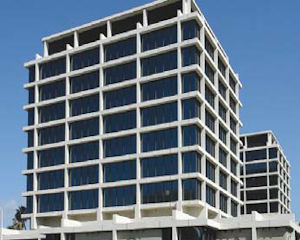
Newport Beach-based Acacia Research Corp. is taking a leading role in patent licensing, an emerging asset class that is gaining ground in the technology industry.
Acacia counts some of the largest technology companies as clients. It has secured more than 180 portfolios with patents that include technologies found everywhere from the first smartphones to biosensors and talking greeting cards.
When it finds a company infringing on a patent, it tries to strike a licensing deal or sues. It splits sales, licensing fees and court settlements with the patent holders.
“We’ve had a rapid growth rate,” said Acacia Chief Execu-tive Paul Ryan.
Acacia topped $100 million in revenue in the first six months of this year. That puts it comfortably on pace to shatter 2010’s record year of $131 million in revenue.
Patent licensing has become a lucrative bus-iness as companies strive to wring revenue out of their research and development legacies.
The trend is relatively new—and Acacia is leading the charge.
“We believe patents are rapidly becoming a new asset class,” Ryan said. “And we’re very well positioned at the early stages of this asset class.”
Acacia is signing deals with patent holders in some of the most valuable areas of technology, including location-based services such as global positioning systems, flash memory, telecommunication, digital media and data storage, according to Paul Coster, an analyst at JPMorgan Chase & Co. in New York.
“We believe Acacia is a company with which most operating companies will choose to execute an agreement,” Coster wrote in a July note to investors.
In March the company raised $175 million in a public stock offering. It now has about $300 million in cash on hand to buy patent portfolios.
New Portfolios
Acacia is landing a new portfolio every two weeks on average as it sifts through hundreds of possibilities before making a decision, according to Ryan. That’s on top of a backlog of 80 or so portfolios it owns but has yet to fully examine for revenue potential.
The firm was founded in 1992. In its early years it relied on individual patent owners, small companies, medical research groups and others to drive revenue.
The trend of big companies looking for revenue from patent portfolios has changed Acacia’s game. It now is targeting large corporations with billions in sales, signing deals with industry leaders that hold hundreds or thousands of patents.
Acacia’s client list includes Seoul, Korea-based Samsung Electronics Co., Microsoft Corp. of Redmond, Wash., and Redwood Shores-based business software maker Oracle Corp.
It also has struck licensing agreements with—or settled patent infringement claims against—a roster of Orange County-based companies, including Irvine-based flat TV designer and seller Vizio Inc. and Sage Software Inc., both in Irvine, and Fountain Valley-based D-Link Systems Inc., among others.
In some instances, Acacia works with companies it has sued or settled with on behalf of other clients.
A year ago it partnered with Renesas Electronics Corp., a Tokyo-based joint venture of Hitachi Ltd. and Mitsubishi Electric and the remnants of NEC Electronics Corp. that created one of the largest chipmakers in the world.
Renasas has about 40,000 patents, and Acacia has started to license the portfolio.
The most recognizable and valuable portfolio Acacia represents is the smartphone technology it licenses on behalf of Access Co. Ltd., a Tokyo company that purchased many of the original Palm operating system and smartphone patents.
Acacia has licensed patents from the portfolio to Microsoft, Samsung and Finland-based Nokia Corp.
Acacia also recently filed a patent infringement lawsuit in Texas against a host of smartphone makers, including Cupertino-based Apple Inc. and HTC Corp. of Taiwan. It recently settled lawsuits against Schaumburg, Ill.-based Motorola Corp. and Research In Motion Ltd., the Canada-based maker of Blackberry phones.
Acacia used to get most of its revenue from lawsuits.
The company’s growing revenue—and profits of about $34 million last year—have allowed it to go after more cases. The recent recognition of patents as an asset class has made settlements without litigation more likely.
“Troll” No More
A few years ago, Acacia had three portfolios and was fighting an uphill battle to establish its name and a reputable image. Critics called it a “patent troll” or a “nonpracticing entity,” both pejorative terms used in tech and legal circles to describe companies that don’t make any products and license technologies they haven’t designed.
A recent spate of high-profile patent licensing deals helped shed the stigma.
The latest boost came from Rochester, N.Y.-based Eastman Kodak Co., which got a lot of positive headlines in the last few months after putting its portfolio of digital imaging patents up for sale.
Company watchers value the portfolio in the neighborhood of $3 billion.
Kodak generated $1.9 billion from various other patent licenses from 2008 to 2010, jumpstarting a bull market and a corporate shift as companies looked to cash in on intellectual property.
Patent licensing in the U.S. has grown to a $500 billion-a-year industry, according to Deloitte & Touche LLP in New York, up from $15 billion 25 years ago. And that’s just a fraction of the $3 trillion to $5 trillion in global intellectual property assets.
“It’s becoming accepted and better understood,” Ryan said.
In July Apple, Microsoft and RIM led a group that purchased a patent portfolio from Canada-based Nortel Networks Corp. for $4.5 billion in cash, outbidding Mountain View-based Google Inc. in the process. The deal brought the companies key technologies for mobile phones and tablets.
“I think that woke up board rooms around the world,” Ryan said.
Google Buy
Industry insiders also believe the growing trend prompted Google to buy Libertyville, Ill.-based Motorola Mobility Holdings Inc. last month for $12.5 billion. The former Motorola mobile devices division brings Google more than 17,000 patents as the company looks to take on Apple and other smartphone players in a brewing battle some pundits have tagged the “smartphone war.”
The recent developments signal one of the biggest technology trends today, but patent licensing remains largely underappreciated by most investors, according to Jonathon Skeels, who believes Acacia has just cracked the tip of the iceberg.
“There’s no other competition for them right now,” said Skeels, a research analyst at Davenport & Co. LLC in Richmond, Va. “As they sign up more and more large companies, they’re becoming a leader in this field, which creates a large barrier to entry to replicate what Acacia does.”
