

Aside from sunglasses and a bandana, Erin Whitcomb’s packing list for the Coachella Valley Music and Arts Festival this month included a 26-foot refrigerated truck, a soda station and 15 ice cream carts.
Her posse of about 65 workers made sure the 200,000 festival-goers didn’t have to stray far from the stage to get a frozen treat.
Whitcomb owns Front Porch Pops in Orange, which sells Popsicle bar-like creations in gourmet flavors including Mojito, Mango Chili, Vietnamese Coffee and Balsamic Strawberry Swirl, made from personal recipes with real fruit, fresh dairy, and, when possible, local produce.
Among more than 150 performers, Childish Gambino, Tame Impala and Ariana Grande headlined the music festival.
“This is 100% our audience,” Whitcomb said. “The people here love our products.”
Live Acts
Whitcomb began prepping in November for her fifth appearance at the annual festival in Indio—two months before passes for the two weekends of music went on sale to the general public.
“It’s a lot of work, but it is fun.”
Advance work included menu development and a heavy dose of logistics―once on festival grounds, vendors cannot run to the store to replenish supplies. This year, Whitcomb added sodas and “nachos and munchies” to her line-up of offerings at Coachella.
“So much of it is pre-production,” Whitcomb said. “I’m a planner at heart, and for every single thing we do we have a Plan A, we have a Plan B, we have a Plan C, and then we’re like, ‘Oh boy, do we have to go to Plan D?’”
Case in point: her popsicle-filled truck began to shut down—“going out of temperature”—at 2 a.m. the first weekend of the event.
“How do I even get the Ryder people to come out here to repair that?” she recalled. “How do I even get him onto the grounds?”
A repairman called and walked her through troubleshooting steps that got the truck up and running again.
Logistics Jam
Ten minutes later, a small fire at the festival campground forced Whitcomb to evacuate her staff preparing food for the next day.
“That’s just part of festival life,” she said. “You have to think on the fly and … be a problem solver.”
This includes a big dollop of self-sufficiency and being “able to work with other people and have a smile on your face pretty much the whole time.”
Her five dozen or so “pop stars … slinging popsicles all day in the heat” sold “tens of thousands” of the gourmet bars at $5 a pop.
Los Angeles-based festival organizer Goldenvoice charges booth fees and “a hefty” cut of revenue―about 40%, according to Business Journal estimates and other news reports—but “it’s still worth it for us.”
Whitcomb noted Front Porch Pops has pivoted to events like Coachella. Its website mentions an affinity for farmer’s markets and the company recently bought a commercial kitchen in Irvine—and closed its three brick-and-mortar locations to focus solely on catering events and festivals.
“We generate a lot of other event leads.”
Feathered Friends
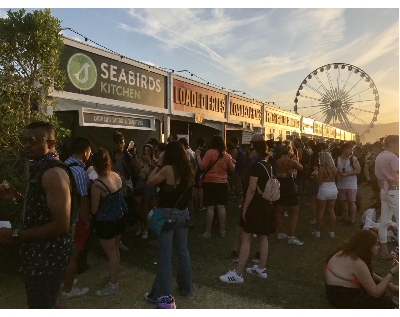
Costa Mesa-based vegan eatery Seabirds Kitchen also went to Indio.
Their Coachella-specific menu included beer-battered avocado tacos, Cremini mushroom Reubens, grilled cheese sandwiches and purple potato taquitos.
On the first day of the festival―usually the slowest of the six―its 15 staff members completed 800 total transactions.
Bill Denton, a hospitality industry veteran who co-owns Seabirds with founder Stephanie Morgan, said Coachella is definitely a moneymaker for Seabirds, but “not at the margin level that we have at our restaurants.”
Morgan, like Whitcomb, started with a food truck in 2010, and in 2013 opened a restaurant at Shaheen Sadeghi’s The Lab in Costa Mesa.
The now “multimillion-dollar business” opened a second location in Long Beach in 2017, on 4th Street about a half-mile from the shore, and two more are in the works this year―one in the Los Feliz neighborhood in L.A. and one at “a premier shopping facility” that’s “very close to us,” Denton said.
Coachella commission fees are high compared to other venues and festivals, he said, but “it’s Coachella … they are able to do that.”
He said, also like Whitcomb, the big festival is a chance for exposure.
“Coachella [helps us] reach guests who don’t know that vegan food can taste good and be good for you,” he said.“At the end of the day … it’s about marketing and not really the net income.”
