

They won’t change the name—Surf City it is, and Surf City it ever shall be—but Huntington Beach marketers told the Business Journal they’re preparing to market the locale to travelers based on fun of all types.
Yes, surfing’s fun. So are the beach, the pier, the air show, the food, etc.
But promoting it to visitors on the basis of the all-in-good-fun hijinks that can ensue there—that’s new.
“We’ve been brainstorming a broader context” highlighting some of what the city is already known for, said Kelly Miller, chief executive of the Visit Huntington Beach destination marketer.
Miller started with the city’s heritage—102 years of surfing dating to the days of businessman Henry Huntington and founding father of surf George Freeth—sprinkled in its International Surf Museum and Surfing Walk of Fame; got as far as the Guinness World Record the city set in 2015 for “most people riding on a surfboard”—66—and ended up realizing there are dozens of annual surf competitions and surfers out every day “from before sunrise through sunset,” visitors watching them from the pier.
“It [was] like being in the pits in NASCAR,” Miller said. Back then, they’d “get 5,000 people on a Friday, 10,000 on a Sunday.”
Now they’re developing an app to tell travelers what they should be looking for in Surf City. It will tell thematic and visual stories tied to things such as Huntington Beach’s surf history and legends, places and events, music and fashion, and art, pop culture and lifestyle. Self-guided walking tours and street signs that link to information on the app will also be part of the mix, along with a potential software platform to enable prospective visitors to access the material online. The final version should appear next year.
“The historical has been really helpful,” Miller said. “Our cultural heritage is huge.”
Camping Out
Other cities are to some extent joining the battle for the hearts of locals and travelers alike.
The city of Costa Mesa has for years had developer Shaheen Sadeghi’s retail and restaurant layouts The Lab and The Camp, long before the concept took on an expanded form at the Packing House food hall and the Center Street Promenade in Anaheim.
Travel Costa Mesa has promoted the area in part by talking up Sadeghi’s older projects, and he and his wife, Linda, recently sat for an interview with travel talk show host Samantha Brown.
“The retail centers do a good job of making a fun, laid-back environment for visitors,” said Jenny Wedge, the destination marketer’s public relations manager.
The Lab’s “outdoor living room with swings and couches” is where Brown met with the Sadeghis on her tour through OC a few months back to film segments for her broadcast work.
Parking spaces and stairways at The Camp, meanwhile, are marked with motivational ideas, such as “Unplug.”
“I’d call it inspirational,” Wedge said.
Emotional Intelligence
In fact, the emotional element of cities is apparently now a thing.
A May 30 Wall Street Journal story highlighted efforts by urban locales to liven themselves up. Efforts include:
• The Hello Lamp Post project in Bristol, U.K., which invites people to text codes slapped on bus stops, mailboxes and lamp posts to get a conversation with a chat bot—think interactive Siri-like software—that tells about the place where they’re standing.
• Piano key-like stairs in Stockholm play notes when stepped on—a la Robert Loggia and Tom Hanks in the movie “Big”—and encourage subway patrons to walk instead of taking the escalator.
• Street intersections in Germany that offer versions of the classic video game “Pong” to play while waiting for the light to change, or ask pedestrians to dance for a camera that digitally translates movements to stand in for stick figures on the Walk-Don’t Walk sign.
If those sound too wacky and foreign, know that that the paper paired the piece with one on the more quantifiable Smart Cities concept, in which towns use data and technology to change the way we experience urban areas. It also reported last month that cities and developers in several U.S. states want zoning and ordinance changes allowing patrons of outdoor retail and entertainment centers to drink alcohol in public areas.
Young Love
The efforts are guided by younger destination marketers, meeting planners and consultants unabashed in their use of words like “love” and “emotion” when talking up towns.
CalTravel, a state trade association for destination marketing organizations, includes a 30 and Under award in the lineup of honors at its annual California Travel Summit. Two winners at this year’s event in June at Newport Beach Marriott Resort & Spa work for Visit Anaheim—Senior Manager of Strategic Alliances and Events Lindsay Walker and Manager of Tourism Development Ryan Alsup.
Destination marketers in other areas are getting into the act, including VisitPittsburgh, which put four of its youngest staffers in charge of a 10-year planning process in July.
Peter Kageyama, who spoke at the Newport Beach travel confab on how cities can tap quirky concepts for attention from meeting planners and travelers, has given a TEDx talk and written two books on related topics.
Workable Creativity
Kageyama said fun stuff has to be “organic, surprising, and nonprogrammatic”—which can be tough, because it can be like saying, “How do you mandate fun?” Kageyama said. “Well, you can’t.”
San Luis Obispo has become known for bubblegum alley in its downtown district—a 70-feet-long walkway framed by 15-foot-high walls covered in used gum wads—but the work definitely developed organically, literally and figuratively.
The fifth annual “dam dinner” in Goleta in Santa Barbara County was planned for Aug. 19 atop its Lake Los Carneros Dam, an otherwise prosaic landmark. Last year’s event drew 300 diners.
Grand Rapids, Mich., was named one of America’s “Dying Cities” in 2011, in part due to a declining population. The city responded with a 10-minute “lip dub” video combining lip-synched singing with audio dubbing to the tune of Don McLean’s “American Pie.”
Roger Ebert called it the “greatest music video ever,” and at last count the video had drawn 5.7 million views on YouTube.
“People want to emotionally connect” with places they visit, Kageyama said. “You can create conditions where that connection can happen.”
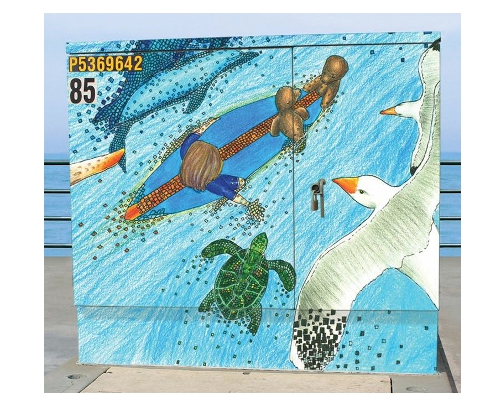
In Huntington Beach, the winning design of a public art project that drew 120 entries from high school students now adorns utility boxes at the municipal pier. Similarly, 30 trash dumpsters publicly visible in the downtown business district are getting a new paint job in a “Dumpsters on Parade” project.
Iconic Memories
Kageyama lives in Florida but travels regularly, and for the CalTravel conference flew into John Wayne Airport.
“I see a lot of airports, and you hope they’re functional,” he said. What he remembers about John Wayne is the Duke statue.
Huntington Beach wants to promote its take-away icons, so it began with what’s there—the surf culture, the pier, the T-shaped promenade formed by Main Street, and the asphalt boardwalk that runs along its beach—and amped them up.
“The crux of what destinations are doing is figuring out how to talk about what’s already there,” Miller said. “Unscripted experiences still need some sort of structure. The fuzziness (of fun) needs function and form. It’s organic but then (gets) organized” as cities push the new concepts in front of meeting planners and travelers.
“You can have bubblegum alley, but you still have to tell people about it,” he said.
Huntington Beach has been “unconventional for years,” Miller said. Now it’s a matter of marketing.
“First you appreciate what you have,” Kageyama said. “Then you, (for instance), shine that social media light on it.”
Risk Management
Cities can plan stuff—“build that bridge, plant those trees”—Kageyama said, but originality that resonates with visitors may not always succeed, though it’s not impossible.
Since cities build bridges and plant trees for reasons, he said, they can figure out reasons to make their cities more inviting to visitors.
“You have to have risk tolerance for it,” he said. “But businesspeople understand the importance of taking risks.”
Cities can also get on board.
“No is an easy answer and a lazy answer, and people don’t get into trouble for saying no,” he said. “People would do it more, but they run into bureaucracy. Cities could make it a little less of a pain in the ass to do it.”
