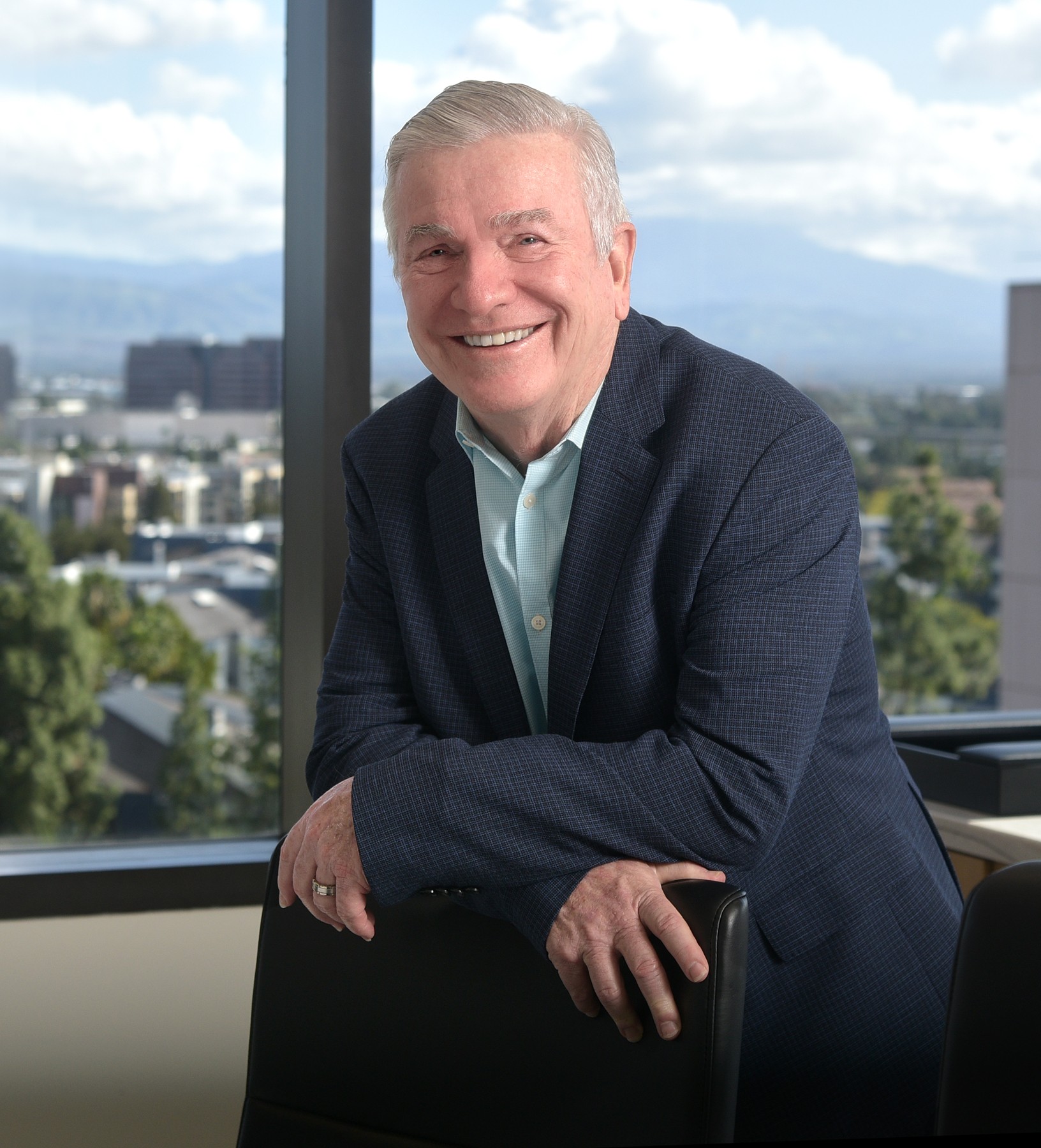
Jared Wolff looks relaxed even after seven months at the helm of the once problem-plagued Banc of California Inc.
“We’ve spent a good part of the year becoming more efficient,” Wolff said during an interview in his Santa Ana office. “There were a lot of expenses we didn’t need.
“We’ve been very targeted in what we’ve done to make sure we hit the ground running next year.”
Since starting as chief executive in March, he’s implemented a strategy to cut unnecessary costs and convince top tier executives to join him. Recently, the bank had to report a $36.1 million charge because one of its borrowers was the victim of a fraud in a scam that the Securities and Exchange Commission said “defrauded approximately 50 investors.” The charge is higher than the $23.7 million net income the bank reported for 2018.
As if he didn’t have enough on his plate, a week before issuing the bank’s third-quarter earnings report, Wolff had to report for jury duty, which he was able to postpone until the Christmas holidays.
The bank (NYSE: BANC) on Oct. 23 reported a third-quarter loss of 45 cents a share because of the fraud charge. Its shares fell about 8% in the following five trading sessions to around $13.79 and a $700 million market cap.
“We reduced forward EPS given lower asset balance assumptions, but we expect asset stabilization and income growth to emerge in 2020,” Keefe, Bruyette & Woods analyst Jacquelynne Bohlen wrote in a note to investors. “We maintain our Market Perform rating given strategy execution risk, but believe there is potential upside to our forecast should the funding remix perform better than our expectations.”
The bank’s third-quarter report revealed it has shed more than $2 billion in assets this year to $8.6 billion as of Sept. 30, causing it to lose the title of largest bank based in Orange County to rival Pacific Premier Bank (see separate article, page 26).
Wolff is a familiar face to other top banking executives in the area.
“He comes with a ton of experience,” said Scott Kavanaugh, chief executive of First Foundation Inc., the county’s fourth-largest bank.
“I’m sure he’ll be able to turn it around quick enough.”
Assets Quadrupled
Banc of California was formed earlier this decade when then-CEO Steve Sugarman combined two banks, and then went on an acquisition spree that in about five years quadrupled Banc of California’s assets to $11 billion, becoming the biggest bank based in Orange County.
The bank became known on Wall Street as a “serial issuer” of stock and debt to fund its acquisition spree. It spent heavily on marketing, such as paying $100 million for the long-term naming rights to a soccer stadium in downtown L.A. that cost $350 million to build.
Sugarman resigned in January 2017, on the same day the bank announced the Securities and Exchange Commission would investigate how the bank responded to comments by an anonymous blogger.
The SEC hasn’t released its findings and Wolff declined to comment on the matter.
Afterward, the bank went through a proxy battle that ended with a shakeup of the board of directors. It dumped its residential mortgage unit, cutting its workforce in half. It now has about 700 employees, a good portion located at its South Coast Metro headquarters next to the Costa Mesa (55) Freeway that the company bought in 2015 for $77 million.
The bank hired veteran Doug Bowers as CEO in 2017, following Sugarman’s departure. The problems continued as the bank last year revealed it was the victim of a $13.7 million fraud on a line of credit. Bowers, who implemented a turnaround plan that didn’t impress Wall Street, departed after 22 months on the job.
A Banking Veteran
Wolff, who began in March, was previously the general counsel at City National Bank. He served in multiple roles at Beverly Hills-based PacWest Bancorp (Nasdaq: PACW) from 2002 through 2014, leading more than 20 acquisitions, including the $2.3 billion purchase of CapitalSource in 2013.
Even though he has kept his residence in Santa Monica, Wolff said there aren’t any plans to abandon the bank’s Santa Ana headquarters.
“I love being here in Orange County,” Wolff said. “I’m not a stranger to Orange County. I acquired a lot of banks here when I was at PacWest.
“There are fewer players competing here, but it’s very active and competitive. It’s a robust market with some great players in it.”
Part of that competition is for top talent.
In September, Banc of California announced three executive hires: John Sotoodeh, a former lead regional president for Wells Fargo in Southern California, as president of community banking division; Hamid Hussain, another former Wells Fargo executive who will oversee real estate, warehouse lending and middle-market banking groups; and Robert Dyck, a former PacWest executive who will become chief credit officer early next year.
New Relationships
Banc of California historically didn’t earn money in the traditional banking way as it relied more heavily on outside brokers to bring it business, said Wolff, who prefers “relationship banking.”
“We’re focused on lending to people we know,” he said. “Lending to sophisticated real estate investors is something I’ve done at all the banks I’ve been at.”
The bank’s loans will be about 70% to 75% on real estate with the remaining 25% to 30% on commercial operating companies.
“People who aren’t from here think Southern California is dominated by entertainment,” he said. “People that are here know Southern California is dominated by real estate.”
It’s also expanding lending to healthcare, which Wolff called the second-biggest industry in Southern California.
He said a competitive edge will be its speed to provide customers with quick access to capital. The bank’s other competitive advantages, he said, include reliability, nimbleness and the ability to craft solutions for individual customers.
The bank will rely less on mortgages for residential and smaller multifamily apartments because such loans have become commodities that don’t provide the profit needed, he said.
“The price you charge on a commodity loan is based on what the market says you will charge,” noted Wolff.
“When you’re a relationship-based lender, the pricing tends to be higher because people value what you do. They are paying you for execution and service.”
Deposits
A key to increasing its share price, which hit a five-year high of about $23 in 2016, will be to reduce its reliance on costly certificates of deposits for funding. The company in the third quarter said it increased non-interest bearing deposits by $114 million to $1.1 billion, which is about 19% of its total deposits.
“If you look at the valuations of banks in California, the most highly valued banks are the ones with the lowest costs of deposits,” he said. “That’s the hardest thing to do—gather low costs of deposits.”
Wolff has a reputation for making acquisitions, which he is open to eventually.
“This year, it’s important to focus on getting our priorities in order. We have a long way to go.
“We’re in a good spot. We spent a good portion of this year getting rid of things that I didn’t think were enhancing our franchise and were distracting us from our vision.”
Pacific Premier Reports Q3;
Reflects Successful Strategies
Says Charging Lower Rates on New Loans
Irvine’s Pacific Premier Bancorp (Nasdaq: PPBI), the OC bank with the highest amount of assets at $11.8 billion, on Oct. 22 reported third-quarter adjusted profit of 64 cents, topping a 62 cent estimate of Raymond James analyst Donald Worthington, who raised his target price by $2 to $36.
“There is total return potential of [about] 9%, including the current dividend yield of 2.5%,” Worthington wrote in a note to investors. “We believe that PPBI shares should trade at a premium valuation compared with the peer group.”
Chief Executive Steve Gardner said the bank was able to “protect” its net interest margin. This key metric of bank profitability was 4.4%, up from 4.3% in the second quarter.
“Our third-quarter results reflect successful execution on the strategies we are employing to manage risk and enhance franchise value in the current environment of economic uncertainty and slowing growth,” Gardner said in a statement.
The bank is charging less on new loans, reporting that its weighted average interest rate was 5.28% in the third quarter, compared with 5.42% in the second quarter. The bank’s lending in the past year has increased mostly to franchises and farmers while decreasing most for consumer, land and one-to-four family housing, according to Raymond James.
In the week following the results, its shares rose about 8.3% to a $2.05 billion market cap, more than twice the amount of the next highest bank based here.
“The Orange County and California economy as a whole are remarkably strong and diverse,” Gardner told the Business Journal. “Economic indicators have slowed as of late, but are still growing at a moderate pace.”
A year ago, Gardner told investors he was unhappy with what he considered a low share price and thus initiated paying a dividend as well as buying back shares. In the first nine months this year, it’s returned to shareholders about $140 million.
“This significant return of capital is another reflection of the transformation and maturation of our company,” he told investors on a conference call.
First Foundation Sees 40% Jump in C&I Loans
Tops Q3 Consensus as Profit Rises 18%
First Foundation Inc. (Nasdaq: FFWM) on Oct. 22 reported first-quarter net income climbed 18% to $17.4 million, or 39 cents a share, topping the 37 cent consensus estimate.
That wasn’t the only good news as the Federal Reserve’s reduction of its key benchmark rate in September has improved the outlook for Orange County’s regional banks.
“In my opinion, now that the Fed rate has decreased (its interest rates), some of that pressure seems to be abating,” Chief Executive Scott Kavanaugh told the Business Journal.
The best part of its growth was in the commercial and industrial lending space, which is helping to diversify its loan portfolio, Kavanaugh said.
“Those numbers jumped 40% year-over-year,” Kavanaugh said. “That’s been a culmination of four years of work. We’ve put together a team and this finally is the year that everything came together.”
D.A. Davidson analyst Gary Tenner reiterated his buy rating with an $18.50 price target.
“First Foundation remains a strong asset generator with pristine asset quality and an outlook for improved profitability metrics despite the challenging rate environment,” he wrote.
Its shares rose about 4% in the week after the results were announced to about $16 and a $715 million market.
“Employment is incredibly strong” in Orange County, Kavanaugh said. “I still see a lot of optimism. The county is still strong.
“I don’t see a slowdown in anything. Perhaps housing sales have slow, but I don’t see a price decline.”
Opus Bank Smashes Consensus Estimates
Expense Cuts Initiative Surprises Wall Street
Opus Bank Chief Executive Paul Taylor made a good impression in his second quarterly report since taking over in May.
The Irvine-based bank (Nasdaq: OPB) reported a third-quarter adjusted profit of 58 cents a share, topping the 36 cent consensus estimate of analysts.
“We undertook an expense reduction initiative in the second quarter and we saw an immediate benefit,” Taylor told investors and analysts on a call.
Its shares rose 4.2% to $24.81 in the first trading session after the results were announced, the highest in a year. The company now sports a $900 million market cap.
New loan fundings in the third quarter totaled $406.1 million, a 42% drop from the second quarter, mostly because of fewer multifamily loans and elevated loan payoffs.
Net interest margin, a key metric in the industry, dropped to 2.8% compared with 2.9% in the second quarter.
Taylor wants to increase the amount of commercial business loans, saying that will help boost the stock because they are more profitable. He noted this area has “heavy competition from peers.”
The executives sounded upbeat about their markets.
“Despite the difficult interest rate environment, we are optimistic and we continue to see slow, steady economic expansion in our markets,” Chief Financial Officer Kevin Thompson said on the call.
Farmers & Merchants Sees Nonprofits Helping Growth
Reports Q3 Profit Climbs 11%
Farmers & Merchants Bank of Long Beach (TCQB: FMBL) reported third-quarter net income climbed 11% to $22.8 million.
“Locally, we find the economy thriving well,” Dan Walker, chief executive and board chairman, told the Business Journal. “A lot of great growth is going on.”
He pointed in particular to nonprofit organizations constructing new buildings such as the Samueli Academy, the Christ Cathedral, St. Michael’s Abbey, and the Orange County Museum of Arts.
“These are areas that we’ve dedicated our business to,” said Walker, who is the fourth generation of the Walker family to run the bank.
While the bank isn’t on this week’s list because its headquarters is in Long Beach, its presence is large in the county. About a third of its $7.6 billion in assets are in Orange County, where it employs 467 at 13 branches.
“All of Orange County offices are in the plus category on deposit and lending growth as well,” Walker said.
He’s seeing OC growth in areas like senior housing and parcels with eight to 12 multifamily units.
Walker said the bank may add a couple more branches in Orange County this coming year, pointing to Irvine and Santa Ana as possible locations.
“We believe that Santa Ana will be one of the bright new stars in the county,” he said.
Shares of the company are lightly traded; it has a $1 billion market cap.