

The Shops at Mission Viejo is seeing some well-received tenant moves.
The mall, which usually is 100% full, has had a lot of its 10-year leases expire. That’s opened up space for a slew of new stores.

Some that are opening, or have opened recently, include H&M, Zara, Apricot Lane, Crazy 8, Microsoft Store, The Disney Store, Swarovski Crystal and Wet Seal.
Ann Taylor Loft just opened at the mall, which also has an Ann Taylor store.
Forever 21 is expanding into the departing Saks Fifth Avenue’s 98,000-square-foot space.
The Microsoft store is one of the top-performing stores, said Patsy Sanquist, director of marketing and business development.
“They’re really pleased. We’re really pleased,” Sanquist said.
Microsoft draws customers from a wider area because it’s the only store around, aside from one that recently opened in San Diego.
Apple Store also is one of the top stores at the mall. Apple expanded at the mall last November.
The Disney store—opening soon—is one of 20 that Walt Disney Co. is opening across the nation this year.
Vans Shoes has strong sales and it may expand at the mall, Sanquist said.
Zara, an apparel store with a Spanish flair, is strong.
The mall’s jewelry stores also do well, Sanquist said.
When the mall brings in a new tenant, it looks for stores that cater to families and are unique to the area, she said.
Microsoft and Disney are two good examples. So are BCBGeneration, Farrell’s Ice Cream Parlour & Restaurant and Daisy Shoppe.
The Daisy Shoppe, which sells aprons, dresses, handbags and other items, is locally owned. It has one other location at the Brea Mall.
Daisy Shoppe recently moved into a bigger space at the Mission Viejo mall. True Religion took over Daisy Shoppe’s former space in April.
The mall, part of Indianapolis-based Simon Property Group, has seen a consistent number of shoppers throughout the downturn, Sanquist said. But the amount of money they’ve spent has gone down, she said.
Driving Advertisement
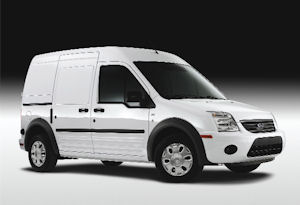
The Ford Transit Connect commercial van is an attention-getter.
The unique van, which hit showroom floors last year, is being snapped up by small business owners and bigger companies buying fleets.
“They’re just a great big box,” said Jim Graham, owner of Santa Margarita Ford.
The Transits sell for $18,000 to $25,000, depending on added options. It is smaller than the Mercedes-Benz Sprinter, which also is a commercial van.
“It’s a lot of cargo room for the money,” Graham said. “And they’re way cool.”
The shape and styling of the van makes it perfect for advertising decals.
“People can put their company logo on and trick it out,” said Len Deluca, director of commercial truck sales and marketing for Dearborn, Mich.-based Ford Motor Co. “It looks very professional.”
Graham’s dealership works with a couple of local businesses that “wrap,” or put custom labels on the vans for customers. Any kind of graphic that can be generated on a computer can be applied to the vehicle, Graham said.
“Some people look at it as a rolling billboard,” he said.
Ford also lets customers design their wraps online and have the custom-designed vans shipped to local dealers.
The Ford Transit Connect has a small engine—four cylinders—but it’s designed to carry as much weight as a van with a larger engine.
Plus it gets the benefit of better gas mileage.
Ford Transit Connect first launched in Europe at the end of 2002.
Ford began selling the Ford Transit Connect more than a year ago.
So far this year, Ford has sold about 14,700 vans, for a total of 23,417 since it launched in the U.S.
The first eight months of sales were primarily to entrepreneurs.
Lately, sales to larger companies have picked up.
Boca Raton, Fla.-based ADT Security Services Inc., which installs home security systems, bought 1,500.
Richfield, Minn.-based Best Buy Co. Inc. bought 290 for its “Geek Squad” fleet that services home appliances.
“We’re very happy with how it’s performed in the marketplace” said Ford’s Deluca.
Relative to other auto launches, Deluca said it has met or exceeded expectations.
California, New York and Chicago are Transit Connect’s biggest markets.
