

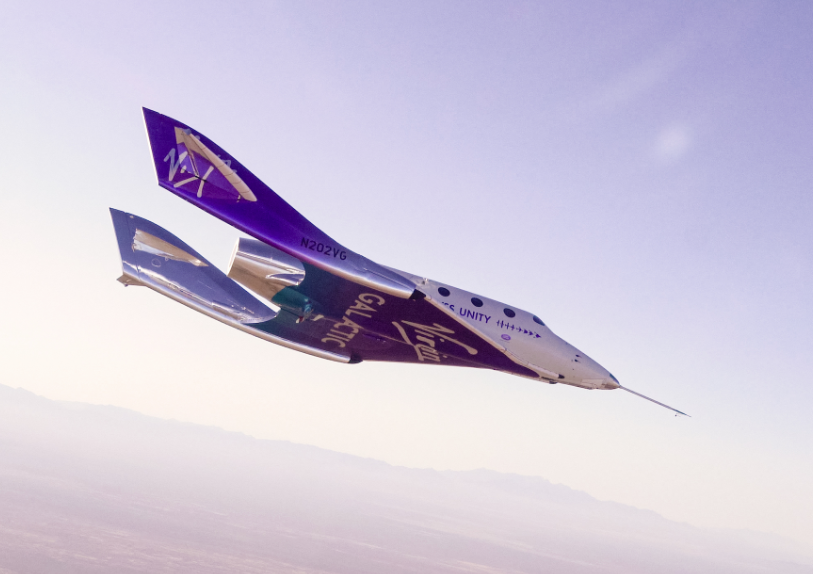
Tustin-based Virgin Galactic Holdings Inc. is officially ready for takeoff.
Following several setbacks, the space tourism company (NYSE: SPCE) founded by billionaire entrepreneur Richard Branson will begin commercial service this week.
Between June 27 and June 30, the first spaceship, Galactic 01, will carry crew members from the Italian Air Force and the National Research Council of Italy to conduct microgravity research.
The next commercial spaceflight, Galactic 02, will carry the company’s first true paying space tourists to fly in early August for the price of $450,000 per seat, with monthly spaceflights expected after that.
Virgin Galactic hopes to build up to 400 flights a year.
The passengers will be wearing custom-made blue flight suits aboard the suborbital flights.
“Livestreams for both Galactic 01 and Galactic 02 missions will be available to view on our website,” Vice President of Communications Aleanna Crane told the Business Journal on June 16.
News of the coming launch—announced on June 15—was well received by investors with shares popping more than 14% the following day.
The company went public in 2019 and once counted a market valuation of about $15 billion. It was valued at about $1.3 billion as of last week.
Moving Forward
Virgin Galactic has spent years and suffered several setbacks getting to this point.
In 2014, a pilot was killed during a test flight that went awry.
In 2021, the Federal Aviation Administration investigated the space plane for deviating from its scheduled flightpath on its first fully crewed flight, which had company founder Branson on board.
The company previously hoped to start commercial service at the end of 2022, with that goal pushed back twice.
The flights will take off from Spaceport America, about 180 miles south of Albuquerque, N.M. More than 800 people have signed up for the experience so far.
The 90-minute journeys include several minutes of weightlessness and will soar more than 50 miles above the Earth’s surface.
Virgin Galactic’s specially constructed, twin-fuselage carrier airplane, named VMS Eve, will take flight with the VMS Unity spaceship attached; once they reach a certain height, the VMS Unity will blast off, taking the passengers and pilots upward into space.
The VMS Unity can hold up to six people: four passengers and two pilots.
Headwinds
Making the company profitable is still a notable challenge for the firm, which moved its headquarters to Tustin last year.
The company said in a regulatory filing on June 22 that it had raised $300 million in a stock offering, and that it plans to raise up to another $400 million through a share sale.
Shares in the company fell 18% to $4.37 per share the following day for a market cap of just under $1.3 billion.
“Virgin Galactic stock has a problem,” Barron’s commented. “Every time it goes up on good news, it goes down again, and there’s a good reason for that. As a capital-intensive startup, it always needs more money.”
Billionaires in Space
Richard Branson isn’t the only billionaire looking to send people to space.
On the same day Virgin Galactic Holdings Inc. announced a launch date for commercial service, the National Aeronautics and Space Administration (NASA) announced plans to partner with seven U.S. aerospace companies to advance human spaceflight, including Jeff Bezos’ Blue Origin and Elon Musk’s SpaceX.
Blue Origin will resume launches of its New Shepard suborbital vehicle within the next few weeks after being grounded since last September following a structural failure during a payload-only flight. The crew was unharmed.
The company is also in production for its New Glenn rocket with a launch for a NASA mission targeted for late 2024.
SpaceX, meanwhile, launched last week a Falcon 9 rocket with a communications satellite with the goal of accelerating internet access in Indonesia. It marked the launch of the country’s largest telecommunication satellite from the U.S.
