

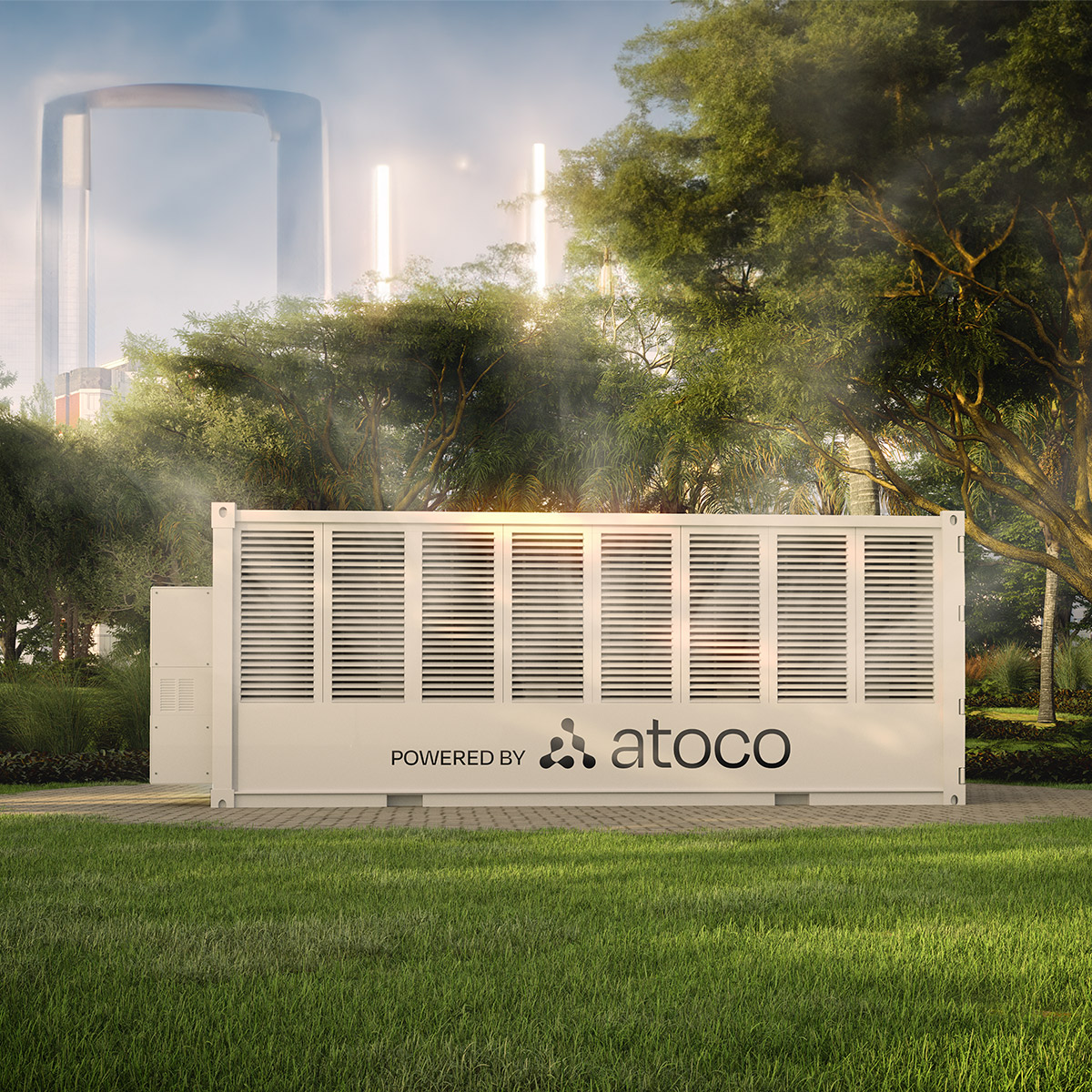
Irvine startup Atoco is drawing attention after its founder, Omar Yaghi, won a 2025 Nobel Prize in chemistry.
Yaghi, a professor at University of California, Berkeley, was recognized for his discovery of porous crystals that can harvest water and carbon dioxide from the air, positioning the technology as a solution to two of the most urgent global issues: water scarcity and climate change.
“He founded the company with a very clear mission of addressing the cause and effect of climate change,” Magnus Bach, vice president of marketing and business development at Atoco, told the Business Journal.
“The cause here would be the emissions of carbon dioxide and the effect, in our view, would be widespread water scarcity.”
Atoco is working to commercialize the technology for a wide range of applications, from data center cooling to vertical farming.
The company is currently deploying industrial prototypes of its water harvester to “various partners,” according to Bach. The company expects to begin taking preorders for them in the second half of this year.
Bach said that they’re still far out from commercializing on the carbon capturing.
Officials declined to disclose how much funding Atoco has raised to date but said it’s backed by Revonence Technologies International, a private equity firm with an office in Irvine. Revonence was founded in 2012 and headquartered in Jersey, Channel Islands, with regional office also in Dubai.
Founder of Reticular Chemistry
Yaghi started Atoco in 2020 and currently serves as chief science officer.
He is credited as the founder of reticular chemistry, or the science of linking molecular building blocks to create highly porous structures that can capture, store and release molecules.
The advantage of working with these structures is that they can be designed to capture specific molecules from the atmosphere, according to Dr. Benjie Limketkai, vice president of R&D at Atoco.
“In our case, we tune the particular materials to preferentially adsorb carbon dioxide from the air or water,” Limketkai told the Business Journal, referring to the process where molecules adhere to a surface without penetrating it.
Reticular materials have been in existence for 20 years now, Bach said, but most companies that have commercialized them buy them off the shelf. Atoco, on the other hand, custom-develops and nano-engineers the materials for specific use cases.
“We manage the entire process,” Bach said. “We not only design and synthesize these materials, but we also make use of them in the final system, so that’s a big difference.”
The company’s R&D and manufacturing operations take place in Irvine, with the vast majority of its employees in OC.
Democratizing Access to Water
Bach said that Atoco plans to commercialize both off-grid and on-grid 20-foot containerized water-harvesting units that can produce up to 1,000 liters and 4,000 liters of water per day, respectively, depending on climate conditions on site.
A few years down the road, they envision building a water plant capable of producing hundreds of thousands of liters per day.
“We will be able to democratize access to water, even to remote communities in the middle of nowhere,” Bach said.
Atoco’s technology could benefit dry areas without groundwater that rely on desalination.
“Instead of transporting water from far distances, we can produce the water out of the air, even in arid environments where the humidity is really low,” Bach said.
Atoco’s off-grid water harvester is powered entirely by ambient energy without any external electricity supply. One form of ambient energy is low-grade waste heat from industrial processes.
“It’s all ambient waste heat that you would normally throw away,” Limketkai said. “So that innovation for both on grid and off grid was a challenge that we overcame and found patents for.”
