Hoag Memorial Hospital Presbyterian finally won its much-wanted South Orange County property.
Two years after Hoag’s second place finish in a bidding war for the Ziggurat office complex, then being awarded the property only to see the sale canceled, Orange County’s second-largest hospital system has now bought the iconic site from the U.S. federal government for $207 million—$30 million more than the winning bid in 2024.
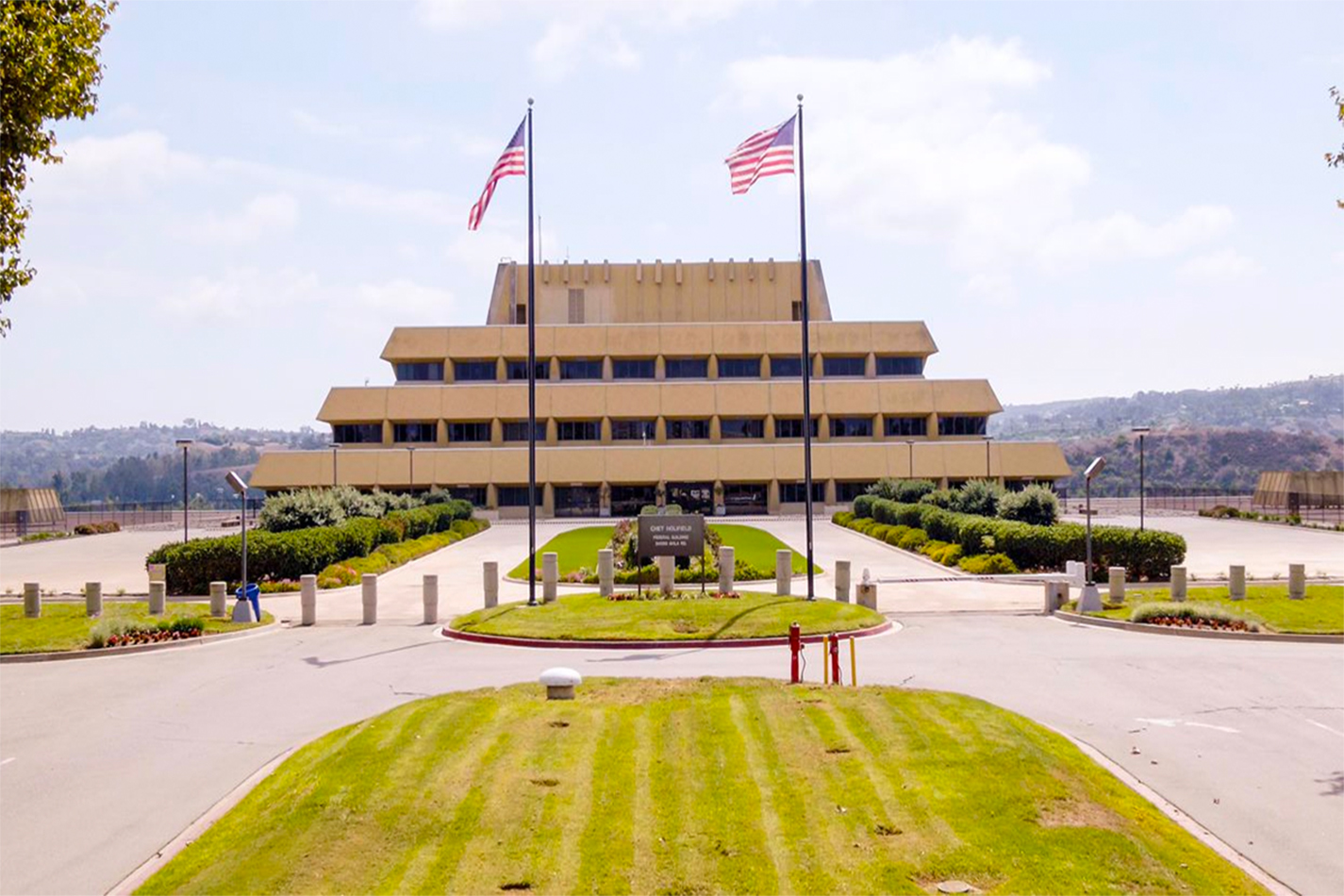
The U.S. General Services Administration, on June 30, officially announced the sale of the Chet Holifield Federal Building, a 1-million-square-foot office campus on 89 acres at 24000 Avila Road, to Laguna Ridge Health Care Development LLC, an affiliate of Hoag Hospital.
CBRE handled the transaction.
At a press conference outside the iconic Ziggurat building, Hoag Chief Executive Robert Braithwaite stood behind a podium with the words, “From Vacant to Vibrant.”
He said the nonprofit hospital system has been interested in this site since 2023. He sees it as the future location of a “health and wellness village.”
“There was a collective and very clear realization that this would be the perfect site for a bold and inspiring health and wellness future for Laguna Niguel,” Braithwaite said in front of a small crowd of hospital and federal officials.
“Our goal and ambition is to pursue a noble and inspiring vision for strengthening access in Orange County.”
City officials welcomed the deal, saying that the sale represents a meaningful step toward increased economic activity, job creation, and long-term revitalization.
“The city is pleased to welcome Hoag to Laguna Niguel,” said Mayor Gene Thomas in a statement to the Business Journal. “This milestone represents an opportunity to build upon the strong foundation of our community through thoughtful civic and commercial reinvestment that can benefit future generations.”
Hoag’s Southern Expansion
The sale marks the soon-to-be demise of one of Orange County’s most recognizable but underused landmarks.
“GSA continues to deliver on President Trump’s goal of eliminating costly, vacant properties from the federal real estate portfolio,” GSA Administrator Edward C. Forst said in a news release. “The sale of the former Chet Holifield Federal Building generated over $207 million in revenue and saved American taxpayers more than $340 million in long-term repair and upgrade costs.”
For Newport Beach-based Hoag, the sale provides a clear path for expansion as it aims to redevelop one of the region’s largest parcels. The acquisition also aligns with the hospital system’s broader push to expand healthcare access across South Orange County.
The nonprofit’s board of directors unanimously voted in November 2023 to expand the hospital system into South Orange County, a strategy Braithwaite said centered on finding the right location for a regional healthcare hub.
“We felt strongly that if we could find the right spot in Laguna Niguel for what we call a healthcare hub, that would be the linchpin of the whole strategy,” Braithwaite told the Business Journal.
The 1-million-square-foot building, long considered an albatross, is expected to be demolished to make way for new facilities, a redevelopment that could easily run into the billions of dollars.
Hoag emphasized that this property gives them the flexibility to create the future of healthcare for Southern California.
Federal officials said Hoag will have flexibility in redeveloping the building, but, as part of the agreement, they must ensure the legacy of the building’s architect, William Pereira, is honored.
Hoag’s acquisition comes as rivals race to expand into South Orange County following the closure of MemorialCare’s San Clemente hospital in 2016.
Providence Mission Hospital is investing $712 million in new medical facilities in San Clemente and Rancho Mission Viejo, while Hoag has already opened a $20 million health center in San Clemente and operates facilities in Trabuco Canyon, Foothill Ranch and Dana Point.
Braithwaite has said Hoag’s long-term goal is to have one of its healthcare facilities within 10 minutes of every Orange County household.
Auction Block
For many real estate developers, the massive 89-acre site was a rare chance to redevelop one of the largest properties in the county.
In 2024, the government offered an eBay-style system for the Ziggurat with bidding starting at $70 million. During a four-month stretch, three bidders submitted 157 bids. Two of them—Hoag and a venture of Pintar Investment Co. and Hilco Development Services—went back and forth, bidding almost every day between June 5 and Oct. 24 during that year. Each new bid had to be a minimum of $300,000 higher.
The Pintar team eventually won with a $177 million bid. But the transaction unraveled. Hoag sued, challenging the original auction process.
The GSA rescinded the joint venture’s bid and instead selected Hoag, the runner-up, as the buyer before completely canceling the entire sale.
Earlier this year, GSA placed the office campus back on the auction block.
Hoag won this time.
Details on how the victor was selected weren’t disclosed. Neither the GSA, Hoag nor CBRE discussed the final purchase price, which is 17% above the previous $177 million winning bid.
Jeff Pintar, owner of Pintar Investment, didn’t say whether his company placed another bid on the property this time around. He congratulated Hoag on the purchase.
“We look forward to seeing what will be planned and ultimately developed as it is such a prime piece of land with an infinite number of options for the new owners to add value to the community and surrounding areas,” Pintar told the Business Journal. “I’m sure there will be plenty of community engagement throughout the process ahead.”
Pharaoh Wanted: The Ziggurat’s Long Journey
Inside a conference room, Brandon Birtcher, the CEO of Newport Beach-based Birtcher Development, lays out the history of the Ziggurat property in the 1970s and 1980s.
Among the newspaper clippings and other documents is a brochure marketing the building to prospective bidders in the early 1980s.
The paperwork read, ‘Pharaoh Wanted…Pyramid For Sale.”
Birtcher chuckles at the property’s long arduous history.
Once called “the worst example of underutilized federal property,” the federal government has tried to sell the massive beige, pyramid-shaped building, nicknamed “The Ziggurat,” along Avila Road and Alicia Parkway for more than 55 years.
“The building has been for sale for decades,” Birtcher told the Business Journal. “I think they’ve tried to sell it at least five times.”
In the late 1970s his company helped prepare the environmental impact report, which he still keeps in his office, and master plan for the 3,200-acre North American Rockwell land holdings surrounding the campus. The documents laid the groundwork for neighborhoods such as Kite Hill and Country Village and what later became the Birtcher Business Center, back when Laguna Niguel was still unincorporated Orange County.
Birtcher has watched the building’s saga unfold for nearly five decades.
Designed by renowned architect William L. Pereira, whose work also includes the Transamerica Pyramid in San Francisco and the master plan for UCI, the seven-story Brutalist building was modeled after ancient Mesopotamian temples known as ziggurats.
Rockwell International completed the building in 1968 for its aeronautics division but never occupied it after losing a key government contract.
“We heard that President Richard Nixon was not in favor of the space program,” Birtcher recalls.
Birtcher said during that time, Fluor Corp. outgrew its space in Anaheim and nearly purchased the Ziggurat for its corporate headquarters.
According to Birtcher, a major newspaper learned of the deal and ran the headline, “Fluor to Buy White Elephant.”
Worried about public backlash or a negative image, Fluor executives canceled the deal just days before closing. Instead, the engineering company built Park Place, two 10-story buildings on 105 acres in Irvine.
Years later, Rockwell traded the Ziggurat to the federal government for two other surplus properties. Due to lack of buyer interest, the federal government transformed it into Orange County’s largest federal office complex, housing several federal agencies—but it only took up one third of the one million square foot office property.
Birtcher’s own firm also explored buying the property in 1983. At the time, Birtcher envisioned redeveloping the site into a campus of business parks and corporate headquarters. But he said the economics never penciled.
He welcomed the sale, saying the aging landmark had become too expensive for the government to maintain.
“I’m glad that it has sold,” Birtcher said. “Having an asset of that prominence needs a sponsor as capable as Hoag.”
—Joseph Pimentel