Backed by Bill Gates, Jeff Bezos and Nvidia, FieldAI is building the brains for a new generation of robots.
The Irvine-based startup, led by co-founder and Chief Executive Ali Agha, is developing software deployed everywhere from defense and outer space to forests, construction sites and underground mines.
“We are a brain company,” Agha told the Business Journal during an exclusive tour of the company’s headquarters.
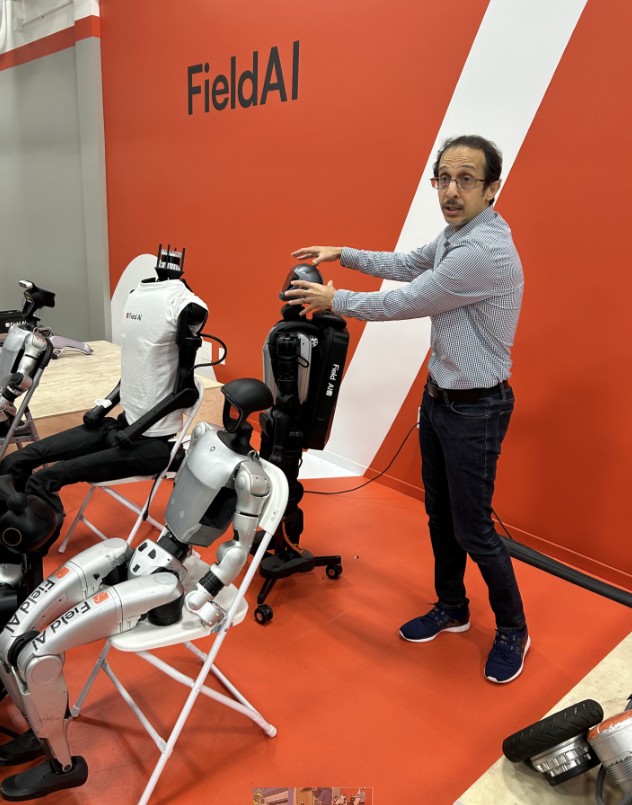
One robot model climbs a rickety wooden ramp and carefully returns down a set of steep steps. A human-shaped robot, responding only to voice commands, can pick up a set of keys and drop them into a nearby bucket. Unmanned robotic vehicles are getting ready to dash into forests to help prevent catastrophic fires.
FieldAI on April 22 held what could be a coming-out party for Irvine city officials and the Business Journal.
Almost a year ago, FieldAI said it had raised over $400 million in funding, boosting the valuation to $2 billion. It is now one of Orange County’s most valuable privately held tech firms.
It is located in a two-story building off Alton Parkway and soon will be looking for more space to handle explosive growth.
‘Unlimited Applications’ for Robots
In an exclusive interview with the Business Journal, Agha says the autonomous robots have “unlimited applications.”
FieldAI is building universal AI software that works across many robots, tasks and environments, while many other companies build the actual “hardware.”
In short, FieldAI is developing AI software for other companies’ robots that enables them to perceive their environments, navigate without GPS on land, by water or in the air, and even communicate with each other.
The robots’ brains are “learning all the time,” says Agha.
“We are a software company. We build the brain that sits on a variety of different robots,” Agha says.
He looks at one of his creations with an almost parental awe.
“You see how it’s adjusting speed and trying to think very carefully,” he says. “This is a very unique part of the architecture we are building.”
In other words, that robot is making its “own decisions,’’ bringing AI thinking that much closer to humans, says Agha.
Videos produced by FieldAI also show various robots on worksites, mingling with colleagues just like human co-workers.
Big as Trucks
“Three years ago, we started the company,” says Agha. “Since then, we’ve been getting a ton of momentum.”
The company’s robots range from the small “dog robots” to ones as big as multiton trucks. Robots can even detect dangerous gas buildup when they enter mines.
FieldAI does not release any specific headcount numbers. However, the company’s LinkedIn page says the company has between 201 and 500 employees.
While he declines to specify revenue, people familiar with the matter tell the Business Journal that the company has more than $100 million in booked revenue and partnerships with large industrial customers.
The company’s backers also include Nvidia’s venture capital arm, NVentures, Khosla Ventures and Intel Capital.
FieldAI’s production deployments span thousands of missions across hundreds of sites on three continents. The company has attracted dozens of large enterprise customers.
FieldAI has a subsidiary that works with the federal government, and federal applications are part of its work.
Anduril vs. FieldAI
While OC observers may be tempted to draw a parallel with the defense company Anduril Industries, there is a fundamental difference: FieldAI is serving a potentially very large market, whereas Palmer Luckey’s creation caters to the huge but still limited military and border patrol markets.
Visionaries, including Elon Musk, have touted the vital role robots will play in the future.
FieldAI has been recognized by business magazine Fast Company as one of the Top 10 most innovative AI companies, alongside Google and Anthropic.
The company boasts top talent from high-flying companies, including DeepMind, Tesla, Nvidia, Amazon and JPL.
$3K to $500K
Some of the “dog” robots can cost between $3,000 and $4,000, while subscriptions for the vehicles can range from tens of thousands to $500,000.
“When it comes to the general-purpose brain for robots, we have the most deployments all around the world now, from Asia Pacific to Europe, to North America,” he says.
The “intelligence layer” is key to robots, which can look deceptively simple but are highly sophisticated machines that will soon be an integral part of business and family life.
FieldAI also sees uses for its robots in defense, space and manufacturing, in addition to doing “dirty, dull and dangerous work” in unpredictable environments.
In short, Agha calls his work the “physical part of AI.”
FieldAI Outgrowing Irvine Offices
Fast-growing robot developer FieldAI now occupies more than 41,000 square feet of space for offices, labs and warehouse at 3 Morgan in the Spectrum area of Irvine.
The company will likely need a lot more space.
“We moved to this space six months or so ago,” co-founder and CEO Ali Agha said.
“Before the end of this year, we are going to outgrow this space.”
He’s already looking ahead.
“We are actually thinking of how we’re going to do it, the neighboring buildings and so on,” he told the Business Journal during an exclusive tour of its headquarters.
About two-thirds of the staff is in Irvine; the company also has offices in Tokyo, Singapore, San Francisco and Boston.
The company is also occupying a research office and laboratory at a Carnegie Mellon University research center.
He foresees a bright future for Irvine at the forefront of what’s called “physical AI.”
“We have been able to bring some incredible people from the Bay Area,” says Agha. And there are plenty of schools and talents around Southern California with a “very robust set of talents.”
“There is an opportunity here for Irvine to be at the forefront of pushing the nation,” he says.
From Exploring Mines to Calling the Cops: Robots are Here
If you’ve ever thought about how great it would be to have a robot at your beck and call for your business, FieldAI probably has similar ideas.
CEO Ali Agha runs off a long list of uses for the robot “brains” he creates, ranging from the mundane to the futuristic.
They can check for potholes and construction defects, saving developers plenty of time and money.
“In an airport construction recently, we made a catch—one catch saved them $1.2 million,” Agha said.
They can carry loads of materials, including to dangerous points, and detect dangerous gases deep in various mines.
They can check for power line failures in thick forests before they explode and burn down dozens of houses—and also work in deserts.
“They can do quite a bit of different tasks,” from material transport on solar farms to inspecting pipelines and power utilities.
They can also be used in rescue operations.
And if things go wrong, Agha says, FieldAI-powered robots can also call the police.
On the consumer side, package deliveries are a key possibility. Agha paints a scene of a robot one day greeting visitors—even non-English-speaking visitors—and showing them around the Irvine Spectrum Center.
CEO Brings NASA JPL Experience to FieldAI
FieldAI co-founder and CEO Ali Agha holds a doctorate in computer science and engineering from Texas A&M University, followed by two years of postdoctoral research at the Massachusetts Institute of Technology (MIT).
Before FieldAI, during his seven-year tenure at NASA’s Jet Propulsion Laboratory, Agha was a principal investigator for some of the nation’s most high-profile and cutting-edge projects in autonomy, including the latest in the series of DARPA challenges (DARPA Subterranean and DARPA RACER), as well as NASA’s Autonomous Mars Cave Exploration and Coordinated Autonomy for Prototype Mars Helicopter-Rover.
FieldAI’s president is Shayegan Omidshafiei.
Prior to FieldAI, Omidshafiei was a leading research scientist at Google and DeepMind for over five years, focused on training and evaluation of large-scale AI models, co-leading several major research efforts on single and multi-agent deep reinforcement learning and sequential decision-making.
Omidshafiei earned his doctorate and master’s degree from MIT.