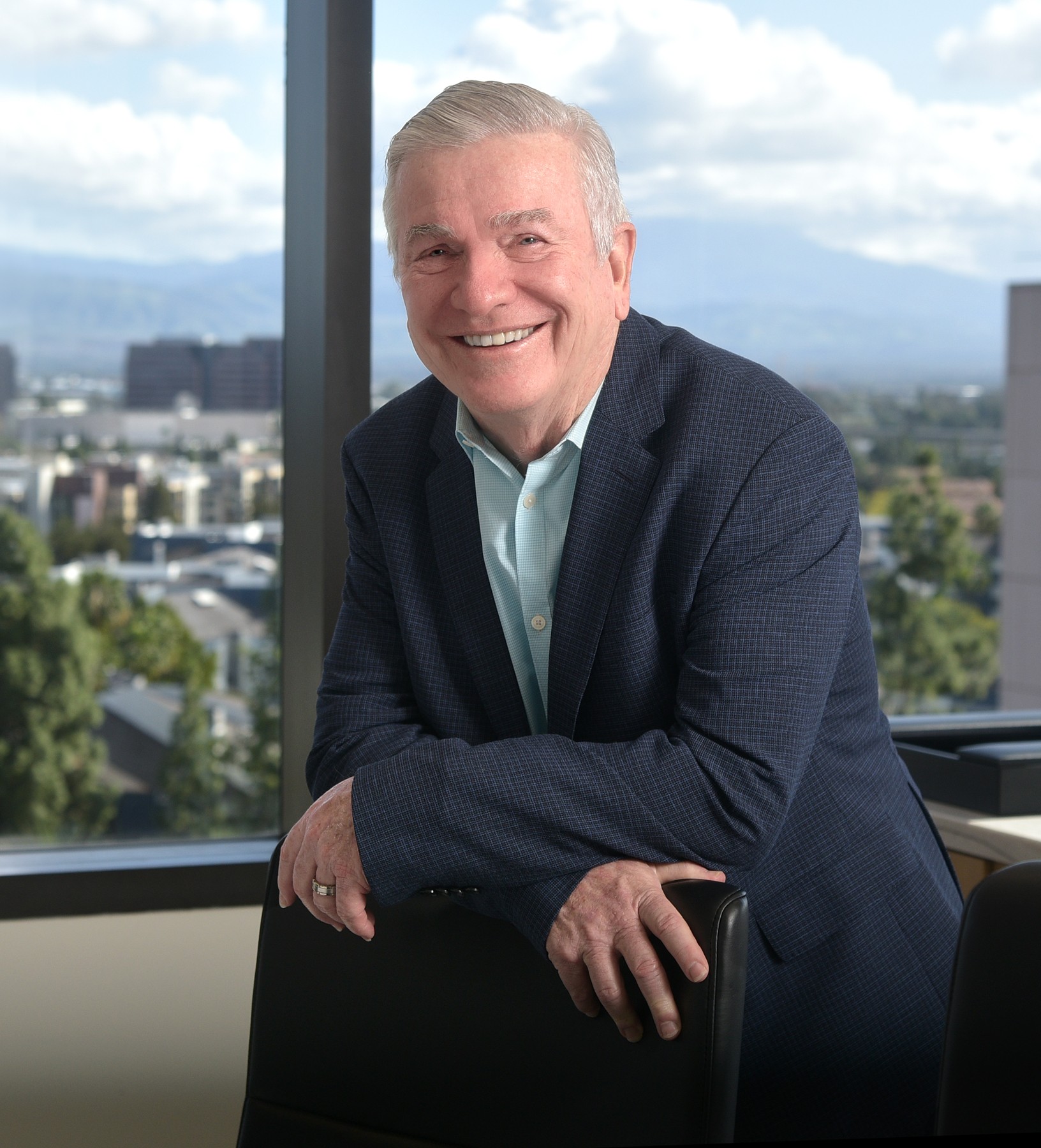
Bill Witte in the 1980s spent a decade in San Francisco, where he led that city’s housing efforts and learned the intricacies of local governments.
When he decided to enter the private sector, he met Stephen Ross, founder of the Related Companies that eventually became famous for developing the Hudson Yards, a $25 billion mixed use project on Manhattan’s West Side that became the largest private real estate development in U.S. history.
Ross was looking to expand into California, so he interviewed Witte for the job.
“At the end of the interview he says, ‘I don’t know if you know what you’re doing, but you sound good,’” Witte told the Business Journal.
“It was just me. I had no staff. I hired a secretary just so I’d have someone to talk to.”
Thus began a 35-year relationship where Witte and Ross built Related California into the state’s largest developer of mixed-use projects that now includes 20,000 homes and a $3 billion redevelopment project in Santa Ana.
Effective Jan. 1, Witte retired and his role is being taken over by his top assistants: Gino Canori as chief executive of Related California and Ann Silverberg as chief executive of Related California Affordable & Northwest.
The 74-year-old Witte is now chairman emeritus.
“My trajectory was not normal,” Witte said. “I did not have a background in finance or construction or design. My father used to say to me, ‘What do you guys do?’ I just kind of had to learn along the way.”
16th Birthday Present
Witte was born in New York City and raised in Connecticut, where his father was a building contractor and started a small business investment company. At a young age, he became fascinated with urban developments.
“For my 16th birthday, I asked my father to drive me through the inner cities of Bridgeport, New Haven and Hartford just to see urban renewal,” he said.
He earned a degree in city planning from the University of Pennsylvania and eventually worked in the planning departments at the city of Philadelphia and the federal government’s Housing and Urban Development in Washington D.C. He then accepted a job working for San Francisco Mayor Dianne Feinstein.
“Feinstein was the most demanding boss,” he recalled. “Every Monday morning, every department head in the city was in her office, police, fire, health, public works, housing.
She had her book out, boom, boom, boom. Feinstein had a private sector mindset who wanted results.”
He also learned an important technique to get things done in the government.
“You have to listen to people, even if you disagree with them,” Witte said. “You couldn’t just order things to get done.
“San Francisco’s a very politically active place. You have to work with all these disparate groups, but simply calming the temperature isn’t going to get anything done. You had to bring people together.
“After some years in government, I didn’t want to just be a referee or enable things to happen. I wanted to try to actually do things.”
The Make or Break First Job
Related California became an affiliate of the Related Companies, which provides financial backing for the projects. Nationwide, Related has more than $60 billion in real estate assets owned or under development.
By the time Witte started his company, his parents had moved to Newport Beach, which is how he learned about Orange County. His brother had an office here, so he sublet space.
Witte’s first redevelopment was at Normandie Terrace in Los Angeles, a 35-acre public housing site with 400-low-income units.
“Ultimately, it was maybe the most complicated thing I’ve ever done. I had no private sector experience, so I had to learn on the job.”
The project, which took seven years to complete, eventually had 400 replacement low-income units intermixed with 224 for sale condos that were built by Larry Webb, a well-known OC homebuilder who became his close friend.
“Had that project not gone forward, there would be no Related California,” he said. “We took off from there.”
Triumphs include various transit-oriented communities, often forged through partnerships with nonprofits, local governments, and bonds funding affordable initiatives. Witte’s dual focus on affordability (via lines of credit guaranteed by Related Companies) and market-rate ventures allowed the firm to navigate California’s regulatory maze, where Witte advocated for regional planning to overcome fragmented local governance.
In 1999, Related California started construction in San Francisco on what became a 487-unit, 40-story high-rise called The Paramount, which the company still owns today. To get the tax benefits, about 20% of the homes had to be low income, which meant that 398 units were market rate while 89 were affordable units.
Related California started off as an affordable housing company; as it grew, the company expanded into other asset classes, such as middle-income housing and mixed-use projects.
Building both affordable and market rate homes is a unique combination, Witte said.
“There are people who did one or the other, but not both,” he said. “It also enabled us to be busy even through say the 2007, 2008 downturn because we could continue to do affordable housing all over the state. It’s a model that has characterized Related since its inception.”
In the early 2000s, the company was the winning developer of what became a mega-mixed used project called The Grand LA, located on a hilltop that spans three city blocks in Los Angeles’ Bunker Hill neighborhood. Designed by the famous architect Frank Gehry, it took 15 years to complete the project.
“It was just complicated and challenging, but it got built,” he said.
Nowadays, Related California owns hundreds of apartments in the area, with 20% of them saved for affordable housing. It also owns the site Conrad Los Angeles hotel, which is Hilton’s five-star brand. Another site became The Broad museum. Across the street, Related California built a 271-unit, 20- story tower called the Emerson, where 20% of the units are affordable.
It spent $57 million to help develop what became Grand Park, a 12-acre “urban oasis” that provided water fountains, wide green lawns and performance areas.
Fashion Island Development
When asked why there is a shortage of affordable housing in Orange County, Witte said there are several reasons, such as laws favoring commercial development over residential development.
“I don’t want to oversimplify it because it’s complicated,” he said. “The part that’s not complicated is the pace of housing development has not kept pace with job and population growth. You have this huge growth not accompanied by as much housing.”
Another reason is the infamous NIMBY, or not in my backyard. About a decade ago, the company struck out when a Newport Beach vote blocked its efforts to build a 20-story residential complex on land owned by the Orange County Museum of Art.
Witte said he has sympathy for local residents.
“Let’s even say you were allowed to build a 40-story tower in the middle of Newport or Huntington Beach. From an urban design and planning point of view, I just think that’s wrong. I don’t support something that’s so out of whack with the surrounding area.
“Fashion Island is different. There are already eight or 10 towers there. It’s an urban core.”
Nowadays, a state law makes it more difficult for a city and its residents to oppose housing, and the company is moving forward on a plan to build two condominium high-rises at the site of the Regal cinemas in Newport Beach’s Fashion Island neighborhood. The company is in the process of getting city approval and the goal is to have it built by 2029.
It’s built more than 25 affordable housing projects in cities like Anaheim, Santa Ana and Laguna Beach. For the past decade, the company has also partnered with Five Point
Holdings to build seven affordable housing projects at Irvine’s Great Park.
He pointed out his reasoning on emphasizing well design residential communities with plenty of parks.
“First of all, we’d like to be invited back to this community. Second, we’re going to own this long term. It does no one any good, including us selfishly, to have an inferior product.
“So we’ll spend a lot of time on the common areas, which brand the project, the community rooms, the public spaces, fitness areas, computer rooms, things like that.
“When we’re trying to convince a community to build new affordable housing when they’re skeptics, we’ll sometimes take residents or city council members on tours of our projects that are 10 years old.”
Suburban Shift
Related California typically has developed projects in the urban cores of San Francisco, Los Angeles and Santa Monica. It now sees opportunities to develop urban housing in suburban locations.
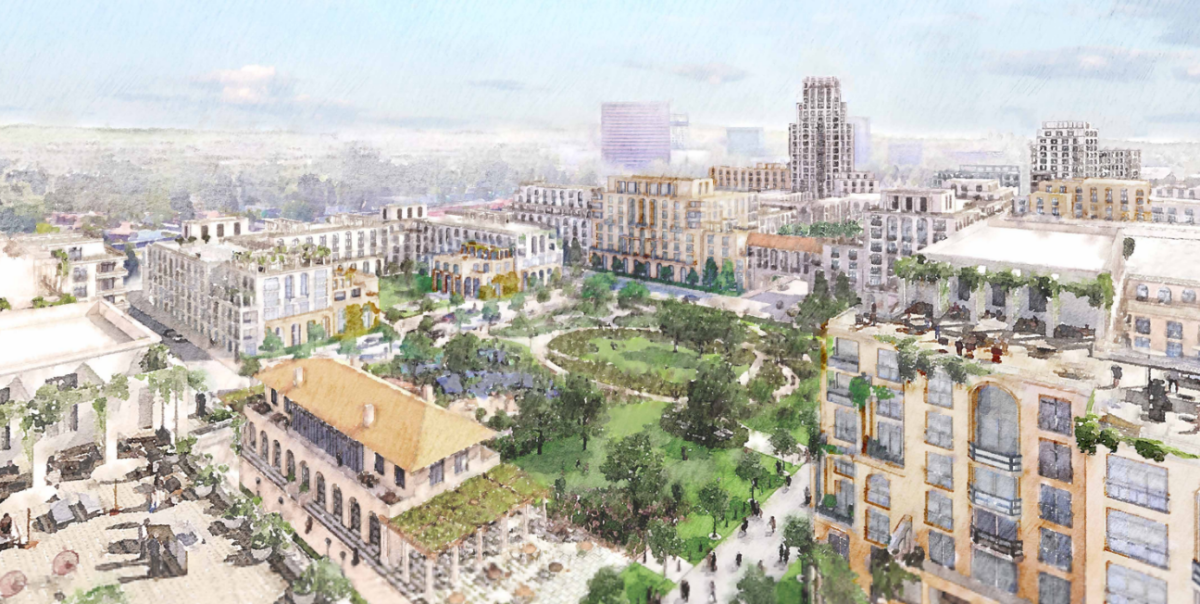
The company’s latest endeavor, Related Bristol, is a $3 billion project that aims to redefine the landscape of Orange County by converting 41 acres of an existing and aging suburban shopping center into a mixed-use destination with apartments, cafés, restaurants and shops across the street from mega-mall South Coast Plaza.
A quarter of the 41-acre Related Bristol project will be open space. It will have 350,000 square feet of retail space that won’t be a covered mall.
“Our current plan does not have high-rise housing, even though it would be allowable,” Witte said. “It’s not out of scale with the broader area, but it’s bringing these kind of live, work, play places, which typically hasn’t been done much, certainly outside cities.”
The Profit in Affordable Housing
Affordable housing signals that developers won’t get the highest market price possible, which begs the question—why build?
“There’s not a lot of speculative value,” Related California founder Bill Witte said. “It’s a volume business in terms of fees and cash flow.”
It attracts investors who want low risks and steady returns as well as tax benefits, he said.
Modern affordable housing projects are different than the projects that turned into slums in the decades after World War II. Those housing projects created by the government often used the cheapest materials and lacked a key element—private owners, Witte said.
The federal tax reform act of 1987 created the low-income housing tax credit program, which took the industry a few years to figure out, he said.
The owner must agree on a covenant that the units will stay affordable for at least 55 years while rents can go up over time. A development fee is allowed.
“It’s possible to lose money, but if you’re a good operator and we typically manage what we develop, in most cases, you’re not going to lose money,” Witte said.
Developing the Bullseye of Orange County
With the retirement of Bill Witte from Related California, two long-time executives are stepping up to manage $10 billion in development projects, including $4 billion in Orange County.
Gino Canori is now chief executive of Related California, while Ann Silverberg is chief executive of Related California Affordable & Northwest.
Their biggest project is Related Bristol, a $3 billion site that will ultimately hold 3,700 residential units and 350,000 square feet of commercial space as well as about 13 acres of open areas. It will be built over the next seven years.
Previously known as Metro Town Square, it is located a block north of the South Coast Plaza and the Segerstrom Center for the Arts in Costa Mesa.
Metro Town is a two-city block center with big box retail and smaller stores, banks, offices and fast food restaurants. It was first developed in the 1960s and is now partially vacant.
“When you look at where the location of that site is relative to everything else, it’s the bullseye of Orange County,” Canori told the Business Journal. “There are hundreds of tenants who want to be in that area.”
It is also in the process of entitling the site of the Edwards movie theaters near Newport Beach’s Fashion Island shopping district. It’s aiming for 150 condominiums in two towers that will also include offices. It’s aiming to be built by the middle of 2029.
It’s leaving its office on Von Karman in Irvine to move to a 10,000-square-foot facility on Newport Center Drive.
Related California is a vertically integrated real estate company that has two lines of businesses. One is affordable housing, which is what the company was founded on in 1989, and it has evolved into what they say is the largest mixed use developer in the state.
“We essentially have done just about every single product type except for a strip center retail, so that is affordable housing, hotels, office buildings and sort of everything in between,” Canori said. “The one product type we haven’t developed, which we will venture into later this year as an industrial distribution warehouse in Santa Clara.”
Related California usually focuses on in-fill projects that replace existing works.
For example, the Metro Town Square shopping center was basically a large area of strip malls and parking lots. The Callens family, which owned the site, decided to put it up for development, inviting 12 developers to bid for the project. Related California won with a 99-year lease.
“We competed for that business and won it basically on our reputation and our ability to create,” Canori said. “We pulled together everything that works to our strengths, which is mixed use. It’s in our DNA.”
Canori said that infill developments are more difficult than developments without buildings. Company executives had more than 200 meetings to convince residents in Santa Ana about the benefits of Related Bristol.
“You’re moving into an established community with naysayers, and you’ve got to work with the community to sell your vision and to be able to pull something like that off,” Canori said.
Infill is “our bread and butter. That’s what we do. A lot of people shy away from that, but that’s kind of all we know.”
Affordable Homes
Silverberg is responsible for the strategic direction, overall management and daily operation of the company’s affordable portfolio in the Western United States, including California, Oregon, Utah and Washington. For the past seven years, Silverberg has overseen and directed the growth of the affordable pipeline in Northern California and the Northwest.
Prior to joining Related California, Silverberg was executive vice president and chief investment officer at BRIDGE Housing Corporation, where she directed and oversaw its Northern California Division.
She led the development and redevelopment of more than 8,000 affordable, mixed-income, mixed-use and transit-oriented housing units. She directed the capital aggregation and placement of equity and debt for their Low-Income Housing Tax Credit (LIHTC) and non-LIHTC developments and oversaw the negotiation and placement of over $3 billion in project level debt and equity.
For the past 24 years, Canori has been pivotal in building the company’s substantial portfolio of mixed-use and mixed-income developments with development costs exceeding $7 billion. He is currently overseeing a $10 billion pipeline of more than 7,000 multifamily and senior units, and over 5 million square feet of commercial space located in San Francisco, East Bay, North Bay, Silicon Valley, Los Angeles and Orange County.
Canori, who was raised in Mission Viejo and graduated from University of Southern California, has a pipeline of Orange County developments in Irvine and Anaheim as well as Santa Ana and Newport Beach. Silverberg is working with Five Point to develop affordable homes.
“I’m from here, so I know every corner of this county, and I’ve always felt that the growth that will come here over the next decade could be very significant,” Canori said.
“Orange County is actually very important to our affordable group. We have long history here. We’ve been developing here for almost 38 years, so we have 30 developments, almost 3,000 units here in the county, which is a lot.”
Witte Hall for a Book Lover
Bill Witte says his father loved books.
After his father passed away in 1997, his family decided to honor him by starting a speaker series at the Newport Beach Library.
“It’s still going strong today. It’s been hugely successful in his honor,” he said.
When the idea for the lecture hall emerged, the Witte family stepped up to donate $4 million for the $24 million facility.
Witte Hall, which will be owned by the city, is a civic auditorium that can hold 300 people. Located adjacent to the Newport Beach Central Library at the Civic Center, the nearly 10,000-square-foot facility is scheduled to be completed early this year.
The Hall is a small project compared to the mega billion dollar developments Witte is often involved with.
“It was really more about continuing to honor my father. So we stepped up to be the lead donor to help make it happen.
“We actually try to be philanthropically involved wherever we live.”