Aviation Capital Group has placed an order for 50 Boeing 737 Max jets to be leased out to commercial airlines, as the company sees growing demand for fuel-efficient planes.
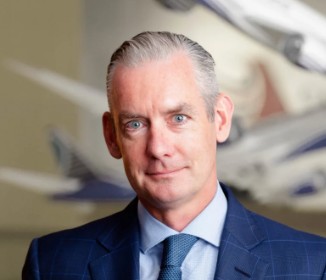
Chief Executive Tom Baker declined to specify the price for the 50 new jetliners, though he said a catalog price would be “well in excess of $7 billion.”
“We do not pay catalog list prices. We pay much less than that,” Baker told the Business Journal.
The announcement is another positive signal for the Newport Beach-based firm, which has significantly recovered from the pandemic years when the travel industry was decimated and the Ukraine war, where it recently reported recuperating $545 million in insurance claims after its planes were “stolen” by Russia.
Last year was a “strong market” when it delivered 46 aircraft, the company said at a December presentation at Goldman Sachs 16th Annual Aircraft Leasing Conference.
ACG, as it is commonly called, had approximately 470 owned, managed and committed aircraft as of Sept. 30 that were leased to roughly 90 airlines in approximately 50 countries. The term “committed” refers to aircraft on order.
“We’re about $14 billion dollars in assets under management right now,” Baker said. “We definitely want to be bigger than that.”
‘Our Children’
Baker considers his company’s billions of dollars’ worth of leased-out jetliners as more than just expensive flying machines.
“They’re our airplanes. They’re our assets. We love our children very deeply,” Baker said during a Jan. 20 interview. “We care about their condition and their health.
“We make sure that the lessee takes very, very good care of them and pays for proper maintenance, submits the proper records, keeps the airplane in good condition according to the terms of the lease.”
Its customers range from United Airlines to Air France, Hungary’s Wizz Air, Poland’s LOT, Italy’s ITA and Virgin Australia.
ACG calls itself a major global airplane lessor based in California. Baker said ACG’s biggest competitor is Los Angeles-based Air Lease, which analysts expected to report $3 billion in 2025 sales; it has a $7.1 billion market cap (NYSE: AL).
The acquisition of the 50 jets increases ACG’s Boeing 737 MAX order book to 121, including 50 firm orders for the 737-10, Boeing said in a statement on Jan. 13 (NYSE: BA).
The 50-count order is split evenly between the Boeing 737-8 and 737-10 models, with deliveries scheduled for 2032 and 2033.
The company also has commitments to another 73 planes from Airbus, the European consortium.
The typical first lease is for 12 years, according to the ACG CEO.
“We deliver them an airplane. We help them retrofit the airplane. We finance the costs of that retrofit in the lease,” according to Baker.
In turn, the airlines are responsible for leasing costs, maintenance, crew, insurance and related charges, he said.
Among recent jetliner deliveries, ACG announced on Dec. 26 the delivery of a new Boeing 737 MAX 8 to LOT Polish Airlines.
A month earlier, ACG announced the delivery of its first new Airbus A220-300 to Italian carrier ITA Airways, a new customer for ACG.
ACG says it also provides certain aircraft asset management services and aircraft financing solutions for third parties.
The company has about 135 full-time employees worldwide, with approximately 85 in Newport Beach.
ACG is currently located at 840 Newport Center Drive and will move to 520 Newport Center Drive this year, according to Baker.
Leasing Increasingly Popular
ACG was founded in 1989; Newport Beach-based Pacific Life Insurance Co. in 2005 took a majority stake and, for several years, floated a possible IPO for ACG. However, Pacific Life sold ACG to Tokyo Century Corp. in 2019, where it is now a wholly owned subsidiary.
While the practice of leasing jetliners may be little known to ordinary passengers, it provides more flexibility for the air carriers.
“Airlines have a choice between buying their aircraft or leasing them. Leasing has emerged as the preferred option, rising from roughly 10% of the total fleet in the 1970s to 58% at the end of 2023,” the International Air Transport Association said in 2024.
9-Month Revenue Up Slightly
On Nov. 12, ACG reported total revenues of $934.7 million for the nine months ended Sept. 30, 2025, up slightly from $923.1 million a year prior.
Total pre-tax net income, excluding insurance proceeds, was $124 million for the nine months ended Sept. 30, 2025.
ACG funds its purchases from various sources, including the U.S. bond market and loans from a syndicate of more than 50 banks, according to Baker. It has investment grade ratings of Baa2 from Moody’s and a BBB from S&P Global.
ACG on Jan. 22 announced the closing of its sale of $1 billion of senior unsecured notes.
The company said it intends to use the net proceeds from the notes for general corporate purposes, including the purchase of commercial aircraft and the repayment of outstanding indebtedness.
ACG Collects $545M in Insurance After Russia ‘Stole’ its Planes
Aviation Capital Group said nine of its jetliners were seized in Russia after Vladimir Putin’s nation invaded Ukraine in February 2022.
ACG CEO and President Tom Baker said at the time that the loss was covered by insurance.
Now, several years later, some major insurance sums have been paid to ACG.
“The key message there is we got made whole, but it took us four years to do it,” Baker said, referring to the aircraft as having been “stolen.”
The company said in November that it had received a net benefit of $544.8 million from the “settlement of insurance claims related to our losses incurred from Russia exposure.”
ACG listed $574.7 million in its annual financial statements as Russia-related losses for 2022. The company also said in the statements that it had incurred “damages in excess of $700 million” from the Russian seizure.
Baker explained that the $700 million figure is the “fully loaded number to include the value of the airplanes, the costs of recovery, lost rent, so on and so forth.”
– Kevin Costelloe
A Backpack Made from an Airline Seat?
Aviation Capital Group is doing its part to reduce airline pollution by recycling old airline seats into what it calls “stylish, high-quality backpacks.”
“The environmental impact is significant, as aircraft seat leather and life vests are made from durable, high-quality materials designed to withstand tough conditions,” the company’s 2024 annual environmental report said.
“By repurposing them, we extend their lifespan, reduce landfill waste and decrease the demand for new raw materials. This sustainable approach lowers the carbon footprint of traditional manufacturing and contributes to a circular economy.”
The company is also beginning to use “sustainable aviation fuel,” which is a renewable alternative to traditional fossil-based jet fuel. The fuel, known as SAF, is produced from waste oils, agricultural residues and non-food crops.
ACG says the new fuel can reduce lifecycle carbon emissions by up to 80% compared to traditional aviation fuel.
“All of our aircraft are capable of flying with up to a 50% blend of SAF,” said the environmental report. “Both Airbus and Boeing are targeting 2030 for 100% SAF capability and certification.”
The Newport Beach-based company has also invested in the United Airlines Ventures Sustainable Flight Fund and obtained a $550 million senior unsecured term loan with “sustainability-linked terms.”
—Peter J. Brennan
CEO’s Journey from Ivy League to Jetliner Buying
Tom Baker joined Aviation Capital Group in 2016 from Goldman Sachs’ Investment Banking Division, where he covered clients in the Aviation & Transportation Sectors.
Before assuming leadership of ACG in November 2020, he served as executive vice president and chief revenue officer, with responsibility for leading ACG’s Sales/Marketing, Trading and Technical teams.
From 2012-2014, he was head of the Asia (ex-Japan) Transportation coverage group for Goldman Sachs in Hong Kong, where he worked on debt and equity financings in the aviation and transportation sectors.
Prior to Goldman Sachs, Baker spent several years at Citigroup in investment banking and Morgan Stanley in equity research.
He holds a bachelor’s from Brown University and an MBA from Massachusetts Institute of Technology.
—Kevin Costelloe