

Vans might soon need a bigger skate pool at its Costa Mesa headquarters if its executives’ brash proclamations of corporate growth over the next five years come to fruition.
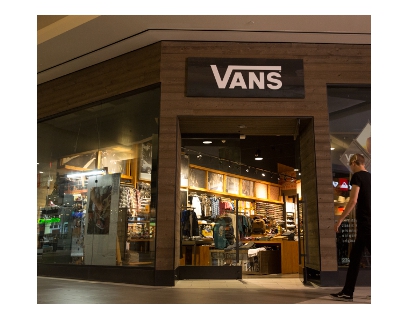
The action-sports clothing and footwear manufacturer, already Orange County’s largest apparel firm by revenue, recently announced an ambitious plan to ratchet up sales from $3 billion this year to $5 billion by 2023.
The plan—announced last month at the company’s annual investors day conference—relies heavily on increasing sales at its brick-and-mortar stores, rising e-commerce sales and growth overseas, as well as cashing in on the skateboarding shoemaker’s well-earned and unique reputation among young and old shoppers alike, executives said.
“Five billion in 2023—it’s not a number that we take lightly,” said Steve Murray, vice president of strategic projects at Vans’ parent company, V.F. Corp. in Greensboro, N.C.
“A lot of work has gone in to understanding how that [growth] will come about by region, by product, by category, by channel,” said Murray, who served as president of Vans for five years.
Emphasizing that work: Vans unveiled a 129-page and buzzword-heavy presentation at the conference detailing how it expects to reach its new goals.
V.F. Chief Executive and Chairman Steve Rendle called the plan “bold.”
The growth projections translate to a compound annual growth rate of between 10% and 12% from now until 2023. Those projections could be underselling Vans’ potential, according to the investor’s day presentation: the company’s currently seeing CAGR in the 20% range.
“I am confident in the Vans team’s ability to deliver” on the plan, which will establish the company as one of the world’s largest apparel brands, Rendle told investors in the September meeting.
Others are taking note.
“Vans could soon become the third-largest lifestyle sports brand in the world behind Nike and Adidas,” CNBC ‘Mad Money’ host Jim Cramer said following the event.
Parent Stock Upswing
The recent and projected growth at Vans has been welcome news for V.F. (NYSE: VFC), which bought the Orange County company for $396 million in 2004, when it was based in Cypress.
It moved to its Costa Mesa digs alongside the San Diego (405) Freeway last year. As well as other perks, the black-and-white checkered headquarters has a skate pool for workers.
The company, which employs about 750 people in Costa Mesa, is the third-largest area apparel company by employee count, according to Business Journal data.
Vans is now the largest, fastest growing, and most profitable brand for V.F., which also owns The North Face, Dickies, Timberland and Altra brands, among others. It passed The North Face as the No. 1 brand by sales about a year ago.
The company recently reported revenue rose 23% to $2.8 billion and net income surged 46% to $160.4 million for the fiscal first quarter ended in June. Sales at V.F.’s “active” division, which is led by Vans, represented about 40% of the parent company’s first-quarter revenue.
In its most recent fiscal year, Vans generated $3 billion in sales, reporting a 60% profit margin and an operating profit of $700 million, according to the presentation last month.
V.F.’s stock is up nearly 50% over the past year, giving it a market value of $37 billion.
Next Wave
Vans Global Brand President Doug Palladini said at the investor meeting that the company is entering a new phase of growth under V.F.’s ownership, one now focused on bringing more customers into its family.
“We [will] do that by remaining very sharp and very clear about who we are and who we are not,” Palladini said.
The iconic skateboard brand has stayed true to its counter-culture roots and “Off the Wall” slogan, but in an effort to tap into a bigger market, it’s taking its emphasis on creative expression to the global stage, he said.
“If you embrace creative expression, then you’re a Vans family member, which is why Vans is a rare brand in which grandparents, parents, teens and even babies can wear our product in the same family, at the same time without any brand fallout—a very distinct position for Vans that we think is quite powerful,” Palladini said.
“Vans has grown beyond California to about 85 countries. We understand that embracing geographic and cultural nuances is also essential.”
House of Vans
Brothers Paul Van Doren and Jim Van Doren, as well as partners Gordon Lee and Serge Delia founded the company as The Van Doren Rubber Co. in 1966, selling shoes out of its Anaheim warehouse.
By the late 1970s, the footwear maker operated 70 stores and was the shoe of choice among skateboarders, who liked the canvas sneaker for its sticky waffle soles that could grip a skateboard deck.
The brand’s popularity started to wane in the early 2000s—sales stagnated around $300 million by 2003, and it was losing an estimated $30 million a year.
Analysts at the time referred to the brand as “tired,” and news reports highlighted a label struggling to expand beyond young male customers.
V.F. purchased the brand in 2004, helping the apparel giant take its first step into other segments of the footwear industry.
Vans spent the following years refocusing its efforts to become an action-sports leader while repositioning it as a brand equally inspired by music, art and street culture. It also relied on V.F.’s financial prowess to help fund a slew of marketing initiatives, such as House of Vans in London and Brooklyn, as well as pop-up music and arts venues in Seoul and Hong Kong.
Efforts have paid off, as the brand sold more than 75 million pair of shoes last year. According to a recent Piper Jaffray survey, it’s now the second-favorite footwear maker among teens.
The company’s not relying on just that demographic to boost sales over the next five years, according to David Gold, Vans’ vice president of strategy.
“You don’t need to be a consumer insights expert to know that you don’t do that [level of growth] by selling exclusively to high school skaters in Southern California,” Gold said at the meeting last month.
