
Move over, Rosie the Riveter, the World War II symbol of women in the workforce.
Now it’s Rosie the Robot’s turn to help build launch vehicles for Huntington Beach-based Rocket Lab.
The small-satellite firm’s new, high-tech machine cuts more than 400 hours off the production of its Electron rockets.
Rosie’s unveiling this month marks the latest step by Rocket Lab—Orange County’s biggest upstart aerospace firm in a decade—in its efforts to ramp up production.
Rocket Lab, which has blasted some 40 satellites into orbit on the Electron rocket since the start of last year, has a stated goal of having one of its Electron rockets—a fully carbon-composite launch vehicle tailored for small satellites—built and launched every seven days.
Until recently, Rocket Lab had been producing one Electron launch vehicle every 30 days.
Next Phase
“Rosie represents a new phase in our advanced manufacturing operations,” Rocket Lab founder and CEO Peter Beck told the Business Journal this month.
“From day one, Rocket Lab has been focused on providing frequent and reliable access to orbit, and rapid manufacturing is a major factor in enabling that.”
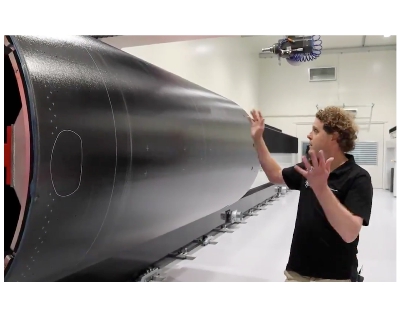
The newly installed, custom-built, 140 square-meter (1,500-square-foot) robot—now being used in the firm’s New Zealand manufacturing facility—enables the precision machining of Electron’s carbon-composite structures.
It takes just 12 hours to complete all marking, cutting, drilling, milling, and sanding on a full vehicle, the company said.
Electron Rocket
“We can produce one launch vehicle in this machine every 12 hours,” said Beck, during a recent video presentation of Rosie.
“Raw materials come in; rocket comes out in a matter of hours. Every bit of marking, every bit of machining, every bit of drilling—all the operations that you can imagine,” Beck said.
It’s not the only investment in infrastructure that the company is making.
The company has also upgraded facilities on the other side of the country to allow its first launch from U.S. soil next year, when an Electron is scheduled to take off from Wallops Island, Va.
The 13-year-old company is aiming to launch one of its Electron rockets every week as early as 2021, and the price per launch starts round $7.5 million.
Weights of the payloads it launches into space range up to nearly 500 pounds.
Its best known private sector competitor, Elon Musk’s SpaceX in Hawthorne, can send some 50,000 pounds of payload into low Earth orbit via its much larger Falcon 9 rocket. It’s designed for crew and cargo vehicles, while Rocket Lab’s uses are strictly for a small-satellite payload.
In addition to satellites that orbit Earth, Rocket Lab is looking to send small satellites into lunar orbit or to conduct fly-bys of the moon for paying customers.
“A machine like this didn’t exist in the market, so we custom-built one that’s big enough to park a bus in,” said Rocket Lab’s Director of Production, Jamie France. “It means building a rocket stage takes hours, not weeks or months.”
The cost of developing the robot hasn’t been disclosed.
500 Employees
Work toward a reusable first stage for Electron is also underway, with Rocket Lab’s next mission featuring an upgraded booster to support recovery efforts. The launch window for the next mission, named “Running Out of Fingers,” is scheduled to open this week.
Rosie is automating machining tasks, but human hands are still in high demand on the manufacturing teams at Rocket Lab’s Huntington Beach headquarters and the company’s Production Complex in Auckland. More than 100 jobs across manufacturing, test, and design are being recruited into the company over the next 12 months.
The company has a total of about 500 employees at its Huntington Beach headquarters and its locations in Virginia and New Zealand.
The company is considered a “unicorn,” which is Silicon Valley lingo for a private startup company with a value of $1 billion or more, thanks to a $140 million round of funding last year. It’s one of the largest funding deals in OC the past few years.
Rocket Lab’s financial backers include Data Collective, Khosla, Bessemer, Promos, and Lockheed Martin.