

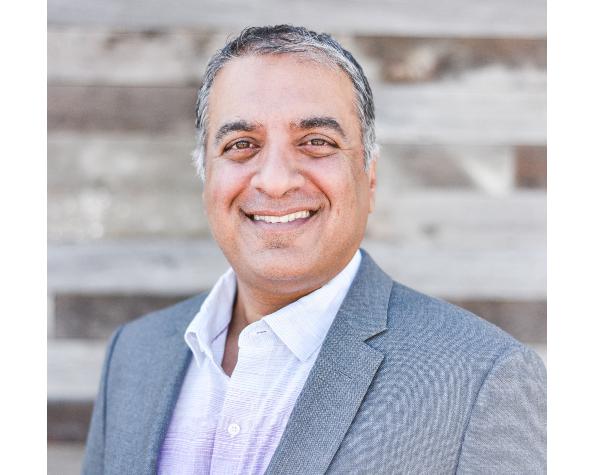
Editor’s Note: Rajeev Kapur is CEO of 1105 Media Inc., an Orange County-based provider of B2B media and marketing services with more than 100 employees. What follows are excerpts from his book: “Chase Greatness; Enlightened Leadership for the Next Generation of Disruption,” which last November hit No. 1 on Amazon categories for Business Leadership and Business Culture. Kapur is one of the nominees for the Business Journal’s Excellence in Entrepreneurship Awards. Nominee bios begin on page 44.
Michael Dell, CEO and chairman at Dell Technologies, was especially important to my early career. When I was working at Gateway Computers (you may remember their boxes decorated with the spots of a Holstein cow), I met some people from Dell at a convention. After we talked a little, they said they’d be interested in hiring me if I ever wanted to leave Gateway.
When I didn’t get a response after a month, I sent my resume directly to Michael Dell himself … I got an answer and the offer I wanted within three days.
I didn’t let anybody at Gateway know I was leaving for Dell, because there was a noncompete clause in my contract—but since I was working at Gateway in South Dakota and Dell’s headquarters was located in Austin, Texas, I knew those kinds of clauses didn’t hold up in the Lone Star State.
But the blowback came anyway. When Gateway found out I had jumped ship to Dell, they raised a big stink, to the point where they tried to get Dell to fire me. Luckily, Dell decided I was worth paying a settlement, so I got to stay. Not only that, but it put me on the radar of upper management at my new company.
The Winning Gambit
A couple of months after that whole mess, I was sitting at my desk when I felt the presence of someone standing behind me. I turned—and saw Michael Dell staring down at me.
“Hey, are you the Gateway guy?” he asked.
“Yeah.”
“Do you mind coming into my office for a few minutes?”
“No, not at all.”
What was I going to say?
At the time, Gateway was beating the pants off Dell, and Michael wanted my input on a strategy to surpass them. I was to report directly to him while I worked on this project. We found our opening by marketing directly to small and medium-sized businesses instead of Fortune 500 companies (hard to believe no one had thought of that gambit before that time). That created a whole new massive market for our products that up until then had been largely ignored—allowing us to hit a home run by capitalizing on that opportunity
My reputation rose, and I was asked to help launch the first Dell.com e-commerce site. Then I became director of West Coast sales for Dell’s Medium Business (MB) division and built over a billion dollars of revenue with my team.
So, yes, Michael Dell was an important influence in my life and my outlook on leadership—he remains so today. And my respect for him rose even further when I saw how he reacted to the pandemic.
The China Experience
Back in the 1990s, I had brought in, with the help of my team, over a billion dollars of revenue for Dell … Frankly, I thought I was hot sh*t.
In 2000 when Dell sent me to China to help turn around their sales in that mammoth country, I had the biggest eye-opening experience of my life. I went there pounding my chest like I was King Kong, ready to dominate their burgeoning computer market. After all, Michael Dell had asked me to go there himself because the existing team there was struggling.
I totally ignored the fact that I was in a completely different culture that did business in a completely different way. I wanted to do it MY way. I was convinced I only had to use the Dell model as I had in America and China would soon be buying billions of dollars of product from my company.
You want to know how bad employee disengagement can get? Here’s how bad. I’d be in meetings and some of the locals who worked for us would start talking Mandarin to each other.
What were they saying? I had no idea. And when I found out, I wasn’t pleased. They were telling each other to simply nod and go along with whatever I said, encouraging everyone to patronize me by saying things like, “Just play along with the guy, then we’ll go out and do things the way we want to do them.”
In other words, my employees actually disengaged me. After six months of misery, I was getting nowhere and I knew I was in trouble. I finally realized it was ridiculous to try and make an entire country conform to me, a complete outsider.
Adapting a Hybrid Model
The people working for me in China hadn’t cared about what I had to say because I didn’t care what they had to say. I had no idea how to sell effectively in China—but they did because they were an actual part of that country’s culture.
I decided we had to modify the Dell culture, one tailored to Chinese culture that would connect with its people, not push them away. This culture had to be a hybrid of the best of what worked in the U.S. and the best of what it took to be successful in China.
As a starting point, I promoted two people to be the face of this new hybrid culture. They would be local and they would speak Mandarin, so they had credibility with potential customers. They also obviously had to understand the Dell operation and adapt it to China. Finally, they needed to be fluent in English and understand Western culture because they would be interfacing with me as
well as management back in the States.
I identified the two people I believed fit these requirements and I made sure one of them was a woman. I told them, “We have to make some progress here, but we can’t do it if I’m the face of the effort. You two have to represent us here because they will trust and respect you, not me.”
From there, I did something that was new for me as a leader in China—I got out of their way. I worked things behind the scenes while they went to the front lines with their sales teams. They started implementing the things we needed to implement, and pretty soon, we saw the needle move.
Because I eventually succeeded in China, Dell soon assigned me the task of helping to turn around their operations in Singapore, Malaysia, Thailand, Indonesia, Philippines, India and Taiwan.
Each of these countries had their own cultures and challenges, and I had to tailor our approach to each one—or I might once again have people talking trash about me in another language.
