

Life hasn’t changed much for Ingram Micro Inc. since it was taken private a year ago for $6 billion by Chinese conglomerate Tianjin Tianhai Investment Co.
Sure, the world’s largest distributor of technology products no longer has to meet with Wall Street analysts, though it still must file public quarterly reports to appease lenders.
Its quarterly shareholder meetings now consist more of global strategy sessions between parent HNA Group, a Hainan-based Fortune Global 500 company with major operations in aviation, tourism and logistics, and the leaders of HNA’s diversified portfolio of companies.
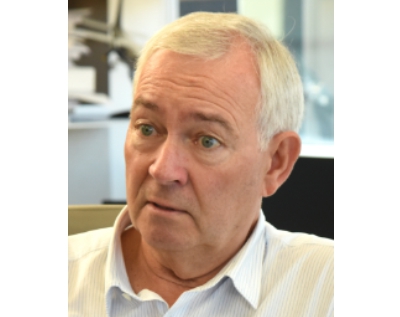
“They are not involved in the day-to-day management of the company. That is something we had agreed to,” Ingram Chief Executive Alain Monie told the Business Journal in a wide-ranging 40-minute interview at his glass-framed office at Park Place in Irvine. “We’re running the business the exact same way.”
Monie was tapped six years ago to succeed Greg Spierkel in the top post.
In a February 2012 sit-down with the Business Journal, he identified several key areas for improvement, most notably boosting productivity to grow sales and margins for high-volume business lines; expand higher-margin specialty businesses; and continue investments in innovation.
Check, check and check.
Ingram Micro at the close of the third quarter was on pace to beat its 2016 performance when it posted revenue of $42 billion and net income of $100 million.
The company through the first nine months of last year posted sales of $32.8 billion, up 10.7% from the same period in 2016, and net income of $143.3 million, up 6.1%.
Its fourth quarter and year-end financials will be released next month.
The distributor enters the year as Orange County’s 14th largest foreign-owned company, with 900 local employees (see list, page 15) and is, by a longshot and by dint of being a distributor, the biggest revenue generator here.
Since its inception in 1979, Ingram has never been big on publicity, shying away from branding and marketing campaigns.
It hummed along for decades without much investor dissent and was lightly tracked by analysts in an unsexy segment in tech.
The sale to Tianjin rewarded those investors; the price of $38.90 per share was about a 30% premium when announced in February 2016. It closed in December.
“We’re the largest company nobody knows about,” Monie said with a laugh. “We’ve never been very noisy.”
Monie has shifted the company significantly during his tenure, diversifying into the booming segment of cloud computing and cybersecurity, while charting a path in global expansion and acquiring new services—three newer tenets in his strategy to combat a business of razor-thin profits.
Last year’s buy of Dubai-based Network Information Technology on undisclosed terms checked several of those boxes. NIT distributes security products in the Middle East and Africa, where Ingram has carved out substantial business in the past few years.
Its first acquisition in that part of the world came in 2012 when it acquired certain IT business units of Aptec Holdings Ltd. in Dubai on undisclosed terms. The buy at the time added about $250 million in annual revenue and some 3,800 resellers in a fast-growing market with high-margin opportunities.
“We’re up to a $1 billion now and very profitable,” Monie said. “We’ve built a new region.”
It’s one built on value-added services, particularly in cybersecurity, and not volume.
The company bolstered its position on the cyber front with its December purchase on undisclosed terms of San Jose-based Cloud Harmonics, a value-added reseller for U.S. and Canadian markets.
Ingram said the buy will bring it new education, training and technical services, along with relationships with new and emerging security vendors. Cloud Harmonics employs about 50.
“Cybersecurity is a huge issue everywhere,” Monie said.
In late May the European Union will enact one of the most stringent data-protection laws in the world, requiring businesses to provide transparency and meet several data-gathering consent guidelines, or face stiff financial penalties.
“It’s a big undertaking for everybody, especially since it’s not clear how it’s going to work,” Monie said.
The Cloud Harmonics deal marked the 30th acquisition for Monie since he took the helm.
“We continue to look at acquisitions. Right now we have three or four in the hopper,” he said.
Cloud Lift
Monie placed big bets on cloud services and to a lesser extent e-commerce, or product life cycle services.
Those wagers are starting to pay off.
The company is now Microsoft Corp.’s largest cloud-service reseller and recently passed two million users on its cloud platform. But challenges reign amid a global expansion that requires a local presence for billing and attracting as many vendors as possible with offerings to sell to Ingram’s tens of thousands of resellers.
Ingram’s cloud service is built on technology acquired in late 2015 from Seattle-based Parallel Holdings Ltd., an Intel Capital portfolio company. The software allows Ingram to orchestrate multiple cloud services to multiple providers, acting as an automated traffic control tower, of sorts.
The company is also selling the software outright to telecommunications companies, web hosting providers and other large corporations. Annual revenue in the new line of business is $250 million to $300 million, “but it’s much more meaningful than gross revenue in a distribution business,” according to Monie. “All of a sudden we are selling software, which is an interesting proposition.”
It’s eyeing China as its next big launch market, a development fueled under the umbrella of HNA. Only companies or joint ventures in China can offer cloud services to the world’s most populous nation.
The China cloud service, a completely autonomous unit from Ingram, began beta tests last month for a potential March roll-out.
Beyond IT
A new e-commerce engine under development for more than a year at its Irvine headquarters could push the company further from its IT roots.
The software, built on technology gained from its 2013 acquisition of San Jose-based Shipwire Inc., allows Ingram to connect hardware vendors in warehouses worldwide to online marketplaces.
The service, scheduled to roll out midyear, is targeting small vendors that want to expand their reach through Ingram’s vast customer base.
If the vendor doesn’t have the infrastructure to fulfill orders, Ingram can supply that service, as well.
The offering opens up new segments for Ingram, such as office supplies and apparel.
“That takes us completely outside of IT,” Monie said. “The retailer can sell anything.”
