
Wireless infrastructure firm Mobilitie LLC expects an ambitious telecommunications project it is working on for the Bay Area’s main public transportation system will lead to similar undertakings elsewhere in the U.S. and overseas.
The Newport Beach-based company is investing more than $100 million to make the San Francisco area’s 5G cell phone and Wi-Fi coverage the “gold standard” for the subway and local rail riders, with the payback coming in the form of a long-term revenue-sharing arrangement, according to Chief Executive Christos Karmis.
Some 120 million travelers every year travel on the Bay Area Rapid Transit (BART) system, which connects the San Francisco Peninsula with Berkeley, Oakland, Fremont, and other cities in the East Bay 121 miles of rail tracks.
BART is buying 775 new rail cars for its system, called the “Fleet of the Future.”
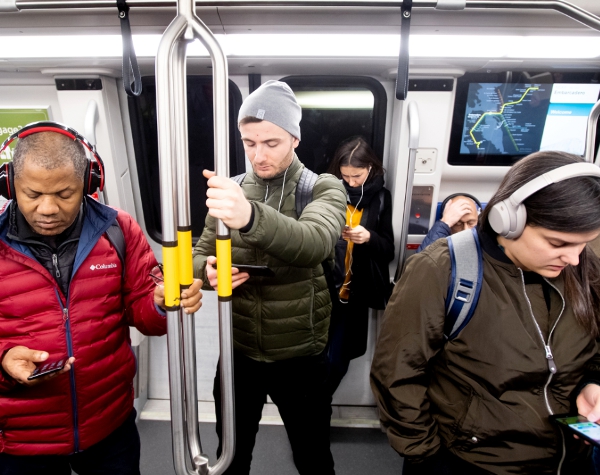
Mobilitie’s new system will make sure riders stay connected to their phones while they’re underground and in transit in those cars, as well as in the stations themselves.
The multi-year project plan also includes Mobilitie providing coverage on the city of San Francisco’s local transit system, which is commonly referred to as Muni.
“When we get done with this, it will be the most advanced wireless system in the transportation industry in the country, probably in the world,” Karmis told the Business Journal.
“We would look at this as a great project that we would expect will also lead to additional projects as well,” in both the U.S. and abroad, he said.
“We already have qualifications and are active in the transportation and government industries.”
The system, approved a month ago, will include Wi-Fi and Bluetooth wireless technology in all BART stations, and extend wireless services into the system’s new train cars.
It’s one of the more prominent 5G-related contract wins of late for Mobilitie, the largest privately held U.S. telecommunications infrastructure company.
Company executives expect more to come.
In the next five to 10 years, 5G-related work will result in the “greatest investment in wireless infrastructure we’ve ever had,” Gary Jabara, founder and chairman of Mobilitie, told the Business Journal in November.
Mobilitie deploys and operates a variety of next-gen infrastructure for wireless carriers and owners of large properties where cellphone usage can be heavy, such as sporting arenas, office towers and casinos.
Its portfolio of cellphone towers and small-cell towers runs into the thousands.
Faster Bandwidth
The fifth generation of cellular wireless technology, also known as 5G, is currently being deployed and designed to give high-bandwidth connectivity up to 100 times faster than current 4G LTE connections.
Despite the Bay Area’s tech-focused economy, wireless connections on BART trains has been spotty at best to date. That’s set to change, Karmis said.
“As people are spending proportionately more time on the trains, they’ll have much better connectivity while they’re there,” Karmis said.
The four-stage BART project could take up to four years for 100% completion, Karmis said. He is aiming for an earlier time frame and said it’s “more than likely we’ll be in the one- to three-year deployment period” with all stages being built in parallel.
“Different segments will come online at different times,” he said. It is a “massive deployment.”
The first stage will add cellular service to three Muni tunnels for the local San Francisco transit system, according to BART.
BART has a contract with Bombardier, which is building the cars ready for Wi-Fi, which is provided by Mobilitie.
“People will have ubiquitous coverage from the time they walk into a BART station,” Karmis said. “They can get on the train system, go through the tunnels, go through any of the stations when they change trains, and will stay connected until they leave the station.”
Revenue-Sharing
Mobilitie will enter into a revenue-sharing arrangement with BART for the project, which also includes a large fiber network along certain BART and local San Francisco rail rights-of-way, he said.
“We expect to generate several hundred million dollars across the network by providing wireless services not just to the wireless carriers, but also to cable and telecommunications companies as well as to large enterprises,” Karmis said.
The deal will allow Mobilitie to install fiber services throughout the entire region, and connect the fiber backbone into multiple data centers.
BART says it expects the system will generate more than $243.1 million in revenue over 20 years, and the initial 20-year term of the licensing agreement can be extended to up to 30 years.
Mobilitie Revenue
Communications in other urban U.S. transit systems leave a lot to be desired.
“Most of the transit systems in the country do not have good connectivity,” Karmis said, noting “there’s not a robust 5G network” in the Los Angeles transit system, for example.
On the other hand, “We did Seattle Sound Transit, where we installed a system there. They have a great network.”
It started work at the Seattle system—which serves some 24 million riders annually in the Puget Sound area—in 2017.
Mobilitie’s infrastructure is often in settings with many wireless users in a relatively small area such as stadiums, malls, casinos, large office buildings—places it calls “the largest and most complex venues” for providing service.
Late last year, Mobilitie was selected to design and deploy a custom network for downtown Los Angeles landmark U.S. Bank Tower.
According to the company’s website, other wireless projects include systems for Toyota Park in suburban Chicago, Tacoma Dome and Greater Tacoma Convention Center, and the national 9/11 Memorial & Museum in New York.
The company in August said it had reached a $1 billion “exclusive arrangement with a foreign investment fund to fuel the next five years of growth around 5G infrastructure.” The name of the fund wasn’t disclosed.