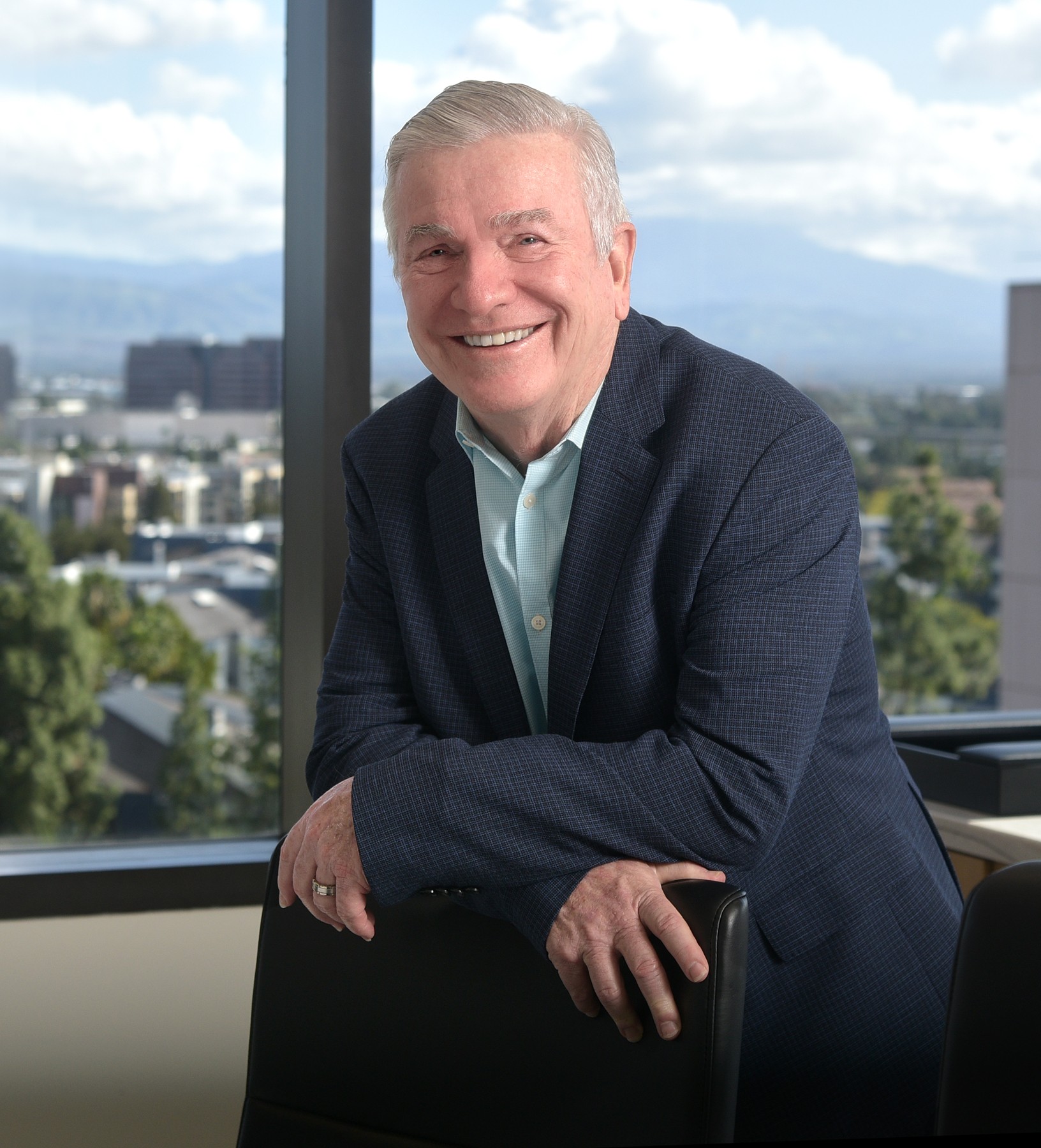
Ninety-year-old Vernon L. Smith likes to watch college kids play games.
Mind you, not just football or basketball games. There are also economics games.
In one, Chapman University students are given shares that pay dividends over 15 periods. The students are able to bid the share prices up or down. If they hold the shares to the end, they will earn a small amount of cash.
Like many market participants, the students start ignoring fundamentals, get excited about rising prices, and keep bidding them up to as much as double the actual values.
“When I ask them if the shares are over-valued, they say yes,” recalled Smith. “They believe they’ll be able to sense when to get out ahead of the others. Then they’re surprised at how fast it comes down.”
Smith chuckled with delight, sounding a little like Jimmy Stewart, at the fact he’s still able to teach undergraduate English majors about the perils of auctions and bubbles. It’s part of his latest endeavor to create a new field—humanomics—a combination of English and economics.
If there’s anyone who can start a new college field, it’s Smith, who’s often considered the father of experimental economics.
You read that right. Before Smith came along in the 1950s, economics was a field where it was considered difficult to conduct rigorous experiments. His research became so respected that he won the Nobel Prize in Economics in 2002.
“Vernon’s pioneering work in experimental economics demonstrates that bubbles and crashes are deeply rooted in human psychology and that the rational investor so often assumed in finance theory is a fiction,” said Rob Arnott, founder of Newport Beach-based Research Affiliates LLC, which manages or advises $179 billion in assets.
Arnott considers Smith a friend and invites him to speak at his company’s seminars.
“Most of economics postulates a world populated by homo economicus—rational people operating singularly on objective logic and sheer intellect, which is completely at odds with common sense,” Arnott said. “Vernon takes great delight in exploring unintended consequences, which are often ignored in the political economy.”
Last week, University of Chicago Professor Richard Thaler won the Nobel in economics for similar work that draws on psychological insights to understand irrational choices people make.
Kansas Boy
During the course of a two-hour interview at his office in the center of Chapman in Orange, Smith discussed economic games; his favorite metrics for gauging the economy; tax policy; and where he invests his money.
His conversation quickly veered to topics such as innovation, even in dire economies. He casually discussed a little-known fact that the aviation industry blossomed in his hometown of Wichita in the 1930s with manufacturers like Stearman, Cessna and Beech, because a local retailer liked investing in new fields.
“Even though it was the depth of the depression, you had innovation going on,” Smith said.
Born in Kansas in 1927, Smith recalled attending a one-room school house on the prairie and growing up on a farm that the family lost during the Great Depression.
“Anyone from that period would have had similar experiences, just like mine,” Smith said.
300 Papers
Smith obviously wasn’t like a lot of other people. Along the way, he earned an undergraduate degree in electrical engineering from the California Institute of Technology, a master’s in economics from the University of Kansas, and a doctorate in economics from Harvard. He’s taught at many major universities, including Purdue, Arizona, Stanford and Brown.
Among his many awards are centers named after him at universities in Illinois, Shanghai and Guatemala. He’s on the board of many economic publications, a founder of the International Foundation for Research in Experimental Economics, and a senior fellow at the Cato Institute in Washington, D.C.
He’s published about 300 scientific papers and a dozen books, including one in 2014 on housing bubbles.
Smith is optimistic about the current economy, predicting it will grow about 3% and believes it’s capable of 4% annual growth. To track a possible downturn, one of his favorite leading metrics is new housing expenditures, which fell before 11 of the 16 most recent recessions, he said.
Raised a Unitarian, he’s become more religious in the past decade and nowadays attends St. John’s Lutheran Church of Orange. He’s writing a new article on religion and science about the mysteries of existence.
“There is stuff in quantum mechanics that is really spooky,” he said.
Private Freeways?
Smith is a lover of the Western lifestyle, with paintings of cowboys adorning his office. He maintains a home in Tucson that he likes to visit in the summertime because of monsoon rains and the “spectacular thunderstorms.”
His ideas wouldn’t go over well in current California politics, such as saying the Ronald Reagan tax cuts worked and how high tax rates inhibit investments.
His theories have changed markets; he advised Australia and New Zealand when they deregulated their electricity markets about a dozen years ago, moves he said have gone well.
In a June article on the Wall Street Journal’s op-ed page, he proposed privatizing the nation’s freeway system.
“If you sold off the highway system, they’d go right away to tolls. There would be innovation all over the place,” he said. Although he was contacted by a Trump administration official, Smith is doubtful it will occur.
He also suggested California would do well with a water market, which would bring together representatives of cities, agriculture and environmentalists.
“Let the environmentalists trade water. It might change their views,” he said. “Let them raise money from private donors to influence how they think water should be used rather than having the government force it on all of us through legislation.”
Smith is an investor himself, betting about a third of his net worth on publicly traded biotech companies investigating promising drugs or therapies in big patient pools, such as Alzheimer’s disease and stroke. He sees initial public offerings as a good way to track the future direction of businesses.
The Economic Narrative
It’s been a decade since Chapman lured him and his colleagues away from George Mason University and the University of Minnesota (see separate articles). Chapman began the Economic Science Institute, which hosts workshops for local high school and graduate students from around the world.
Last year, the university opened the Smith Institute for Political Economy and Philosophy, named after both Vernon Smith and the famous Scottish economist Adam Smith. The institute received $15 million in gifts, including $5 million from the Charles Koch Foundation.
It’s promoting humanomics, which is currently a minor degree at Chapman. The goal is for writers to describe economics with a narrative and drama just as it was in 18th-century Scotland when Adam Smith wrote his classic “The Wealth of Nations.”
Smith pointed to other classic works that contain economic theories, such as Daniel Defoe’s “Robinson Crusoe,” which tells the tale of a man surviving on an island with the resources on hand.
Smith said writers on the 2008 financial crisis could have borrowed Shakespeare’s lines on lenders and borrowers. He quoted Shakespeare’s famous line in Hamlet: “Neither a borrower nor a lender be; for loan oft loses both itself and friend.”
Smith smiled, “That’s a powerful thing. It brings back the housing mortgage crash.”
But aren’t English majors afraid of economics and economists dismissive of narratives? Smith chuckled again in that Jimmy Stewart sort of way.
“We want to change that. We think good English programs should understand economics.”