

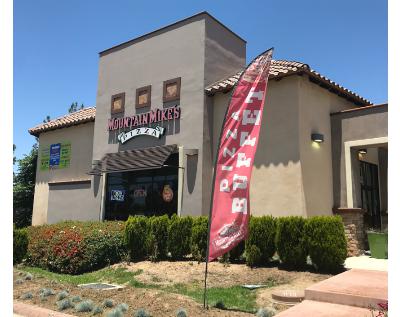
Newport Beach private equity investors that bought two franchises in 11 months are on the hunt for more.
Britt Private Capital LLC and Jupiter Holdings LLC led acquisitions of Oakland-based Mountain Mike’s Pizza in April 2017 and Irvine-based Juice It Up in March.
Mountain Mike’s moved to 24 Corporate Plaza; Juice It Up kept its Sky Park Circle address.
Both buys are restaurant operators, but Chris Britt and Edmond St. Geme, founders, respectively, of the private equity firms, aren’t just food aggressive. The focus is franchising.
“Food is not the only space,” they intend to buy in, Britt said.
He’s been managing partner with Matt Witte of Newport Beach-based Marwit Capital LLC since 1994; Witte’s brother Bill leads developer Related Cos. Marwit owned Irvine-based Boot Barn Holdings Inc., and Britt was its chairman from 2007 to 2011, when Marwit sold it to Los Angeles-based Freeman Spogli & Co., which took the Western-wear chain public in October 2014.
St. Geme has “$1 billion of discretionary institutional capital” in backing, its website says. For 10 years Jupiter and Marwit owned Fire Grill LLC, a 43-unit Burger King Midwest cluster, and invest in real estate and public companies.
Each deal has a third investor.
The Mountain Mike’s buy was backed by L.A.-based Levine Leichtman Capital Partners; Britt worked there prior to Marwit. It’s held stakes in restaurant chains, including Cici’s Pizza, Quizno’s Subs, Wetzel’s Pretzels and Nothing Bundt Cakes.
Dover Shores Capital LLC in Newport Beach joined the Juice It Up acquisition—“It’s three guys who wanted to do a deal together,” Britt said—and its founder, Chris Braun, is the chain’s chief executive. He also advises cold-brew coffee maker KonaRed Corp. in San Clemente and specialty olives importer Dotta Foods LLC in L.A.
College Chums
Britt and St. Geme interacted collegially at Stanford, acquaintances by virtue of their passion for sports—the former on the diamond, the latter on the gridiron—and both majored in economics.
Britt says their “claim to fame” is both played with John Elway, the Denver Broncos Hall of Fame quarterback and now its executive vice president of football operations, who played baseball and football for the Cardinal. Britt also played against MLB greats Randy Johnson, Barry Bonds, and Mark McGwire, and in the College World Series in 1983.
St. Geme was a multiyear starter at defensive back for Stanford and in the summer of 1985 an undrafted free agent who tried out with the Los Angeles Rams. He didn’t make the team but “was damn good,” Britt said. The Rams got Fridged in the conference championship, losing to eventual Super Bowl champs Chicago Bears in the “Super Bowl Shuffle” season under Mike Ditka.
Britt and St. Geme ate at the first Mountain Mike’s in Palo Alto, now a Starbucks.
Both graduated in the class of 1984; Britt added a UCLA MBA a few years later.
Pizza Men
Chris grew up in Fullerton. He and his wife, Frances, have three kids. Ed grew up in L.A. He and his wife, Ceci, have six kids.
They’ve worked together on and off for several years, linking up on the Burger King deal, for instance. Marwit was slowing its pace—its four portfolio companies left, including Promax Nutrition Corp., which makes protein bars—and Britt formed his firm early last year.
The Mountain Mike’s acquisition came in April on undisclosed terms.
The new company, Mountain Mike’s Pizza LLC, debuted on the Business Journal’s restaurant list last week at No. 14 with systemwide sales of $156 million and 193 locations at the end of last year. Franchise documents filed with the state show revenue of $8.5 million and net income of $3 million for the eight months of 2017 the new investor group owned it.
Restaurant chain sales multiples are generally three to 10 times earnings, excluding big deals that are often outliers, suggesting a purchase price for Mountain Mike’s nearing $30 million, depending on its upside.
Order In
Churchill might say Mountain Mike’s is humble for good reason.
The chain was founded in 1978. Its 40 years of wilderness wandering have included several sales, corporate moves, strategy shifts, legal imbroglios, and a bankruptcy.
The Sacramento Business Journal reported its 1997 sale to a bulletin board-traded New York-based submarine sandwich chain, Jreck Subs Group Inc. It said Mountain Mike’s, owned at the time by Quality Franchise Systems Inc., had 83 sites in California, Arizona, Oregon, Nevada and Colorado and pegged annual sales at $30 million, with the buyer’s given as $15 million.
It cited Mountain Mike’s founding focus on small towns—“We have a lot of stores in little burgs,” Chief Executive Brad Gordon said—its bankruptcy and its purchase out of it in 1991 by San Diego businessman Blaine Quick.
Down Time
Jreck, then led by Chief Executive Christopher Swartz, had about 275 locations and planned to dual-brand some sub shops with Mountain Mike’s pizza.
Swartz at some point moved his headquarters to Longwood, Fla., according to an Orlando Sentinel article on the May 2000 sale of Mountain Mike’s to Concept Acquisition LLC in Lake Mary, Fla., for $4 million, including debt.
Jreck, with a dozen chains in 11 states, changed its name to Ultimate Franchise Systems Inc. to be a “consolidator of strong regional franchise systems,” the company told the Sentinel.
Swartz was sentenced last year in Utica, N.Y., to 12 years in prison on fraud charges and ordered to pay $25 million in restitution and back taxes. According to its website Jreck, founded in 1969 by five guys—schoolteacher buddies—is again based where it started, in Watertown, N.Y. It has 35 locations.
Order Up
Concept Acquisition doubled Mountain Mike locations to 180 in 15 years; the chain’s 2016 annual sales were $130 million, up 10%, said a restaurant trade journal—listing the chain’s headquarters as Hayward.
Nearly all of its locations are north of here.
Of 193 locations at the end of 2017, “181 are between Chico and Bakersfield,” Britt said, “seven in San Diego and the Inland Empire; four out-of-state—two in Nevada; one each in Oregon and Utah.” The OC location is in Lake Forest. Two others nearby have closed in the last year. A location in La Habra closed in the last year. A location in Buena Park was involved in a spat with Concept Acquisition—it allegedly continued to use the Mountain Mike’s name after leaving the system, and the franchiser sued owner David Norfolk last year in the Central District Court of California a month before selling to Britt and St. Geme.
Britt said Mountain Mike’s will hit 195 locations this month and have 208 open by year-end.
Secret Sauce
Finance guys don’t own rose-colored glasses—the flecks of financial red sauce blocking mountain vistas were found by Britt & St. Geme during due diligence. Irell & Manella in Newport Beach represented the duo on the deal.
Levine Leichtman’s lawyers were Honigman Miller Schwartz and Cohn LLP, based in Detroit.
Fast casual gets the attention in the wider food world—Chipotle’s moving to Newport Beach, too—as the pizza category goes large for delivery and digital—Ann Arbor, Mich.-based Domino’s Pizza Inc. is said to be more a tech company than a pizza parlor.
Britt & St. Geme see opportunity in the dearth of locations south of the Grapevine. They see 50 Southern California sites in five years, let alone the Southwest U.S.
“There are 75,000 pizzerias in the U.S.,” Britt said. “60% are independents.”
The big four— Domino’s, Pizza Hut, Little Caesar’s and Papa John’s—total some 25,000 of the rest, so the partners see a chance for their brand’s growth from just 200.
Mountain Mike’s locations “co-exist” with the big chains in “daily needs” strip centers—those anchored by grocery stores, say—and have a different focus.
Family Fare
A brand born in the 1970s remembers sawdust-on-the-floor family pizza joints like Straw Hat, where youth sports teams came after games and families had a night out.
Mountain Mike’s are “family-centric with a community feel,” Britt said.
St. Geme said the mountain theme should play well in the West.
They aim for a one-third split among delivery, carryout and dine-in business and a chance to increase social media efforts and online orders to drive sales. The partners call pizza “noncyclical”—fun in boom times, frugal in lean.
“People gotta eat,” Britt said.
Locations are about 2,500 square feet to 3,500 square feet in neighborhoods with “scores of Little League and soccer fields,” Britt said, favoring “mid-market strip centers.”
While Mountain Mike’s former small-town focus is long past, “We definitely are looking at North Orange County … along with some pockets of South County, including Irvine and Aliso.”
The Juice
Juice It Up is owned under SJB Brands LLC.
The juice and smoothie chain has overcome woes of its own, its fortunes soured following the 2008 recession.
Seller Frank Easterbrook had turned the chain around and, Britt said, was ready to slow down a bit.
“He gave it a sound foundation, but we have more risk-tolerance” for a big growth push.
The chain’s $34 million in annual sales puts it at No. 31 on the restaurant list; it has 88 locations; adding those in the works take the total above 100, most in California, along with New Mexico, Oregon, Texas and Florida.
Industry sources suggest the top end of its price range at about $15 million.
Irell again repped the buyers on the transaction.
Franchise Family
Mountain Mike’s franchisees pay $30,000 for the first unit and $15,000 each for additional ones. Royalties are 5% of sales; marketing and advertising 3%; Juice It Up is $25,000; royalties 6%; marketing and advertising 2%.
Upside at either chain involves “growth outside of California” and current markets, said Jeff McNeal, president of restaurant and hospitality consultant Fessel International Inc. in Monrovia. Each has “huge franchise potential.”
Kevin Burke, co-founder and managing partner of investment banker Trinity Capital LLC in L.A. said real estate costs hinder growth of chains with lower average unit volumes: Juice It Up stores gross about $360,000, for instance, though Burke likes its chances in a niche with “strong regional players but no one dominant.”
Mountain Mike’s average unit volume is $820,000, midpack for pizza chains.
Britt and St. Geme said they believe they can take Mountain Mike’s to $1 million AUV and at least 300 units open in four to five years—a doubling of its systemwide sales.
Juice It Up is “looking at noncore” food offerings, such as grab-and-go snacks. It recently introduced a vital protein “blue bowl” menu item and a peanut butter and mocha smoothie made with cold-brewed coffee.
The partners say a 50% increase in AUVs and doubling the unit count—roughly a tripling of systemwide sales—is doable in four to five years.
