

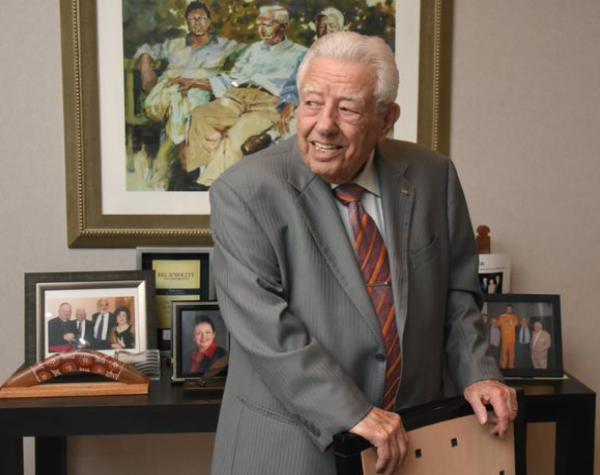
Sebastian Paul Musco, who began Santa Ana-based Gemini Industries and donated tens of millions of dollars to various causes in Orange County, died Sept. 18 of heart failure. He was 95.
He leaves behind one of OC’s biggest legacies.
“As one of Southern California’s most successful entrepreneurs and leading philanthropists, Paul’s (and his wife Marybelle’s) impact is beyond measure,” said Parker Kennedy, who is chairman of the board of trustees of Chapman University, as well as chairman of First American Financial Corp. (NYSE: FAF).
Musco, known for wearing a suit and tie every day and being chauffeured in a Rolls-Royce, was a frequent sight at local performing arts events, philanthropic gatherings, and Italian restaurants, such as Newport Beach’s Il Barone, Santa Ana’s Antonello and Irvine’s Bistango.
He was a financial backer for area charities and arts centers, as well as some of his favorite restaurants.
Musco, who had nine stents, had chest pains at a recent lunch and then went to Hoag Memorial Hospital Presbyterian, where he died the following day, his close friend Frank Di Bella said. Di Bella met Musco 30 years ago as a certified public accountant of Musco’s books.
“He had a heart of gold,” Di Bella told the Business Journal. “He donated to everybody.”
Son of a Janitor
Born in Providence, R.I., he was one of 10 children of Sicilian immigrants. His father, Carmelo, worked as a school janitor for 35 years. His mother, Lucia, forced their children to listen to the Metropolitan Opera every morning, instilling a life-long love of opera.
They taught him the value of tithing and a work ethic.
“They always gave,” Musco recalled in a prior interview with the Business Journal. His parents “never let us know we were poor.”
He didn’t graduate from high school because the 16-year-old at the time was busy lying about his age to enlist in the Navy during World War II. His mother caught him at the enlistment office the first three times.
“I wanted to see the world,” he said. “I was all over the Pacific.”
After the Navy, he got an office job at a manufacturer that worked in metals processing, ultimately supervising 200 salespeople. Before long, he said to his boss, “I want to fire a hundred and double the salaries of the others.”
The boss sent him to a troubled facility in Skokie, Ill. Musco fixed the plant, but when his reward was just a few shares of stock when the parent company went public, another character trait kicked in: He grabbed fellow arts lover Marybelle and the pair headed west.
Gemini Start
In 1974, he started Gemini Industries, so-named because he had a twin brother. He capitalized the enterprise with a $500,000 loan from the Small Business Administration, bringing no business plan but more than a little experience in the precious metals reclamation business.
Musco ultimately bought out his two partners, becoming the sole owner of the company along with Marybelle.
Gemini started out recovering precious group metals, most notably platinum, but also palladium, aluminum and iridium, from the spent catalysts carmakers deployed in catalytic converters to reduce pollution.
Recovering precious metals from spent catalytic converters would become a crowded business, so Musco switched to oil and chemical companies. Companies like ExxonMobil Corp. use giant tubes of platinum to refine crude oil. Gemini, with a factory in nearby Caldwell, Texas, reclaimed pure platinum from the catalysts.
“We’re the biggest platinum mine in the world, and we don’t produce anything,” Musco said.
The Caldwell plant, which does business as Zodiac Enterprises LLC, was highly profitable, he said.
A byproduct at its Santa Ana factory is liquid alum, which it sold to clients like the Los Angeles Department of Water and Power to purify drinking water.
“This metals stuff—it’s pretty low tech,” Musco laughed.
He had no advertising budget.
“There are 10 big oil companies that do 90% of the business in the world,” Musco said. “They know who we are.”
Even in his 90s, Musco would continue to work at his office.
He started winding down his affairs during the pandemic, selling Gemini and its Texas-based affiliate, Zodiac Enterprises, with the condition of full employment for their roughly 100 employees.
“Paul was a true gentleman, a term that sometimes today is thrown around too loosely,” recalled Jim Mazzo, a longtime executive in Orange County’s ophthalmology industry, who along with Musco served on Chapman University’s board of trustees.
“A gentleman is one that cares, shows respect, has a huge heart and is always thinking of the other individual. Paul exemplified all those characteristics,” Mazzo said.
“I can’t think of any time I didn’t see Paul without at least a sports jacket or a tie—a sign of respect for the community that he helped support.”
Donations Galore
Famously low-key, Musco has been quoted as saying he worked so hard to make so much “so I could give it all away.”
Musco has long enjoyed giving to groups like PBS SoCal, the Orange County School of the Arts and City of Hope.
“Many people are successful, but only a few are as generous in sharing their success as our beloved Paul Musco and his wife, Marybelle,” said Annette Walker, president of the City of Hope Orange County.
“Orange County is blessed to have known this big-hearted man who elevated our community’s health and, most of all, its spirit.”
He loved Children’s Hospital of Orange County’s annual follies show, which often spoofed OC’s politicians, celebrities and business executives.
“They get 100 volunteers paying $1,000 to be volunteers!” he exclaimed.
Opera Lover
The Muscos donated about half of the $82 million cost of what became known as the Marybelle and Sebastian P. Musco Center for the Arts at Chapman University.
They were specific in their requirements for the performing arts center. One example: the center’s rows are far wider apart than normal, so that patrons won’t trip over one another getting to their seats.
“Paul wanted nothing but the best of the best as a working laboratory for students,” said Richard Bryant, executive director of the center.
After it opened in 2016, Musco would come to many shows, sitting in the Musco box, off stage right. He was able to watch his friend, Plácido Domingo, perform at the Musco Center in a 3 ½-hour sold-out performance of Verdi’s “Don Carlo.”
“It’s incredibly difficult to overstate Paul’s vision,” Bryant said. “He affected the whole landscape of the arts in Southern California.
“Underlying all that was a man who took joy in being with all people. He’d treat all people the same. It’s one thing to have a great ability to help through philanthropy, but it’s another thing to be a person who just engages and loves everything about it until the day he passed away.”
The Abbey
Another passion was St. Michael’s Abbey in Silverado Canyon, founded in the 1950s by seven Hungarian priests fleeing communism. The abbey is part of the Catholic Church’s Norbertine Order, which has been around for about 900 years.
“For a campaign to be successful, you’ve got to have a good story,” Musco said, “and St. Michael’s has one of the best.”
Musco was instrumental in helping the priests build a new abbey church, monastery, convent, cemetery, chapel and administration building for about $147 million at a 327-acre campus.
“This was one of the most ambitious projects in the Catholic Church,” Rev. Justin Ramos told the Business Journal. “So many people told me that it would never happen, but he was the one who told me it could happen, and he stepped up. He gathered a lot of people around him and that support helped get it off the ground.
“He really enjoyed making people happy. He would often say, ‘if I were to die today, I’d die a happy man.’ He wanted to instill joy and happiness in people.”
Chapman is planning a celebration of Musco’s life later this year.
Paul Musco: A Man for All Seasons
Paul Musco was an emotional guy. I saw him cry twice.
Once was over a dinner, just the two of us and our spouses. He broke down sobbing as he described the death of a sailor in World War II. Musco was a teenager back then who’d dropped out of high school to enlist in the Navy.
The other time was in 2015 in front of hundreds of people when he was being honored at the Orange Catholic Foundation’s business and ethics conference. So choked with emotion that he couldn’t keep speaking, Musco called his grandson to the stage to finish reading his remarks.
Musco, who has died at age 95, will long be remembered as a philanthropist, businessman and patron of the arts. His name and that of his widow, Marybelle, are etched forever on the campus of Chapman University.
Plain Spoken
The first reaction to Musco’s passing has undoubtedly been tears from the many people whose lives were enriched by his generosity and joy. I’m one of them.
Musco was a plain-spoken, self-made success with refined tastes, an outsized personality, a quick wit and an unceasing desire to share his riches.
More importantly to me, he was a friend and mentor.
Without my asking, he offered to help sponsor my public television show. After all, isn’t that what friends are for?
It didn’t hurt that we shared a Sicilian heritage–half in my case, full in Musco’s. He was proud of his 12-member family and his hard-scrabble youth, son of a school janitor in Providence, R.I. “Dad spent 35 years working in education,” he’d quip.
Musco wasn’t much for sports or pop culture, preferring operas, dance, theater and symphonies. He was a patron and board member of LA Opera and a buddy of famed tenor Plácido Domingo. He got Domingo to grant me a PBS interview, another favor for this friend.
Musco didn’t live ostentatiously but he enjoyed a few luxuries—an art-filled home, a chauffeured Rolls-Royce and much fine dining. He quietly backed a couple of restaurants, to support the chefs, but also to ensure himself a private booth with white tablecloths.
He made his fortune recovering platinum and other precious metals from petroleum waste—an intensive, low-tech (his words) process that Big Oil would rather contract for than bring in-house. He named his Santa Ana-based company Gemini Industries, after himself and his beloved identical twin brother, Anthony, who died just two months before him, also of heart failure.
Winding Down
Musco started winding down his affairs during the pandemic. He donated the Rolls to City of Hope, which will auction it off at its gala scheduled for Oct. 23. And he sold Gemini and its Texas-based affiliate, Zodiac Enterprises, with the condition of full employment for their roughly 100 employees, according to Musco’s friend and accountant Frank Di Bella.
Over the years Musco’s largely Hispanic workforce received bonuses, profit-sharing, scholarships for their kids and fully paid healthcare for themselves and their families.
“Mr. Musco, we love you,” then-Gemini CFO Melinda Munoz said in a tribute video a few years back.
Musco complained about charitable-giving lists ranked by dollars, saying it was nothing for a billionaire to write a check for a few million. For him to give that much took real commitment.
He often said, “Why not give it away while you’re alive so you can see the joy on people’s faces?”
That he did.
Rick Reiff is the Business Journal’s editor at large.
Musco’s Mots
Paul Musco had a dry wit. Here’s a collection of some of his more notable statements.
• “I don’t have a heart of gold; I deal in platinum.”
• Some Gemini Industries employees were with him for more than 40 years.
“A young man kept contacting me, asking about job openings. I told him look, I just don’t have any. My people don’t leave.
“I said if you want to work here that badly, tell your father to retire.”
• In the early 1990s, Musco met with GM executives, who asked if he was interested in an acquisition.
“We’re not big enough to acquire you,” Musco replied.
• “‘Rigoletto’ was my mom’s favorite, written over 150 years ago. I’m pretty sure it holds.”
• “Elvis sang opera. Pavarotti, ‘O Solo Mio.’ Elvis, ‘There’s No Tomorrow.”
• “I want to make as much as I can … and that way I can give the most away.”
• He had a dream about winning a $1.4 billion lottery.
“And when I woke up, I’d given it away.”
• “I’m the best friend you’ll ever have … till you cross me.”
• “Why am I generous? I know how that makes a person feel.”
• “It’s better to give a million. It makes an impact.”
• “I’m no genius.”
• “Everyone is important, including the janitor.”
