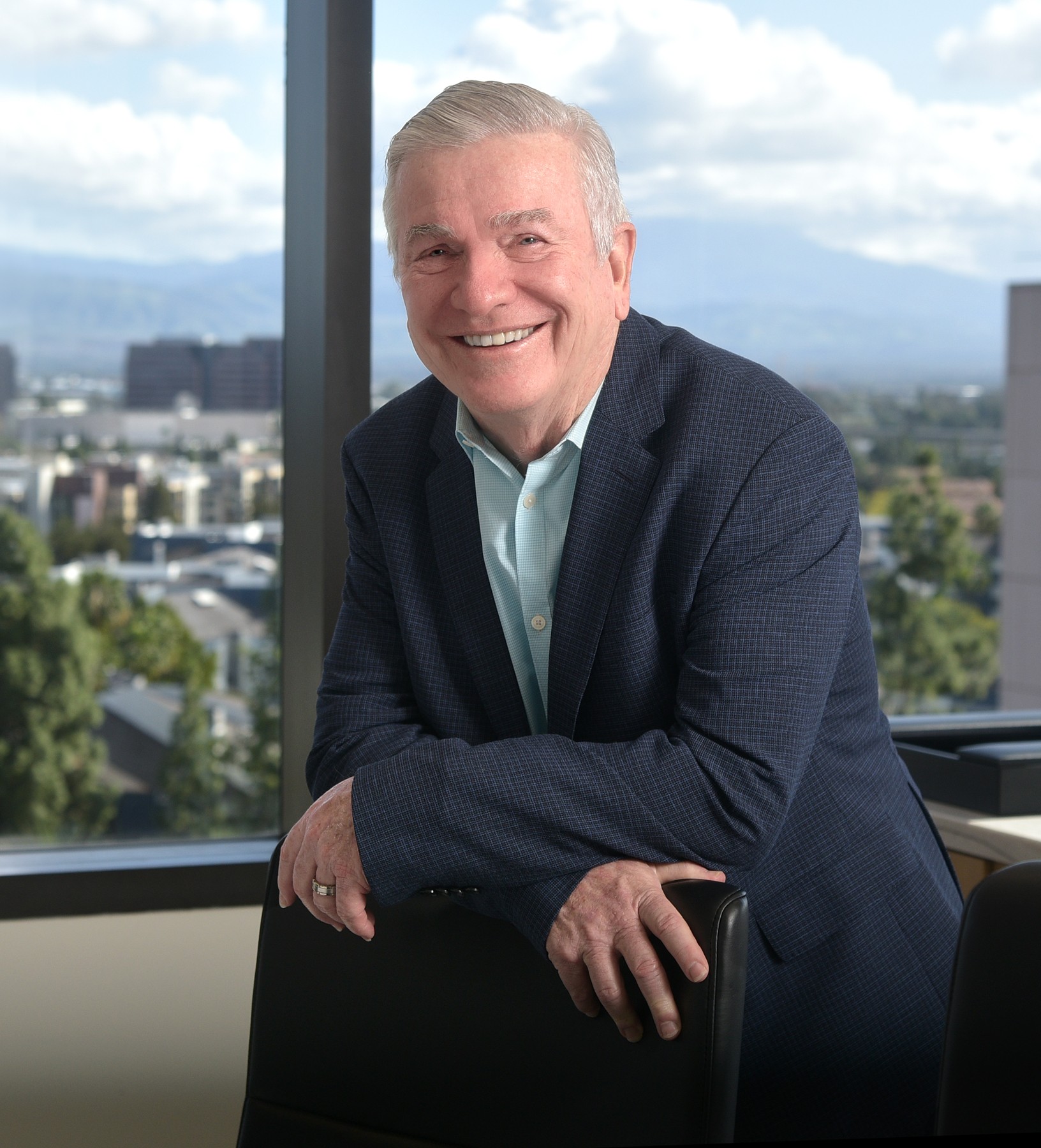
Randall Bell has earned the nickname Dr. Disaster for a good reason.
“I’ve seen more disasters around the world than anybody in history,” he said in his Laguna Beach office. “That’s not an exaggeration. It’s not something I set out to do. It just happened.”
The founder and director of Landmark Research Group LLC has visited the sites of disasters such as Chernobyl, the Bikini Atoll, the 2010 BP oil spill and Hurricane Katrina. He’s studied 9/11 memorials in New York and the Flight 93 crash site.
He’s examined the scenes of infamous murder cases, including those of Nicole Brown Simpson, JonBenet Ramsey and the Heaven’s Gate cult.
Most recently, he studied the floods that devastated Houston.
For insurance purposes, property sales and expert-witness work, Bell analyzes the economic damage of a disaster and estimates its cost, what in legal terms is called “diminution in value.”
He’s hired by attorneys, insurance companies, homeowners, oil companies and others. He’s given TED talks and written books about what he does, including one that set the standard for his industry.
For the past two decades, he’s set up shop in a nondescript building near the Pageant of the Masters amphitheater. He now has 15 contract workers and may expand to 20 to 30, so he may seek more office space. The 59 year old wants to stay in Laguna Beach.
“If I’m going to work on disasters, I want to be close to the beach. I want to decompress,” he said. “You’re dealing with billions of dollars and lost lives. This is serious stuff. I don’t want to have a heart attack over it.”
Upside-Down Skill
Bell grew up in Fullerton, where his father worked for Leo Fender, the famous guitar maker. He recently co-authored a book with Fender’s widow, Phyllis, “Leo Fender: The Quiet Giant Heard Around the World.”
Bell, who holds a bachelor’s degree in finance and accounting from Brigham Young University and an MBA from the University of California-Los Angeles, started his career appraising commercial properties, such as hotels and shopping centers. A day before he was scheduled to begin law school, he had second thoughts about his path.
“I thought, ‘I don’t know if the world needs another lawyer. What if I take the skill set I have with real estate and what creates value and turn it upside down and what creates a loss of value?’”
The early 1990s were a good time to start by evaluating properties damaged in landslides, the L.A. riots and the Northridge earthquake. He even studied the Heaven’s Gate mansion where 39 people committed suicide in Rancho Santa Fe in 1997.
Such appraisals brought him fame, including a Wall Street Journal article that led him to Price Waterhouse, where he started the company’s real estate damage group. After the firm’s merger with Coopers & Lybrand in 1998, Bell decided to strike out on his own again.
Wrote the Book
In 1999, he published a book called “Real Estate Damages: An Analysis of Detrimental Conditions.”
“That book is relied on by appraisers and experts all over the United States,” said Kevin Hannon, a Denver environmental lawyer who “like everyone else,” relies “extensively on his work.”
“He pretty much wrote the book on this subject,” Hannon said.
To determine the value depreciation, Bell interviews neighbors, reads news articles, studies properties around the country and examines comparable tragedies in depth.
Bell gave an example of his work: San Fernando Valley’s Porter Ranch, where he represents homeowners suing over an infamous natural gas leak. If the properties’ value is $500 million and the leakage caused a 10% value decline, that’s $50 million, he said. He conducts what he calls “a rather simple” computation.
“I pinpoint the number for legal or insurance claims,” he said. “It’s a formula, but it has to hold under the scrutiny of lawyers and insurance adjusters that are going to attack that number big-time.
“We are now working on two or three cases where the damages are billions of dollars, and they have to be well-researched because nobody is going to write a check voluntarily without strong evidence.”
Avoidable Disasters
Bell eventually added a doctorate in socioeconomics from Santa Barbara’s Fielding Graduate University to create a unique skill set. He wanted to understand not just the numbers, but also the people behind the disasters in order to better communicate about his work.
Last year, he authored “Me, We, Do, Be,” a book about habits to improve one’s life.
“A lot of these disasters, you sit there and go, ‘This was so avoidable.’
“So many disasters happen because people ignore real basic, fundamental principles. If I can prevent a disaster from happening by going back to fundamentals, that’s a good thing.”
His book combines his work on cases like Chernobyl and O.J. Simpson with classical research to discuss fundamental behaviors that lead to success or disaster.
Nowadays, he enjoys volunteering at homeless shelters and prisons. He plans to develop a website similar to the Khan Academy where videos discuss things not taught in school, such as time management, goal setting, conflict resolution, etiquette and negotiation skills.
He sometimes considers retiring, but his services remain in demand. He’s working on the fires in Napa and Santa Rosa and was recently hired by Montecito landowners to investigate January’s deadly mudslides.
“I pray for world peace, and then I can retire. But until that happens, clients keep coming.”