

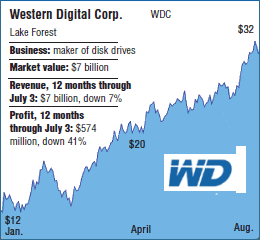
Lake Forest’s Western Digital Corp. is weathering the downturn a lot better than Wall Street expected.
The maker of disk drives for computers, consumer electronics and storage devices has seen growth in a niche segment and is picking up market share in another part of the industry as it rebounds, according to analysts.
“To execute this well during any environment would be impressive, but to do it in the current macro uncertainty is worthy of great praise,” said Richard Kugele, an analyst at Needham & Co. in Boston.
Western Digital’s results for the recently ended quarter blew average expectations out of the water.
It reported sales of $1.9 billion, roughly flat from a year earlier but beating the $1.6 billion expected by analysts.
Adjusted profits came in at $173 million, down 19% from a year earlier but soundly trumping the $62 million expected by analysts.
“As bad as it’s been for everybody in the past nine months, if you look at how Western Digital has performed, they’ve proven to be a really good company,” said Stephen Simko, an analyst at Morningstar Inc. in Chicago. “I never would have thought they would have rebounded so fast.”
At the end of 2008, Western Digital was cutting jobs, paring executive pay and idling plants as demand for drives fell amid the shock of the fall financial meltdown and the larger economic downturn.
But Seagate hasn’t rebounded as quickly and is bearing the brunt of the industry’s downturn.
Seagate largely focuses on drives for desktop PCs and servers, which have been the hardest hit. Western also makes drives for PCs and servers but has sizable sales for laptops and consumer electronics, which are holding up better.
“This year both the desktop and enterprise markets are dropping, which is bad luck for Seagate, while the mobile market is rocking and consumer electronics is somewhat positive news for Western Digital,” Robert Castellano said in a report on financial news Web site TheStreet.com.
Rising Shipments
The total number of drives shipped in the second quarter grew 17% from the prior quarter, Castellano said, with Western Digital outpacing the market with 27% growth in shipments and Seagate lagging at 7% growth.
Western Digital was neck-and-neck with Seagate in the recently ended quarter with Castellano predicting it will take the industry’s top spot by the end of the year.
The company shipped 40 million drives in the quarter, versus Seagate’s 40.6 million. Seagate’s quarterly sales of $2.35 billion were about 25% higher than Western Digital’s.
Western Digital’s move five years ago into drives for laptops, now the biggest part of the drive market, is paying off. Drives for mobile computers—particularly low-priced, slimmed down netbooks—have helped drive growth.
The company shipped 16.9 million mobile drives in the recently ended quarter, 67% more than in the prior quarter and well above the 10.3 million expected by analysts.
Western Digital also has gained with a pickup in the next largest segment of the business, drives for desktop PCs. Western Digital shipped 19.4 million desktop drives in the quarter, up 7% from the prior quarter and topping analyst estimates.
Seagate shipped 22 million desktop drives, flat from the prior quarter.
“Western Digital had a very good quarter as global hard drive demand unexpectedly rebounded,” Morningstar’s Simko said. “It was able to benefit from the industry upturn while also taking share away from its peers.”
Western Digital also appears to have a lead on Seagate in a new type of drive that uses flash memory instead of disks to store data.
In March, Western Digital paid $65 million for Aliso Viejo’s SiliconSystems Inc., a maker of flash-based drives, and plans to release a model for servers and data storage computers in 2011.
Both Western Digital and Seagate trail Santa Ana-based STEC Inc., which for now has the market for flash-based business drives to itself.
Western Digital’s lean, adept management also has been a factor.
It was quick to cut costs at the first signs of trouble last year. It kept close tabs on its stockpiles of drives and was able to quickly meet short-term jumps in demand.
“Western Digital has really been the top operator,” Simko said.
Investors have sent Western Digital’s shares on a bullish run—the stock is up more than 150% since the start of the year.
The run-up is set to continue, according to some analysts.
Analyst Kugele upped his price target on the stock to $39 per share, up from a previous estimate of $30 per share. The company’s stock was trading at around $32 per share late last week on a recent market value of about $7 billion.
“It would be foolish to assume that we have seen the best from Western Digital,” he said in a research note.
Current Quarter Test
Despite the glowing reviews, Wall Street is watching to see how Western Digital will fare during the current quarter, given the industry’s history of boom-and-bust cycles.
“Drives are a cyclical industry,” Simko said. “As great as the company is in its own right, they will ultimately surrender to the forces of the industry.”
The September quarter is typically a cooling off period for the drive industry ahead of the big yearly pre-holiday buildup.
“We are very keenly interested to see the outcome of the back-to-school season because it’s very important to validate what we’ve observed thus far in the year, which is that consumer demand has held up pretty well,” Chief Executive John Coyne said on a call with analysts.
Western Digital’s recent successes continue to be examined with a critical eye as analysts struggle to find indicators of true demand.
It still is unclear if the recent uptick is due to demand improving or manufacturers restocking inventory that had fallen to low levels.
“While industry drive shipments have gone up a lot, it remains to be seen if that’s just inventory restocking due to netbook demand, as opposed to a true resumption of growth and of demand,” Simko said.
For the current quarter, Western Digital said it’s looking for profits of $167 million to $183 million on sales of $1.9 billion to $2 billion.
Analysts are looking for profits of $180 million on sales of about $2 billion.
