

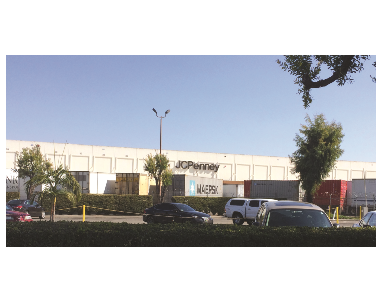
A Chicago-area industrial real estate owner and developer looking to grow its West Coast presence is expected to buy J.C. Penney Co.’s massive logistics and distribution facility in Buena Park.
CenterPoint Properties, an Oak Brook, Il.-based industrial firm with a West Coast portfolio topping 4.5 million square feet, is poised to buy the roughly 41-acre industrial property at 6800 Valley View St., according to multiple real estate sources familiar with the pending transaction.
The new owner would continue using it for industrial uses, and is hoping to land a single user to occupy the space, according to the sources. Redevelopment isn’t in the plans, at least not immediately, they said.
Real estate watchers put a price of about $140 million, or roughly $130 per square foot, on the sprawling property a few blocks north of the Artesia (91) Freeway and about 3 miles northwest of the Knott’s Berry Farm theme park.
The site has nearly 1.1 million square feet of warehouse and logistics space, making it one of the largest buildings in Orange County. It’s one of just five industrial facilities here larger than 1 million square feet, according to CoStar Group Inc. records.
A price approaching $140 million would be the largest deal for a single industrial building in Orange County in over a decade, CoStar data shows.
A sale time frame hadn’t been disclosed, and CenterPoint officials could not be reached for comment. The company’s website lists just one Orange County property to its name, a 121,300-square-foot building in Huntington Beach that it bought in 2011.
CenterPoint has recently been an active buyer in other nearby Southern California markets, said Jeff Chiate, an industrial broker and executive director of the Irvine office of Cushman & Wakefield Inc.
His team helped broker the sale of a roughly 120,000-square-foot property in Santa Fe Springs to CenterPoint last summer in a reported $12.4 million deal.
The company’s made the bulk of its Southern California acquisitions over the past six years, according to CoStar records, during which time it’s spent more than $150 million in the region, primarily in Los Angeles County, according to the data tracker’s records.
The acquisition of the J.C. Penney site would be its largest reported West Coast deal.
Minimal Vacancy
The building’s size and location near the Los Angeles-Orange county line should make it attractive to large industrial tenants once a new owner takes over the space, Chiate said.
“It’s a great project. Keeping it for a single user makes sense.”
For-lease OC industrial buildings larger than 300,000 square feet have availability rates of less than 5%, according to brokerage data.
The property was marketed for sale to potential users and investors who would keep it as-is outside of minor refurbishments, as well as developers who would raze the facility to make way for one or more modern industrial buildings, according to officials at area real estate companies who were considering buying it.
The Business Journal first reported that J.C. Penney was seeking a sale of the property in October. Sources said then that it planned to relocate the operations to a smaller, more efficient property in the Inland Empire.
The property, built in 1967, is used as a merchandise distribution center for West Coast JCPenney stores and as a regional warehouse and furniture distribution center, according to the company’s latest annual report.
It’s one of eight industrial facilities the retailer owns in the U.S. bigger than 1 million square feet and the only large industrial facility it owns in California, according to the report.
The Plano, Texas-based department store operator last month confirmed a sale was in the works, saying it was in “the process of selling its supply chain facility in Buena Park in an effort to monetize a lucrative real estate asset.”
In another cost-cutting move, it announced this month that it planned to close 138 stores, including four locations in California. Its only Southern California closure is the roughly 100,000-square-foot store at the Village at Orange shopping center in Orange.
The closures “will allow us to raise the overall brand standard of JCPenney and allocate capital to a smaller store base, granting us the ability to implement our growth initiatives in a larger percent of stores,” Chief Executive Marvin Ellison said in a letter to shareholders.
The company operated about 1,000 department stores in the U.S. a year ago, including seven in Orange County.
Its market value is about $1.7 billion. The company’s stock has fallen by about a third since late October.
