
The Orange County economy is facing both good news and bad in the coming year, according to Chapman University’s annual forecast.
If the proposed tax change being discussed in Congress eliminates state income and property tax deductions (SALT) from federal returns, the effective marginal rate of state taxation could shoot up. For example, an effective rate of 6% may rise to 10%, which would be a 67% increase in state income taxes, said James Doti, one of the nation’s most eminent economists.
For those in California’s top bracket—which at 13.3% is the highest in the nation—the increase would be even larger.
“It will be the largest tax increase in the history of the state of California,” Chapman’s president emeritus told the audience of 1,000 business and community leaders at the Segerstrom Center for the Arts in Costa Mesa.
That tidbit was one of the many predictions he made during Chapman’s 40th anniversary forecast, where he discussed economic trends for the country, California and OC.
“It’s probably the most difficult forecast ever,” Doti said. “You have a lot of moving parts.”
One of those moving parts was a last minute change in the prediction for job growth for OC because Orange County Register columnist Jonathan Lansner pointed out more favorable jobs data from the federal government rather than the data of the state’s Employment Development Department, or EDD.
After Doti investigated, he revised his OC job growth figures from 0.6% to 2.4% in 2017 and from 0.8% to 2.6% in 2018.
He said the new estimates make more sense because other counties, including Los Angeles, 1.2%, and San Diego, 1.1%, were growing jobs faster.
“What did we conclude? The EDD is wrong,” Doti told the audience.
An EDD spokesperson declined to comment on Chapman’s report. The EDD did say its monthly estimates are revised annually in March using data from both the state program and federal government’s Bureau of Labor Statistics.
“The two programs cited in the article are complementary and not competing,” spokesperson Stefanie Cruz said in an email.
Doti vs. Donald
Doti predicted 2.2% growth in U.S. gross domestic product next year, below the 2.5% consensus outlook of more than 60 economists surveyed last month by the Wall Street Journal.
Chapman, in an internal study, said its forecasts ranked No. 1 for the period of 2004 to 2014 when compared to similar predictions issued by organizations participating in the Blue Chip Survey.
If the tax plan is approved, Doti is revising his estimate up to 2.5%. He said the proposed tax plan will be helpful in eliminating tax loopholes, which he called “crony capitalism” that have benefited certain industries.
Doti’s prediction is notably lower than the recent Department of Commerce report that revised gross domestic product upward to a 3.3% annual rate in the third quarter. He said that higher rate was due to a reduction in inventory and a lower number of imports.
Still, Doti noted that President Donald Trump’s plan to return to 4% annual growth might be possible.
“We don’t see, at least next year, the kind of growth in the 3% to 4% range that the administration is talking about, but that might be in the offing in future years.”
No Correction Seen
The current expansion in GDP is now the second longest on record. Some worry the expansion may exhaust itself, which Doti doesn’t see happening.
Historically, three economic trends have consistently signaled the end of expansions, according to a report Chapman issued for the forecast.
“Those signals include a negative interest rate spread (short-term interest rates are higher than long-term rates), a sharp drop in housing starts, and rising levels of private debt,” the Chapman report said. “With none of these recessionary signals in sight, we are confident that the expansion will continue through 2018.”
Doti, who said he’s proud that his forecast last year for the 10-year Treasury bond was accurate, predicted it would rise about 60 basis points to 3.0% and that its spread of 100 points with short-term rates won’t signal an imminent recession.
He predicted the Federal Reserve will raise rates once this month and twice in 2018. He said the Fed’s planned reduction of its balance sheet “won’t have an impact.”
The stock market “is not ready for a correction,” he said.
State Job Growth
California’s job growth next year may slow to 1.5% from an estimated 1.7% this year, the report said.
Silicon Valley is the big piston in the state’s economic engine. The manufacturing sector hasn’t grown and “is certain” to show additional weakening next year, the report said.
Construction and information service jobs have shown strong growth here. However, a rise in interest rates and lack of affordable housing may cause residential permits to grow at a slower pace in 2018 than 2017.
“California is becoming increasingly dependent on the cyclical and volatile construction sector,” the report said.
If the North American Free Trade Agreement is canceled, California could lose hundreds of thousands of jobs and “is the most serious negative” on the horizon, he said.
OC Transformation
Manufacturing productivity has improved in OC with more high-paying jobs in industries like aerospace and medical supplies. Meanwhile, there are fewer jobs in lower paying industries like textiles and food and vegetable processing.
“There is this transformation in Orange County since 2010, while overall we may be losing manufacturing jobs, we are gaining higher paying, value-added jobs,” Doti said. “No one is directing this. It’s the free market causing this transformation in our economy.”
The proposed tax reform could mean that homeowners can deduct a lower amount of mortgage interest on their federal forms. Many will make up that loss in itemized deductions and the loss of SALT with the higher standard deduction and lower marginal rates.
Translation: Tax reform will provide a tax cut to most homeowners here, but it takes away some of the tax benefit of home ownership, and that will drop values.
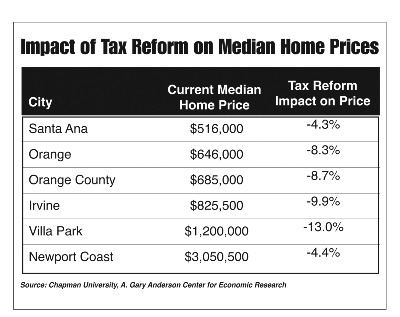
Chapman estimates that the Tax Cuts and Jobs Act would slice median home values in OC by 8.7%.
That’s bad news for homeowners, but in turn means more people could afford to buy a home in OC, where the current median price is $685,000.
The decline in home values could be anywhere from 4.4% in Newport Coast to 9.9% in Irvine and 13% in Villa Park (see graph).
“This gives you an idea of the impact of tax reform on home prices when all those goodies from the government are taken away.”