

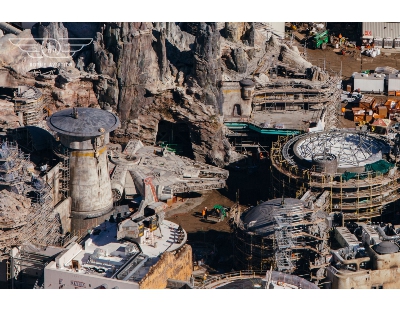
All eyes and mouse ears are on Orange County as the long-awaited Star Wars: Galaxy’s Edge opens this week.
The Walt Disney Co. (NYSE: DIS) spent close to $1 billion to build the new, 14-acre Disneyland Resort attraction over the past three years; it’s the largest expansion at the Anaheim theme park since it opened in 1955.
The hype is strong for Galaxy’s Edge.
“It’s the largest land we’ve ever built, but the sheer audacity of the creativity and technology is even more impressive than the size,” Walt Disney Chairman and Chief Executive Bob Iger said earlier this month.
How much of that $1 billion went toward marketing? Not much, according to Iger.
“I’m thinking that maybe I should just tweet, ‘It’s opening,’ and that will be enough,” Iger said during Disney’s conference call with analysts following the Burbank-based company’s first-quarter earnings report.
Crowd Control
In fact, one of the biggest challenges for the Disneyland Resort—OC’s largest employer with about 30,000 local workers—is how to manage the crowds of people that will be traveling from all over the world to get a glimpse of the immersive park that opens on May 31.
While only those who secured reservations will be able to attend the park for the first 24 days, Anaheim and its growing base of hotel operators are set to start gaining the benefits of the park immediately.
“This is a major investment by Disney that the entire state will reap the benefits of for years to come,” said Bill O’Connell, a hotel developer who’s currently building the 466-room JW Marriott Anaheim slated to open next year.
It will be the first four-diamond property to open in Anaheim since Disney’s Grand Californian Hotel & Spa opened in 2001, and will soon be joined by a second: the 613-room Westin Anaheim Resort. Five other hotels are currently under construction in the city, and more remains in the pipeline.
All told, nearly 3,000 hotel rooms are under construction in proximity to Disneyland.
“There will continue to be investment in the area, with redevelopments and upgrades happening at the older hotels,” O’Connell said, which will contribute to greater economic returns for the city.
Though no official statistics are available, experts put the annual visitor count at Disneyland between 18 and 19 million—roughly 50,000 people a day. That total comprises a majority of the 25 million people that visit Anaheim annually.
OC has about 50 million visitors every year.
Anaheim’s economy is largely driven by hotel tax revenue, which currently generates about $150 million each year.
“This significant expansion is a really good thing for Anaheim, and it will put the world’s attention on us over the summer,” Anaheim spokesman Mike Lyster told the Business Journal.
“We expect the opening to drive millions of new annual visitors per year and increased investment in visitor serving businesses.”
Following the 2012 opening of Cars Land in Disney California Adventure Park, the most recent expansion for Disneyland, transient-occupancy tax revenues jumped 14% to $103 million. That 12-acre expansion is often used as a marker to gauge the impact Star Wars land may have.
“At the time, a lot of us were still emerging from the recession, and that park helped the city come back from the downturn,” Lyster said. “The impact it had for us is encouraging as we look to the opening of Galaxy’s Edge.”
Galaxy’s Edge is expected to have an even greater impact due to its wide appeal to individuals and families across the demographic spectrum.
The new theme park will open in two phases: the first phase includes the first ride, Millennium Falcon: Smugglers Run, and opens May 31; while the second phase will open later this year, bringing with it the Star Wars: Rise of the Resistance ride.
Galaxy’s Edge will also have four eateries, Disneyland’s first public bar called Oga’s Cantina, and five retail shops.
Josh D’Amaro, who became president of the Disneyland Resort last year, said “the epic planet is the most immersive and transformative land we’ve ever created.”
“I started my Disney career in Anaheim, and I am thrilled to be back during one of the most exciting times in our company’s history,” D’Amaro said.
Whiting-Turner Contracting Co. was the main contractor for the project—which stood among the largest private construction projects in the state the past few years—according to trade publication ENR California.
Spreading the Wealth
While Iger said his firm hasn’t put too much money toward promoting Galaxy’s Edge; national media outlets and blogs have kept the project front and center.
That’s helped the bottom lines of plenty of area companies with limited ties to Disneyland, such as Rogue Aviation, a Costa Mesa flight school and aerial production company that operates out of John Wayne Airport.
Company officials said they’ve capitalized on the high-demand for aerial sneak peeks of the new park.
Orange County’s oldest company, title insurance giant First American Financial Corp. (NYSE: FAF), is a fan of the expansion.
As of March 31, the Santa Ana firm had $6.5 million in shares of Disney. The Burbank-based company has a market value of $241.3 billion. First American is valued at about $6.2 billion.
“Disney has several business lines, but the park assets are a great cash cow for the company,” said Jerry Braakman, chief investment officer at First American.
“The company has been a great media investment and a long-term holding for us,” Braakman said. First American’s investment portfolio has topped $2 billion in recent years.
Strong demand has continued to drive higher prices at the park, Braakman said, and the new expansion will continue that trend.
“The new park is a large investment, but a relatively low-risk investment because it’s such a strong franchise, and demand is outpacing capacity at the park,” Braakman said.
A sign of demand: Disneyland tickets now cost $129, while annual passes can run upwards of $1,400 for the highest-end offerings.
There’s plenty more opportunities for new sources of spending within Galaxy’s Edge, from $200 lightsabers to a build-your-own droid station, to a $42 collectible souvenir mug at the cantina.
“The popularity of what we’ve been building … has created an even greater demand and more popularity, which gives us more flexibility on the pricing side,” Iger said.
In terms of higher ticket prices, the company is using it as a means to manage demand, he said.
Disneyland is trying to “spread out attendance so that we can preserve or improve the guest experience,” Iger said.
