

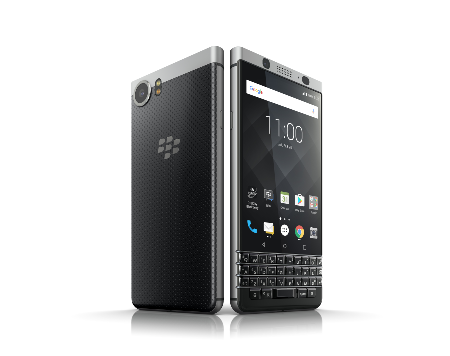
Steve Cistulli has delivered this elevator pitch about the BlackBerry KEYone countless times:
“You get the best of what Android brings, and you get the best of what BlackBerry brings,” he told the Business Journal last week.
But is that enough to resuscitate a brand largely unknown to millennials yet once coveted by corporate executives and government workers for its security and raised keyboard?
Early indications signal optimism following the BlackBerry smartphone relaunch in Canada, where four of the nation’s largest wireless carriers are selling the revamped device.
Strong initial demand there delayed the rollout a month to sure up supply, but it still wasn’t enough to fulfill early orders.
“We’re very happy with the results so far,” said Cistulli, president and general manager of TCL Communication Technology Holdings Ltd.’s North American operation based at the Irvine Spectrum.
That’s where the telecom veteran assembled a stand-alone unit under the umbrella of the Chinese conglomerate to design, market and relaunch the BlackBerry brand.
TCL late last year signed a licensing deal with Blackberry Ltd. after the Waterloo, Canada-based company announced it would halt smartphone production and focus on software. Under the agreement, BlackBerry licenses its security software and service suite, as well as related brand assets, to TCL, which manufactures and provides customer support for BlackBerry-branded mobile devices.
TCL has exclusive global rights, except in India, Sri Lanka, Bangladesh, Nepal and Indonesia.
Financial details of the licensing agreement weren’t disclosed.
Getting a good read on BlackBerry KEYone sales in the U.S. is a bit tricky since the brand is not yet distributed by the nation’s largest wireless carriers—Verizon, AT&T, T-Mobile and Sprint—although the phone is compatible with their networks.
TCL opted for retailers Amazom.com and Best Buy for the U.S. push. The device costs about $550 and features its flagship qwerty keyboard, as well as touch-screen navigation on a 4.5-inch display akin to competing brands.
The KEYone is currently available at about 25 Best Buy locations, but the Richfield, Minn.-based retail chain will carry it at more than 350 stores nationwide by the end of next month, according to Cistulli.
“They’re really the experts when it comes to engaging the customer at the point of sale,” he said.
Some of the locations have already run out of stock.
“The demand is so much greater than any of us could have predicted,” Cistulli said.
The smartphone features 4G connectivity, a 12-megapixel rear camera, and 32 gigabytes of memory. It’s generating some solid early reviews, with a 4.5 star consensus rating from 55 Amazon buyers. The website Android Police describes the KEYone as having “a strong focus on security (and) aimed at enterprise users and long-time fanatics.”
Digital advertising campaigns are under way in the U.S. and Canada. TCL plans to initiate traditional billboard and outdoor digital displays in the U.S. next month, according to Cistulli.
The company launched a similar campaign plan in Canadian metro areas last month.
The BlackBerry brand is far removed from the “Crackberry” craze it created in the mid-2000s. Its position and sales are at all-time lows, with essentially zero market share—a far cry from the turn of the decade, when quarterly shipments surpassed 10 million units.
“This is going to be extremely tough for BlackBerry to establish any type of market share within the U.S.,” said Tuong Nguyen, principal research analyst in the Stockton office of Stamford, Conn.-based Garter Inc. “The panache isn’t what it was five to seven years ago.”
Smartphone Market
Samsung was the world’s top smartphone seller in the first quarter, shipping more than 78.6 million units, with market share eclipsing 20%, according to market trackers IDC and Gartner.
Apple was No. 2, shipping about 52 million units, with a market share of 13.7%.
Total smartphone shipments in the first quarter exceeded 347 million units.
TCL’s strategy, first reported by the Business Journal in January after meetings and demos in Las Vegas during the Consumer Electronics Show, is focused on winning back carriers and enterprise customers that have fled the once-influential smartphone brand over the past several years.
The company has made gains in Canada, lining up distribution with big carriers such as Rogers Communications, Telus Communications, BCE Inc. and Sasktel, and will need similar wins in the U.S. to pick up meaningful market share.
“I can’t make any carrier announcements today,” said Cistulli, who’s optimistic that that will change in the coming months. “By the end of third quarter, we’ll have a very strong carrier presence in the U.S.”
About 90% of U.S. smartphone sales volume is generated through the carrier channel, according to Gartner’s Nguyen.
TCL Communication has plenty of resources to leverage in the effort, from supply chain to deep financial pockets. It’s the fourth largest U.S. mobile phone manufacturer, with annual sales topping $5 billion. Its parent, TCL Corp., has annual revenue eclipsing $15 billion.
It operates Irvine-based Alcatel OneTouch and employs about 80 at its Spectrum operation in sales and marketing, supply chain, research and development, engineering, finance, human resources, quality assurance, testing and administrative personnel.
The company has gradually expanded its presence at the same building since its U.S. launch in 2009.
It employs more than 200 in North America, with operations in Seattle, Kansas City, Miami, Atlanta, Dallas/Fort Worth and New Jersey, primarily near major telecoms, such as AT&T, T-Mobile and TracFone Wireless.
Cistulli gives TCL about a year to make a serious run at market leaders as it builds a sales force to develop enterprise channels to serve customers in the government, finance and healthcare sectors—three pillars BlackBerry has targeted over two decades since it ushered in the era of smartphones.
“I look to Q2 of next year,” he said, with a qualifier. “A lot of that has to do with the sales cycle of the enterprise.”
