

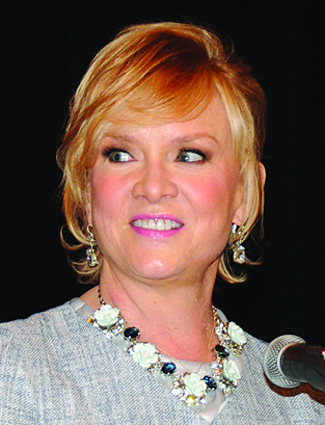
While Arbonne International LLC was acquired by the nearly $3 billion Paris-based firm Groupe Rocher this month, it’s business as usual inside its Irvine headquarters, says its chief executive.
Kay Zanotti said it sounds too good to be true, but sweeping changes to its operations and executive team are unlikely.
“I’ve been amazed at how good they’ve been to work with,” she said. “If you have a brand that’s growing, the worst you can do is come in and change everything. So it was music to my ears that (Groupe Rocher) was not going to change what’s working.”
The direct-sales beauty, skincare and nutrition company is on an upward trajectory since emerging from bankruptcy eight years ago. Revenue grew from roughly $378 million in 2010 to an estimated $560 million last year, and it predicts steady growth this year, though Zanotti didn’t provide a specific estimate. It ranks No. 36 on the Business Journal’s list of the largest private companies with headquarters or major operations here.
Arbonne’s turnaround results from new product offerings—it’s launched more than 150 items since 2010—and reformulation of popular anti-aging skincare line RE9 Advanced. It continues to release a steady stream of products, such as this month’s launch of three anti-aging body care products: a neck cream, firming body cream and retexturizing serum-based lotion.
A key factor, though, is the company’s focus on botanical and nontoxic ingredients at a time when green beauty has become mainstream.
The U.S. “natural” beauty market grew nearly 9% last year, more than double the conventional cosmetics and personal care market, according to research firm Kline & Co. Target announced a year ago that it will expand its natural beauty offerings after seeing double-digit percentage growth in sales of natural skincare products in 2016.
And CVS said it will remove chemicals, such as parabens and phthalates, from 600 of its house-brand beauty and personal care products due to customer feedback.
Jackie Chiquoine, associate editor at New York trend-forecasting agency WGSN, said that despite growth of green beauty, brands should tread carefully.
“People are moving towards a science-based skincare,” she said. “I think there’s consumer fatigue around organic. It’s not necessarily as powerful a label as it used to be. People are looking for more clinical solutions, (and) it has to actually work.”
Smooth Operator
Arbonne has its own scientific advisory board, headed by Nora Zorich, former vice president of research and development at Procter & Gamble Co. The board also includes doctors, psychologists and dermatologists, such as Christopher Zachary, chairman of the department of dermatology at the University of California-Irvine.
It has a three-year development timetable to ensure a product’s safety and effectiveness.
Zanotti said products are manufactured at its facility in Chatsworth, which is also home to its research and development team.
Arbonne has yet to have conversations with Groupe Rocher on sharing resources and research, Zanotti said she anticipates the Paris firm can help its team with sourcing ingredients.
“They grow their own botanicals, which is something we don’t do,” she said. “I’m really looking forward to getting some of their know-how, and our R&D people are very excited about that, too.”
Margarethe Wiersema, a professor at UC Irvine’s business school, said Groupe Rocher will have the benefit of growing its sales platform.
“It expands their footprint, but more importantly, it expands them into a different kind of sales platform (and) different channel of distribution.”
Groupe Rocher scooped up Arbonne and sister company Nature’s Gate for an undisclosed sum from holding company Natural Products Group, whose ownership includes New York private equity firm Eos Partners LP.
The deal is expected to close in the first quarter. It would expand the family-owned company’s direct-sale business by doubling the number of consultants to about 475,000.
It’s a point Groupe Rocher Chief Executive Bris Rocher made in a statement following the announcement of the deal.
“This acquisition will be a real asset that will enable us to strengthen our positioning in the direct-selling channel, which has seen an upturn over the past few years,” he said.
The industry’s biggest players have been struggling. Avon Products Inc. sales slipped last year, and announced it will cease its Australia business. Direct-sales giant Amway reported a 2% dip in sales last year to $8.6 billion, the smallest percentage drop in a four-year decline.
Rosy Outlook
Unlike its counterparts, Arbonne is charging ahead with 800 employees and 250,000 consultants, about 90,000 of whom are active.
Zanotti said the focus will now be increasing the number of active consultants and customers.
“Traditionally, direct selling is all about sharing at the consultant level as opposed to building a true consumer base” through organic means, such as website traffic or social media, she said.
An emphasis on consultants and customers is a welcome change for the Cincinnati native, who joined the company shortly before its former parent, Natural Products, entered bankruptcy.
“I had never been in a situation that needed as much work as this company did nine years ago,” she said. “It was a little scary, but I had made a big move to come out here, so it was sort of like put your head down and keep putting one foot in front of the other.”
Prior to joining Arbonne, Zanotti served as a senior vice president at McDonald’s. She took that role after retiring from her post as vice president at Procter & Gamble.
Zanotti has been in the consumer products world for 30 years, but her entry was tough.
She interviewed with P&G after graduating from Georgetown University, considering it an opportunity to merge her double major in studio fine arts and economics. She was turned down.
“I got some advice that if I got an MBA I’d get to interview again,” she said. “I got a scholarship to Xavier University, had an interview again, and fortunately, worked my way in.”
Arbonne’s greener skincare focus aligns with Zanotti’s formative years. Zanotti, whose father was a doctor and mother a nurse, is the second-oldest of 10 siblings. Growing up, the only thing discussed around the dinner table was medicine, and she planned to become a doctor.
“In high school, I didn’t like chemistry, and I didn’t like biology, and said this isn’t going to work. But I’ve had the great advantage of working in the healthcare business both at P&G (and) Arbonne,” she said. “And I don’t have to know so much about chemistry and biology this way.”
