
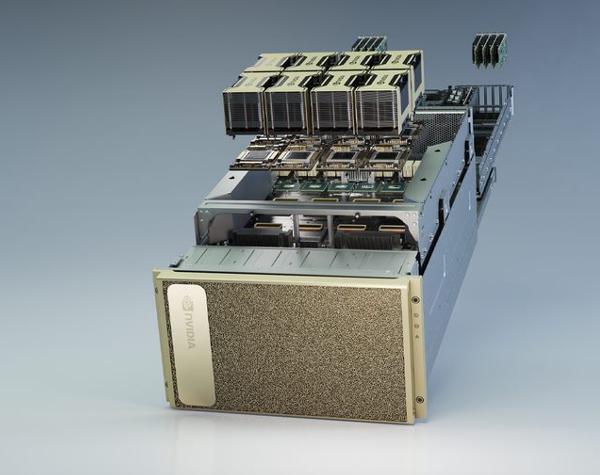
A group of influential business executives trying to increase the base of tech talent in Orange County is organizing the installation of a supercomputer capable of doing 8 quadrillion calculations a second at Chapman University in Orange.
Nvidia Corp. (Nasdaq: NVDA), one of the world’s foremost manufacturers of video graphics with a $540 billion market cap as of last week, is donating the computer to help students from lower-income areas gain access to the latest computing technology, and to expand the region’s pipeline of artificial intelligence tech workers.
“This is the first community operated supercomputer” in the country, Keith Strier, vice president of worldwide AI initiatives for Santa Clara-based Nvidia, told the Business Journal.
“We’re excited to be a part of it.”
The computer may be among the fastest in Orange County, Strier said.
The fastest supercomputer in California is at Nvidia’s campus in Silicon Valley, according to Strier, who works out of OC.
Trace3, CLAOC
Besides Chapman and Nvidia, other contributors to the $1 million project include Irvine-based IT and managed services provider Trace3, Israeli-based Run:ai and the CEO Leadership Alliance Orange County (CLAOC). The supercomputer will be under the jurisdiction of Chapman’s Fowler School of Engineering, whose dean is Andrew Lyon.
“I am extremely excited about this initiative,” Chapman President Daniele Struppa told the Business Journal.
“Two of the founding principles of the Fowler School of Engineering were to broaden access to engineering education and to deepen our ties to our local community and industry. This collaboration will achieve both of those goals while simultaneously accelerating our push into AI, machine learning, and cutting-edge data science research.”
The supercomputer will be made available to all students regardless of age, particularly lower-income people with fewer resources.
The program plans to work with high schools and universities around Orange County, including University of California, Irvine and California State University, Fullerton. Access will be limited to those granted it.
“We want Orange County to become an AI super hub,” said Jasmine Pachnanda, senior vice president of artificial intelligence at CLAOC, whose collection of over 50 top area execs are aiming to build OC into what it calls a “premier, inclusive, innovation talent hub.”
“We know there is tremendous opportunity,” she said.
Pachnanda noted a study saying that 50% of tech-related roles in Orange County face a risk of going unfilled because there isn’t enough talent.
“This will be very impactful for Orange County and the future of education, workforce development and AI leadership,” she said.
Along with Chapman, representatives from the donors are expected to be involved in the project, in providing input regarding the supercomputer’s deployment.
Super Fast
In 2008, the IBM-backed Roadrunner was the first supercomputer to deliver 1 petaflop of processing power, or 1 quadrillion calculations per second.
It cost approximately $120 million to build, according to Strier.
He said an 8-petaflop computer—what’s being installed at Chapman—in 2008 would have cost about $1 billion to build.
Prices have come down as technology has improved. The costs of the project in Orange, which are donated from the companies involved, altogether will be around $1 million, he said.
“Years of innovation across the full stack—compute, storage, networking, software—by Nvidia and other innovators means that what cost $1 billion in 2008 costs just a fraction of that today,” he said.
While it will be housed at Chapman, Trace3—one of OC’s larger tech services firms—plans to contribute ongoing high-performance computing configuration, system administration, technical and data science support for the system, while Run:ai plans to contribute its software platform to automate AI resource management and consumption.
Run:ai is a member of Nvidia Inception, a program designed to nurture cutting-edge startups, as well as a Nvidia DGX-Ready Software partner.
The computer will be at Chapman’s Beckman Hall data center due to its size and power/cooling requirements, according to Struppa. All computation can be done by connecting remotely from other parts of campus, he said.
Tech Exposure
Strier envisions students from junior high schools to high schools to junior colleges to state universities gaining access to the supercomputer’s power.
“If you’re in seventh grade or a sophomore in junior college, having exposure to this technology, seeing examples of how this technology will be applied—these things will be game changing,” Strier said.
Strier said he often interacts with governments around the world on how to build eco-systems.
“I’m slowly starting to see communities get more engage” in technology, he said. “Most of the local initiatives around the world are more focused on startups and data consortiums.”
The CLAOC AI Center of Excellence, with an emphasis on historically underrepresented communities, is a unique one that could be replicated around the world, Strier said.
“I’ve not run across anything like it,” he said.
“The mission is really unique.”