

For many people, agave is either a decorative desert plant, or best served with salt and a lime.
But for Agave Surf, the sustainable material—primarily known as an integral component of tequila—is the main ingredient used in what the company’s founders are aiming to one day be a lengthy product line to include woven textiles, bar tops, decorative interiors, and musical instruments.
For now, though, the company is looking to become Orange County’s go-to surfboard maker for fans of environmentally friendly products.
“We’re kind of setting the stage here. I run into very few people who even know what the plant is until you mention tequila and then if they do, that it blooms a flower,” said Ian Bryan, chief executive of the San Clemente-based startup.
Agave Surf has been around for about two years. While its sales are modest—company execs said they’ve been making about 30 boards a year, with plans to ramp up—the company is starting to catch waves in the surf industry, where boards and accessories are said to bring in about $3 billion in sales annually.
That’s due to a bevy of notable partnerships; both in the surf and tequila world.
The fledgling company recently joined New Jersey-based tequila mega-brand Jose Cuervo as part of a marketing campaign for its Tradicional 100% agave tequila.
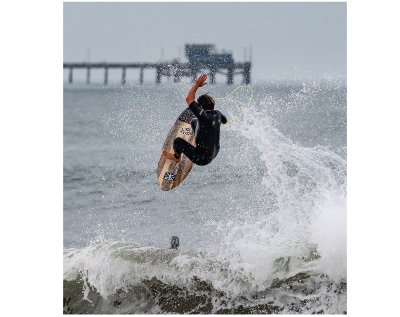
Earlier this month, 10 world-class surfers including OC locals Dane Gudauskas, sponsored by Costa Mesa-based Vans, and Tyler Warren, sponsored by Huntington Beach-based Boardriders Inc.’s Billabong, rode Agave Surf’s boards at a Jose Cuervo-sponsored event; the tequila maker is a prominent backer of the World Surf League.
An extensive photo and video shoot took place at the event, and the content will be used in marketing materials for Tradicional for the rest of the year. Randy Hild from Dana Point-based creative agency Funstrs, which manages the marketing for the Tradicional label, said Agave Surf was a perfect match for the project because they are authentic to the brand and the culture.
“Cuervo trusts us to manage these types of jobs; we’ve trusted Agave Surf,” said Hild, a former executive vice president of business development at Boardriders’ Quiksilver. “They are legit, they have a great product, they have good connections, [and] their hearts are in the right place.”
Returning to Roots
For Bryan and his co-founder Nate Headrick, the focus of the company is sustainability.
The earliest surfboards were made from a variety of woods such as koa and balsa. Most are now made from manmade materials like polyurethane and polystyrene, and a cottage industry has sprung up in recent years to educate surfers about the need to recycle these types of old boards, whose manufacturing process is not environmentally friendly.
Bryan wants people to see there is an alternative to the traditional surfboard that is just as strong, performs just as well, and is made from a sustainable material.
The company’s boards are made not from the agave themselves, but from the plants’ flowers that grow up to 30 feet tall. “Harvesting the flower doesn’t kill the plant, it goes on to reproduce again,” Bryan said.
After harvesting, “the next plant will bloom the next year and that will keep happening,” he said. “So if you manage the patch for the purpose of using it as a building material, then it’s constantly renewable.”
Agave plants can be found all over Southern California, as well as in Arizona, New Mexico, and Texas. It takes six or seven flowers to make a board, so once a month Bryan and Headrick will fill up a truck with 80 to 100 flower stalks, which will make roughly 10 boards.
From there, the stalks are glued together and shaped into a rough surfboard blank. It then goes to “glassing” and is coated with a resin, before it’s sanded and finished, a similar process to any other surfboard. It takes 3 or 4 months to make a board.
The boards are available on the company’s website. There are currently 12 for sale from $2,700 to $4,500.
“It just makes a lot of sense in surf. It’s durable if it’s protected, if it’s glassed properly, it’s really lightweight and again, it’s completely plant based. There is no foam core or anything,” Bryan said.
“As far as we’ve found, it’s the highest performing plant-based surfboard that’s out there.”
Surfers have indicated that Agave’s boards are somewhat heavier than their plastic peers, which gives them more momentum while riding waves.
Oceanside Inspiration
The pair started the company in 2017, after meeting at an art show where Bryan was exhibiting pieces from his Jonathan Seagull butterfly art collection. Bryan was also experimenting with alternative woods at the time, making bamboo skateboards under the company name Laguna Skateboards.
Headrick, who has a bachelor’s degree in sustainable living and high-performance green building from Iowa’s Maharishi University of Management, already had explored making agave surfboards. When he was 9, Headrick saw an agave surfboard hanging on the wall of his optometrists’ office.
That board was made by local shaper Gary Linden, who’s been running his own shop, Linden Surfboards, in Oceanside since 1967.
“Nate was inspired then as a surfer by this beautiful agave board, and a picture of Gary surfing it in Mexico at Todos Santos, and he kind of was obsessed with it ever since,” said Bryan.
Linden has also been working with Jose Cuervo for years, and the three of them collaborated on a board for Cuervo’s event this month with Agave Surf providing the agave board blank, and Linden shaping it specifically for surfer Alex Gray.
For Linden, the point is to raise awareness about sustainable alternatives, a passion he shares with Bryan and Headrick.
“For my own purposes, it’s awareness and opening your mind to the possibilities of using different materials and not wasting resources. That’s more our mutual goal than just a surfboard,” Linden said.
New Uses, New Investors
Boards are just the beginning for Agave Surf, the founders hope.
They plan to use agave for other things as well, from making musical instruments, to clothes and wall treatments for interior design, to bar tops.
They started with surf because boards demonstrate the industriousness of agave, “if you can surf a wave like this on it, it’s going to hold up,” Bryan said.
The company will need support to source the material, though, in order to keep growing its operations.
“We’re trying to create enough of a movement behind it to get support in developing a responsible practice for growing it,” Bryan said.
Agave Surf has a business plan for the next 18 months, and may seek additional outside capital. Bryan said it would need to be a partner that understood the company’s mission.
He was a bartender at Nick’s Laguna Beach when he met the company’s current investor, David Hendryx, who works in residential real estate and also serves as Agave’s chief financial officer.
The cost of making the boards mean that Agave Surf will probably always be a niche offering for high-end collectors and well-off surfers, but he said they are creating a market through education, and buyers are often attracted to the company’s larger purpose.
“The aesthetics of it are undeniable, but as you peel back the layers of what you are looking at, it’s a story that a lot of people want to be a part of in one way or another,” he said.
