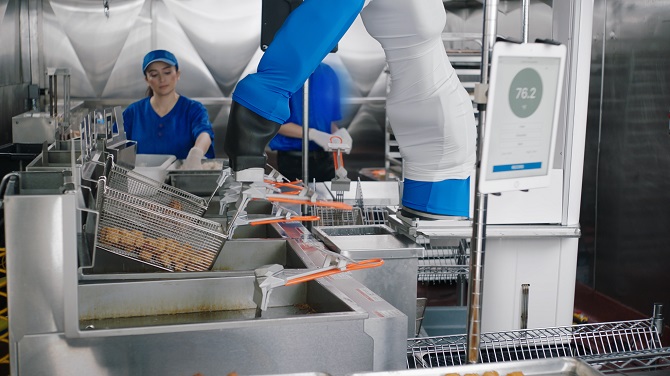
Acacia Research Corp. has gotten rid of automated restaurant kitchen helper Flippy, while also arranging for a significant infusion of funds from an activist investor—the latest restructuring moves for a firm that’s seen a bevy of changes over the past year or so, including a comprehensive management shake-up and a headquarters move from Newport Center to Irvine.
The end result is that the “systematic restructuring of Acacia is now complete and we can commence a focused strategy to diversify our business and augment our portfolio of intellectual property assets,” said Clifford Press, the $150 million-valued company’s recently named chief executive.
The patent licensing and intellectual property firm (Nasdaq: ACTG) said last month that it sold its stake in Miso Robotics Inc., a Pasadena-based developer of multitasking restaurant kitchen assistant robot Flippy, whose skills including flipping hamburgers.
Acacia sold the stake in Miso—whose product has garnered a fair share of media attention, and whose owners are currently looking to raise $30 million in funds—for $2 million; it said that money will be handy as it aims for new acquisitions.
Starboard Onboard
Another larger source of funds was disclosed a few days after the Flippy sale.
Acacia on Nov. 18 said it will get up to $400 million under an agreement with New York-based hedge fund Starboard Value LP.
Starboard is initially investing $35 million in Acacia for convertible preferred stock and warrants, and Acacia said the company could later issue up to $365 million in 6% notes due 2027 to Starboard.
The funds will go to strategic investments and acquisitions, while “Starboard will work directly with Acacia to identify and execute on these opportunities.”
“We believe the Acacia platform is a solid base of assets from which to build,” said Starboard Chief Executive Jeff Smith at the time of the announcement.
“Together with the capital that we are providing, Acacia is now well positioned to identify and execute on the most attractive investment opportunities, and we look forward to working closely with the company.”
Veritone Investor
Acacia’s core business of monetizing patents primarily through litigation has shifted to what Press calls a “focused platform for investing in intellectual property, technology and other unique investment and acquisition opportunities.”
The firm’s website notes the company “believes inventors and their patented inventions are the building blocks of the U.S. economy,” and calls itself “an intermediary in the patent marketplace partnering with patent owners to unlock the financial value in their patented inventions.”
The company’s “professionals actively seek to identify high-quality, but undervalued patent portfolios in a variety of industries.”
Its most prominent local investment is in Costa Mesa-based Veritone Inc. (Nasdaq: VERI), whose AI-driven technologies are used in marketing, media and other industries.
Veritone’s wild stock swings the past few years—it’s now valued at about $75 million, but its shares in 2017 were briefly worth nearly 20 times what they are now—have impacted Acacia’s balance sheet.
It had previously reported a 2018 loss of $5.5 million on its Veritone investment.
Shares of Acacia have fallen by about 50% since the peak of Veritone’s stock price in late 2017. Acacia said it’s lost millions of dollars on the sale of Veritone shares.
Acacia said in its quarterly earnings report last month it had a $7.6 million loss for the three-month period ended Sept. 30, while CEO Press said the company had “a limited number of remaining licenses to be negotiated and we did not generate significant revenues during the quarter.”
The company also reduced its full-year revenue guidance to between $15 million and $20 million from approximately $25 million earlier.
Exec Changes
Press last month acknowledged that it’s taken “some time” to clean up the struggling company, while Acacia is looking at “potential acquisitions and strategic partnerships.”
Press, a member of activist hedge fund firm Oliver Press Partners of New York, was named a director last year following a proxy fight; he was appointed CEO in September.
Also in September, Alfred Tobia was appointed chief investment officer. He’s a portfolio manager for Sidus Investment Management, and was also named a board director last year following the proxy fight.
Senior management of Acacia left the company in the summer of 2018, and board members who were in place before the company’s proxy fight resigned.
The ousted executives included President Robert Stewart; Edward Treska, executive vice president, general counsel; and Clayton Haynes, chief financial officer, senior vice president of finance, and treasurer.
The company has since added a number of new board members, including Katharine Wolanyk, a highly esteemed IP specialist and managing director at Burford Capital in New York.
Last month’s agreement with Starboard gives that firm’s Managing Director Jonathan Sagal a seat on the Acacia board, while the company has “certain other board appointment rights.”
“We now have the right team in place with a focused strategy to diversify our business and build our portfolio of intellectual property related absolute return assets,” Tobia said last month in a call with analysts.