

California State University-Fullerton and Chapman University economists have weighed in on 2020 (see story, page 1).
At the Orange County Forum’s “2020 Housing Outlook” program held this month at the Pacific Club in Newport Beach, a selection of area real estate executives
gave their views on the state of OC’s real estate market. In addition, the Business Journal asked a few other business leaders for their thoughts.
Their responses, edited for clarity and length, are below.
—Pete Weitzner
Paul Johnson
Executive VP, Community Development
Rancho Mission Viejo
Targeting Millennials, Seniors
We believe the market in 2020 will stay strong, but we may see a couple months where it turns negative. Consensus is 2021 will be slower but nothing drastic.
Our company is entitled for 14,000 units—by the end of 2020 we will have built about 4,000. It’s almost impossible to increase our entitlement. We’re looking to build out in 10-15 years. We’re going to stay the course.
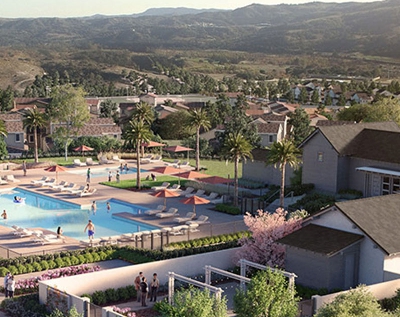
Our goal is to build market-rate housing for young people who want to stay in the county. About 30% of our customers have been and we expect will be millennials; we have a 2022 project that will be 23 units per acre—only with that density can a project pencil out.
Our biggest house will be about 2,000 square feet. We’re also building communities for 55-plus which we see as a tremendous opportunity.
Al Hensling
Founder, President
United American Mortgage Corp., Costa Mesa
High Costs Driving Out Capital, Residents
2019 represented our largest year in total transactions. The unexpected drop in interest rates drove a large demand for financing in the purchase and refinance markets during 2019. Given the 2020 election year it would be safe to say rates should remain at current levels or possibly drop further.
All indicators point to low rates for the foreseeable future. In 2020, I expect that we will continue to see a robust residential real estate market with the supply constraints leading the headlines specifically in the affordable sector.
With that said profits as a percentage of sales were down due to the increase in costs associated with doing business in California and OC.
As a company, we are expanding to markets out of the state where profit margins are significantly higher. Doing business in California is increasingly complicated. The high cost of living led by housing makes it more difficult to attract employees at a cost that allows businesses to remain competitive. Many companies are outsourcing to other states that have a more friendly environment toward business.
A growing number of our staff is choosing to move out of state, realizing they can significantly enhance their lifestyles. It makes perfect sense that (housing) demand will contract if we have a greater amount of people leaving the area.
Lack of affordable inventory will continue to be the limiting factor to continued growth. The unprecedented prices being paid for real estate assets seem to be driven by a surplus of undeployed capital that needs to be invested with a disregard for any real potential economic basis for future earnings.
Bob Anderson
Co-Chair, CEO, Principal
Birtcher Anderson Realty LLC, San Juan Capistrano
Fundamentals Will Keep Commercial Segments Sound
We see Orange County continuing to be strong in office and industrial.
In the commercial sectors, we see in 2020 a “cautious continuation” of what we have seen in 2019, and even the two preceding years. Institutional real estate capital is concerned about how late we are in the recovery part of the cycle yet supply and demand fundamentals remain good—even in the office sector, which tends to be the most-watched by investors. Industrial properties are achieving a level of attention/affection approaching what multifamily has enjoyed for many years now.
We see businesses continuing to expand, though cautiously. The Great Recession seems to be still in the psyche of most decision-makers. We anticipate interest rates to remain low, which is a great thing for a capital-intensive investment sector like commercial real estate.
Commercial real estate will remain strong over the long term for the simple reason of restricted supply. This restriction is not only due to the difficulty, the red tape involved in being able to improve raw land—concerns about traffic, environmental damage—but also because of large tracts of developable property being controlled by a few owners with rational, long-term views.
What is not as clear is what type of business will drive the demand for more space—will the current activity suggesting a move to a more “tech” economy continue?
We don’t think prices are frothy in light of the financial returns to be provided by the growth prospects—specifically provided by solid demand in the face of restricted supply and all this seems particularly true relative to most other investment sectors.
Yes, it seems appropriate to call (Orange County) a “growth stock” with solid fundamentals—though not greatly undervalued due to so many investors already having identified those solid fundamentals and bright future.
Cheryl Osborn
Founder, CEO
Casco Contractors Inc., Irvine
Growing T.I. Contractor Will Add Analytics in 2020
We grew 8% from 2018 to 2019 and we are expecting the same or greater. We successfully completed the largest Spaces project in the United States: 60,000 square feet in West Hollywood. Turning over the first of four floors for Chipotle corporate was a huge success in Newport Beach.
Volume of work looks to be steady for us going in 2020, slightly up from 2019. The L.A. market continues to be extremely strong. We have seen an uptick in our San Diego business, but Orange County still remains our top region. We are looking to use data in 2020 to analyze the best clients for us and the best markets and try to specifically target them. This is a new venture for us, and we hope that this particular type of “data mining” will help us be more strategic.
We are still seeing a lot of growth in the executive and coworking suites—also the creative-office market but more on the higher end projects. Regus Spaces has a bright forecast for 2020. I am also seeing larger projects coming in for healthcare on the corporate side. We have procured a significant amount of work with Chipotle and I see the corporate areas and stores of these fast-casual restaurants really booming.
Obviously, the labor costs are as high as they have ever been and are growing. I am hoping a slowdown on some of the ground-up construction will open up the labor pool for some good hires because we have really struggled hiring project managers and superintendents. The taxes and regulations continue to hit us hard, but in most cases, we are able to cover those costs in the tenant improvements, albeit that means that landlords and tenants are getting less and less for their spend.
I feel like the commercial real estate market is going to stay steady throughout 2020. We have moved our “slowdown” forecast to 2021 based on what we are seeing in the industry and what we are hearing in the forecasts—especially Chapman University. I feel like we are in a really good place in tenant improvement and with the amount of vacant space being healthy, we are positioned very well for sustainability and growth.
But yes, the cost of labor in the scope of tenant improvements continue to outpace the cost of rents so I am worried that this is a significant challenge for landlords and investors, thereby affecting our business. I am hoping that quality of construction and of general contractors does not become a fallout in the market.
Susan Hori
Land Use Partner, OC Administrative Partner
Manatt, Phelps & Phillips LLP, Costa Mesa
New Approaches to Housing Shortage
Truth is local governments have not been saying yes to housing even though we have such a shortage.
We have to look at parking lots and shopping malls. We have to look at what they’re doing for example in Santa Ana, there’s more than 1,000 units planned for the property at the MainPlace Mall.
The future is not going to be your grandparents’ suburbia. It’s going to be evolving to meet environmental issues.
Where cities can they should offer developers, at least partially, pre-approved EIRs (environmental impact reports), so every development doesn’t have to go through planning, conditional use permits.
Rod McDermott
Co-Founder, CEO
McDermott + Bull Inc., Irvine
Housing Costs Stunting Employment Growth
The biggest risks to employment growth in Orange County are the cost of housing and taxes driving away executives, who are going to take their employees with them.
The high cost of housing is restricting the ability of companies to attract up-and-coming talent who can live more affordably in other markets like Denver or Dallas.
High taxes are affecting the workforce who can’t afford to purchase a home in Orange County, but can afford to buy a house somewhere else and the executives who don’t want to pay the high taxes here, so they move to different states and take their companies and workforce with them.
