

Lake Forest’s Western Digital Corp. knows a thing or two about making disk drives.
Earlier this year, the company surpassed longtime rival, Scotts Valley-based Seagate Technology LLC, as the biggest seller of disk drives for computers, servers and consumer electronics.
In the March quarter, Western Digital shipped some 51.1 million drives, compared to Seagate’s 50.3 million drives.
Western Digital made the leap partly because of a series of strategic buys that just about brought all aspects of making a drive in house.
“We manufacture and assemble the entire drive,” said William Cain, Western Digital’s vice president of technology. “It allows us to have a better product and to have more direct control over costs, factory utilization and quality.”
The bulk of Western Digital’s drives go into laptop and desktop PCs, servers and consumer electronics. Others go into portable storage drives and media hubs that work with other home electronics.
The company has yearly sales of about $9 billion.
In the past eight years or so, Western Digital has made a series of deals to buy disk drive parts suppliers and integrate their operations.
n In 2003, the company acquired then-bankrupt Read-Rite Corp. of Fremont, which made heads, devices that read a drive’s metal disks, for about $95 million.
n In 2007, Western Digital paid $1 billion for San Jose-based Komag Inc., which made thin film metal disks that store data.
n In 2008, the company acquired a chip design unit of Switzerland’s ST Microelectronics NV for undisclosed terms.
n In June, Western Digital paid $235 million for some assets of Japan’s Hoya Corp., a maker of glass materials that are applied as a thin layer on spinning magnetic disks. The deal included a Singapore plant.
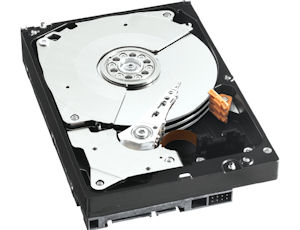
Drives from Western Digital and others are built like complicated record players. An arm with a head at the end reads data from spinning disks, sort of a like a needle on a record or a laser on a compact disc.
Spinning disks in a laptop computer typically make 5,400 rotations per minute. Drives that go into servers see speeds of 10,000 rotations per minute.
The disks are made of layers of aluminum, glass, metal alloys and a carbon-based lubricant layer.
There can be up to four disks, or platters, in a single drive.
Western Digital designs the head and disk parts in Northern California and makes the parts in Malaysia and Singapore. It gets motors for drives from undisclosed suppliers.
The drives also include chips and other electronics, including a microprocessor. They’re on a circuit board that houses memory chips, a chip that controls the drive’s spindle motor and arm, and a controller chip that allows the drive to interact with a computer.
The circuit board also includes what are called “jellybean parts.” Those are small electrical bits, such as resistors and capacitors, found on any circuit board. Western Digital buys those parts, as well as memory chips.
The controller chips are designed by Western Digital in Lake Forest, Colorado and Phoenix and are made in Asia through contract chipmakers. Other chips are made by Western Digital at a plant in Fremont.
Final assembly of the drives is done in Malaysia or Thailand.
There are a lot of moving parts.
“The hard drive is one of the most amazing electromechanical devices on the planet,” Cain said.
One of the most complex mechanical bits made by Western Digital is called a slider—a set of tiny wing-like pieces that are mounted onto the writing head. The head flies above the spinning disk so there’s no direct contact.
“The design is much akin to an aircraft,” Cain said. “It has to fly at a controlled, steady spacing of about three billionths of a meter. It’s incredibly sophisticated how that mechanical system can hold this head on track on an atomic scale.”
The consolidation of production at Western Digital is at odds with other technology companies that have come to outsource much of their manufacturing.
The strategy makes sense for Western Digital, according to Cain.
“By having control over a key technology component that is a significant portion of your materials cost, you have more control over your total costs,” he said.
For the three months through March, Western Digital reported net income of $400 million, up from $50 million a year earlier.
The strategy also helps Western Digital manage the prices of its raw materials by minimizing the chance of the company being squeezed by suppliers.
And having more parts made internally helps Western Digital make better quality drives, according to Cain.
“When you make heads and disks, the way they interact with one another requires close tuning and optimization,” he said. “By having the ability to manufacture those components yourself, you can optimize the overall system.”
