

Dallas-based AT&T Inc. moved closer to rival Verizon Communications Inc. in the local 4G race when it launched its long-term evolution network here earlier this month.
LTE networks are regularly upgraded to boost download speeds and allow users to do more with their smart phones. AT&T’s LTE has been expanded to 26 markets in the country.
AT&T made numerous investments in Orange County last year to boost performance and reduce dropped calls on its network. The efforts included 12 new cell sites and added capacity for 450 others; fiber-optic network connections that enable 4G speeds on more than 500 cell sites; a new and upgraded distributed antenna system, or mini cell sites, at the Brea Mall; and added capacity for cell sites in the area around John Wayne Airport.
AT&T spent $20 billion nationwide on the plan last year.
The local portion of the plan follows major wireless and landline improvements here during the three prior years. From 2008 to 2010, the company invested more than $450 million in upgrades centered in Orange County.
Mobile data traffic on AT&T’s nationwide network has grown some 8,000% in the last four years. As customers consume more data, network traffic is projected to increase eight- to tenfold by 2015, the company said.
AT&T is the nation’s second-largest mobile carrier in subscribers behind New York-based Verizon, considered the leader in the 4G race here and nationwide.
Patent Approvals

Irvine-based Solarflare Communications Inc., one of the area’s best-funded chip startups, recently received five U.S. and three European patent approvals.
The patents are geared to improve performance and speed up processing for 10-gigabit Ethernet networks.
Solarflare makes networking chips and circuit boards that help bridge old networks with new ones.
The company has carved out a niche in the last few years selling its speedy data networking circuit boards directly to banks, hedge fund managers, stock exchanges, brokerages and other financial institutions.
In August it struck a deal to embed its technology at the Chicago Board Options Exchange to boost high-frequency trading.
The shift to directly sell to end users deviated from the company’s initial strategy to sell chips to server manufacturers themselves.
Solarflare has raised more than $200 million in venture funding since starting in 2001.
Cool Demos
Product practicality and the cool factor are not necessarily mutually exclusive, evident with many of the demos during the recent International Consumer Electronics Show in Las Vegas.
Irvine-based mobile electronics accessory maker The Joy Factory Inc. debuted a waterproof and rugged case for the iPad 2—an extension of its similar line for the iPhone—that can withstand immersion in more than three feet of water for 30 minutes. The durable case also allows users to snap pictures under water and guards against drops and harsher conditions at construction sites, warehouses, auto shops and other places.
The product will be available this quarter for about $100.
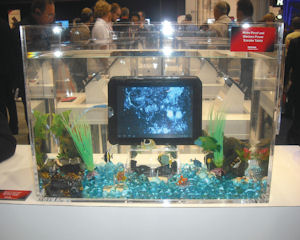
But Toshiba Corp. may have one-upped Joy Factory, with a prototype for a waterproof tablet—which sat at the bottom of fish tank at their space on the exhibition floor. Pitchmen from Irvine-based Toshiba America Electronic Components Inc., the U.S. sales and marketing arm of Tokyo-based Toshiba Corp., touted its top features such as wireless charging.
More than 20,000 products were launched at the show.
Irvine-based chipmaker Broadcom Corp. used CES to launch a pilot blog program to reach key constituents in a different way. The company hired longtime Silicon Valley reporter and blogger Sam Diaz to run the test program with three interns.
Diaz covered the tech beat for the San Jose Mercury News during the dot-com era, and later served in various editorial roles for The Washington Post. He most recently served as senior editor for ZDNet, a CBS Interactive site.
“Like a lot of companies, Broadcom is experimenting with social media to share ideas and cultivate communications with our most important communities,” spokesperson Karen Kahn said. “The Blog Squad did a terrific job of capturing the hottest consumer technology trends from a Broadcom perspective.”
The 2012 CES was the largest in its 44-year history, featuring 3,100 exhibitors covering 1.8 million square feet of show floor. There were more than 153,000 show-goers, including 34,000 international attendees.
