

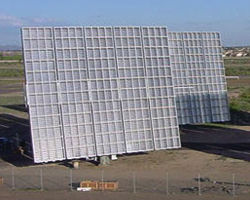
Amonix Inc., a Seal Beach-based maker of solar panels, has big plans for growth.
It recently landed $9.5 million in federal stimulus money, completed a round of private financing, hired a chief executive and plans to add more than 400 workers at two plants set for Nevada and Arizona.
Chief Executive Brian Robertson declined to give specifics on its latest funding, other than to say it’s a “multimillion dollar” deal.
“It’s enough to create two manufacturing plants in the Southwest,” Robertson said of the financing.
Robertson joined in November. Earlier, he served as president at Maryland’s SunEdison LLC, a solar power company that was bought
by silicon wafer maker MEMC Electronic Ma-terials Inc. of Missouri late last year.
Robertson took over for Amonix founder Vahan Garboushian, who is focusing on his role as chairman and chief technology officer.
The technology Gar-boushian used to start Amonix is based on using concentrated light to generate electricity.
The company also has been working with Sylmar-based Spectrolab, a unit of Boeing Co., to create more efficient cells.
“Besides producing what we believe to be the most efficient panels in the world, they’re the largest,” Robertson said.
Because of their size, the panels typically are used in de-serts, Robertson said.
To compete with traditional power sources, solar has to be sold for less than 15 cents per kilowatt hour during peak daytime hours, according to Robertson.
On average, electricity in California costs about 14 cents per kilowatt hour, according to the federal government’s U.S. Energy Information Administration. The national average is about 12 cents per kilowatt hour.
The company’s rivals include Tempe, Ariz.-based First Solar Inc.
Amonix’s pitch is that its technology uses less resources and water, according to Robertson.
“Some of the larger solar projects in this country have stalled because of a lack of water,” he said.
Utilities are warming to Amonix’s solar panels, said Guy Blanchard, the company’s senior vice president of sales.
“We’re seeing a thaw in utilities purchasing solar systems,” he said.
Traditional panels are based on the same silicon material that goes into chips used to run computers and consumer electronics.
Amonix’s panels are made from “fundamentally different materials,” Robertson said, which lower manufacturing costs and im-prove efficiency.
