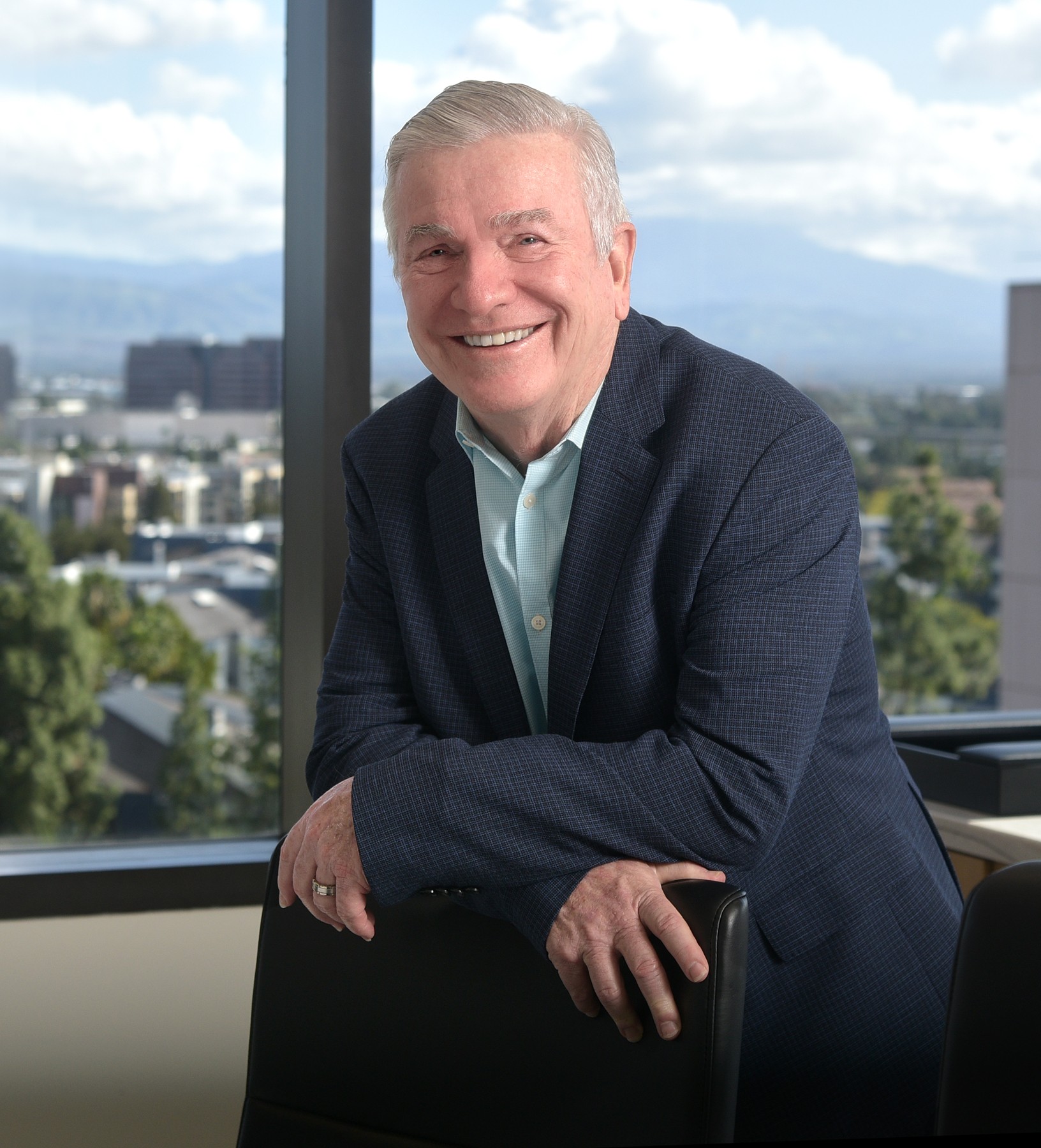
Bill Hoffman had more than 25 years of medical device experience when in 2015 he took a chance by joining a local medical device startup with 10 employees and no approved products.
That leap of faith paid and then some.
As chief executive and president of Irvine’s Inari Medical Inc. (Nasdaq: NARI), Hoffman helped build one of Orange County’s larger public companies.
The maker of products that treat blood clots in veins counts exploding revenue growth, an employee base topping 1,000, a new local headquarters base in the Irvine Spectrum and a market cap of about $4 billion as of last week.
The next chapter for Inari will be written under a different leadership team.
Hoffman on Aug. 3 announced he would remain on the board of directors while handing the chief executive reins to Chief Operating Officer Drew Hykes, who has been with the company for five years.
The exec change is effective Jan. 1.
“I have loved every second of my time here on this mission and with this team,” Hoffman, who was 54 years old as of the company’s last proxy, told analysts when announcing the decision, which he said was purely for personal reasons (see story, this page).
Growth Machine
Hykes is taking over a company on a fast track.
Revenue is expected to grow 33% this year to $369 million and another 20% in 2023, according to analysts’ consensus estimates.
Inari has developed products from the ground up with a specific purpose to remove clots from veins (see story, this page); competitors had tried to repurpose products designed to remove clots from arteries.
In 2017, Inari commenced sales of its products, which now include: ClotTriever for nonsurgical removal of clots from peripheral blood vessels, including for the use in the treatment of deep vein thrombosis.
n FlowTriever for nonsurgical removal of clots from peripheral blood vessels, including for treatment of pulmonary embolism (PE) and clots in transit in the right atrium.
The company believes its total addressable market opportunity is $5.8 billion in the U.S. alone.
Its products have won rave reviews from medical doctors around the country.
“Inari is the only device on the market that can extract chronic clot. Game changer,” Dr. Bhavraj Khalsa, a vascular and interventional radiology doctor at Orange’s Children’s Hospital of Orange County, said on Inari’s website.
2020 IPO, HQ Move
During a two-year stretch ended June 30, 2021, revenue surged 1,123%, ranking it No. 2 on the Business Journal’s 2021 annual list of the fastest-growing midsize publicly traded companies. One reason for the growth was because the company’s products can treat blood clots caused by COVID-19.
Since it went public at $19 a share in 2020, its price has more than tripled to around $74 as of last week.
Hoffman owns 1 million shares, or 1.9% of the company, worth an estimated $80 million at press time, according to the company’s latest proxy statement in April.
In October 2020, Inari moved its corporate headquarters to Irvine Co.’s 6001 Oak Canyon building, where it now leases about 120,000 square feet of space to its corporate headquarters, research and development, manufacturing, and other related activities.
The Beginning
Inari was the first company begun by Aliso Viejo-based medical device incubator Inceptus Medical, which was founded in 2011 by Bob Rosenbluth, Brian Cox and Paul Lubock.
Initial funding for Inari was provided by the founders, Versant Ventures, U.S. Venture Partners and private investors. Versant founder Donald Milder, who is Inari’s chairman, and Managing Director Kirk Nielsen have sat on Inari’s board since 2011.
Before joining Inari, Hoffman was CEO at Visualase Inc., which focused on MRI-guided lasers, from 2008 until its 2014 acquisition by Medtronic, one of the world’s largest medical device makers.
Hoffman, a graduate of Dickinson College in Pennsylvania, also served in executive roles at medical device makers that made minimally invasive breast biopsy and lumpectomy technology and treated peripheral artery disease.
Medtronic Vet
Hykes, 49, has a long history in medical devices, working in healthcare banking for ABN AMRO Bank and spending a decade at Medtronic, where he was director of investor relations and vice president of marketing.
He was vice president of commercial operations at Sequent Medical Inc., a maker of catheter-based neurovascular therapies with a local base in Aliso Viejo that was acquired in 2016 for $380 million by Terumo Corp., whose MicroVention division is also based in that city.
Hykes, who has an MBA from Harvard, joined Inari in 2017 as chief commercial officer before becoming COO in 2020, leading its day-to-day business operations.
“I can make a pretty compelling argument that Drew was and is now much better public-facing CEO than I ever could have been,” Hoffman told analysts.
“And his mindset, his training, his problem-solving skills (make him) the single best executive I’ve ever seen.
“The reason that we’ve promoted him to COO a couple of years ago was because he’s just really good at the problem solving. A lot of the systems and the processes and the programs that are necessary for the explosive growth … (was) conceived, installed and executed by Drew.”
Near-Term Plans
Inari on Aug. 3 reported second-quarter sales grew 46% to $92.7 million. It accelerated the expansion of its U.S. commercial footprint to 270 territories, up from 200 at the beginning of the year.
The company announced FDA clearance and limited market release of two new products; the company says several medical studies on its products are expected to be released later this year.
Inari reaffirmed its 2022 forecast for revenue in the range of $360 million to $370 million.
“It’s pretty apparent that the company is in fantastic shape,” Hoffman told analysts.
“Inari has undergone tremendous growth and change since I joined in 2017,” Hykes said in a statement at the time the exec changes were announced.
“From a venture-backed, pre-commercial startup to an established public company with over 1,000 Clot Warriors, increasingly broad-based capabilities, and a shared ambition to change lives in the venous space and beyond.
“We have maintained an unwavering commitment to our patients, our people and to big ideas,” Hykes said. “I couldn’t be more committed to these same ideals, nor more enthusiastic about this next phase of our growth.”
Hoffman’s Bucket List
“Why am I leaving? It’s purely personal,” Bill Hoffman told analysts on Aug. 2.
“I’ve been CEO now here for almost eight years. And before that, 7.5 years as a previous company that was acquired.
“It’s a long time and (it’s) been a grind. Maybe some people find a way to do that without the intensity that is all consuming, but I haven’t found that path.
“I’ve had no time to love much of anything else. So, (I’m) hoping to spend a little bit more time with books and bikes and my family and my kids and it’s just an exciting time in that way.
“I have no professional plan beyond continued service on the Inari Medical board of directors. I do, however, have a lot of work to do on my own personal bucket list.”
—Peter J. Brennan
Inari Products Save 14-Year-Old Boy
Bill Hoffman isn’t one for the limelight: he prefers attention be directed to Inari Medical Inc.’s medical devices, and how the Irvine-based company’s “mission” to treat certain types of blood clots has a very real-life impact on patients.
To emphasize that point, quarterly calls with analysts often are prefaced with recent anecdotes about the company’s products successfully being put to use.
The following was what Hoffman told analysts following the company’s latest earnings report on Aug. 3:
“A couple of months ago, 14-year-old boy, a competitive athlete in excellent physical condition, collapsed while playing basketball with friends. He was rushed by ambulance to a nearby hospital with multiple generations of family arriving shortly thereafter.
“Imaging showed large blood clots in both his left and right lungs.
“His physicians used FlowTriever along with FlowSaver to wash 12 times until all of the clots were removed from his lungs. The procedure was completed in 52 minutes. His pulmonary artery pressures, heart rate and breathing return to near normal levels immediately, and he was discharged from the hospital within 24 hours.
“The story is remarkable for several reasons.
“First, syncope or fainting suggests a high-risk presentation of PE [pulmonary embolism], and it carries a mortality rate of up to 50%. Second, any clot remaining in the lungs of PE survivors conveys terrible long-term consequences, including persistent right heart strain, shortness of breath, exercise and basic functional limitations and poor quality of life scores.
“Removing all of the clot matters. And this young man has no residual clot.
“He’s not only alive, but the trajectory of this hopefully very long life is changed in the most beautiful ways.
“His entire family openly wept upon hearing the good news about the procedure and seeing the pictures of clot removed from his lungs.
“We remain committed to ideas bigger than ourselves.”
—Peter J. Brennan