

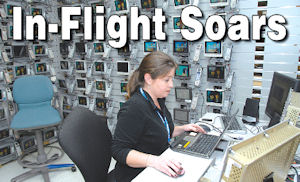
If you’re watching TV on an American Airlines flight from John Wayne Airport to New York, chances are the in-flight entertainment system was designed and assembled in Orange County.
The same goes for that database of thousands of songs and videos available on British Airways flights from New Jersey to London. Or the dozens of movie titles available on a Flydubai flight through the United Arab Emirates.
Orange County is home to the largest cluster of IFE companies anywhere, employing more than 2,500 engineers, programmers and other workers. The companies combine for the lion’s share of a market worth about $2 billion in annual sales around the world.
IFE is one of the few growth markets in aviation, with sales buoyed in the past decade by domestic carriers’ fleet upgrades, foreign airliners’ new-plane purchases and gains in international air travel.
The latest rise for the segment has come from a push to produce lighter planes and equipment in an effort to offset rising fuel costs.
The industry’s roots were planted here in the early days of old-line aerospace manufacturing by the likes of McDonnell Douglas Co., Boeing Co. and Rockwell International. The local operations grew to global prominence amid a wave of technological improvements, from connectivity and networking innovations to cutting-edge data collection and storage.
“Heart and Soul”
“Orange County is the IFE hub of the world,” said Lumexis Corp. Chief Executive Douglas Cline, who has worked for more than three decades in aviation electronics. “This is the heart and soul of the whole bit.”
Lumexis makes fiber-optic IFE and e-commerce systems in Irvine. It competes in a sector dominated by Panasonic Avionics Corp. in Lake Forest and Irvine-based Thales Avionics Inc.
Panasonic Avionics, a unit of Secaucus, N.J.-based Panasonic Corp. of North America, is the market leader in IFE systems, with annual sales of more than $1 billion and an estimated 70% share of the market. The company—ultimately part of Osaka, Japan-based Panasonic Corp.—employs 1,300 people at its sprawling six-building campus on Enterprise Way in engineering, programming, testing, assembly and other operations.
Panasonic Avionics makes every component in its systems, including monitors, remotes, servers, power boxes, software and networking distribution.
“We do everything ourselves,” Neil James, executive director of corporate sales and product management, said during a recent tour at the company’s headquarters. “When we commit, we want to know we control all the resources.”
The business model is geared for long-term clients and recurring revenue streams.
The company counts more than 200 customers, including nearly every major domestic airliner and numerous international ones, including Philippine Airlines, Qantas, and Singapore Airlines. Its IFE systems are carried on more than 3,700 planes flying today.
“The emerging high-end airlines in every region of the world fly Panasonic equipment,” James said.
It inked a $1 billion contract in December, its biggest to date, to provide its systems for Etihad Airways, the national airline of the United Arab Emirates. Panasonic also will provide broadband Internet, live TV and mobile phone services for the airline’s entire long-haul fleet of wide-body aircraft.
Wide-body airplanes typically have two aisles and have capacity for anywhere from 200 to more than 800 passengers.
Panasonic
Panasonic has the largest support network in the industry, with more than 80 offices around the world and 3,100 employees. It has more than 100 job openings in Lake Forest, primarily for engineering positions, James said.
The company was established in New Jersey in 1979 when its parent, then known as Matsushita Electric Industrial Co., signed its first contract to provide a passenger entertainment system for the B767.
It moved its headquarters to Bothell, Wash., in 1986 to be closer to the aerospace market and Boeing. Panasonic still employs more than 400 people there.
Irvine was chosen for a new research and development operation in 1990, and by 1994 had become headquarters as the company took the Panasonic Avionics name.
Irvine quickly became the center of the industry as the region attracted software and development engineers, according to James. It wasn’t long before a cottage industry of IFE vendors sprouted and the industry took root.
“It made a lot of sense for it to be in the Orange County area,” James said. “It’s where the passion for this industry really resides and a lot of key engineering expertise is required.”
Panasonic’s chief rival is Thales Avionics, part of French electronics company Thales Group, which sees about $18 billion in annual revenue. It competes to a lesser extent against Lumexis, IMS Co. in Brea and Cedar Rapids, Iowa-based Rockwell Collins Inc.’s media unit in Tustin, which packages music, movies and TV programming for airlines and has some local hardware manufacturing operations.
Thales’ Share
Thales controls about a quarter of the IFE market and focuses on communications systems, from back-seat screens to ground or satellite-based connectivity. Its three-building campus in Irvine encompasses 160,000 square feet and employs about 700 people.
The company’s high-speed system features a tablet PC that allows passengers to stream hundreds of movies, tens of thousands of songs, maps and video games on planes as large as an A380 to small regional jets.
“That network is the single, most complex system on the airplane,” said Jeff Sare, vice president of product and development and strategy.
Thales counts 51 airline customers. Major clients include British Airways, Air China and China Eastern.
In October it landed a contract with Biman Bangladesh Airlines to produce IFE systems for four new Boeing 777s, the government-owned carrier’s first new aircraft in 40 years and the country’s most expensive asset purchase.
The 777s are 19% lighter than similar models and costs 20% less to operate per seat, due to less fuel consumption.
Emerging markets are fueling growth as U.S. carriers tend to embrace IFE systems less than counterparts in the Middle East, Asia and Europe.
“The U.S. has less of a market for IFE than anywhere else in the world,” Sare said.
IFE system sales are growing 8% to 10% annually, according to Sare, as airliners shift to lighter weight and lower-cost installations.
Global opportunities and a push to lower costs have opened the door for smaller and new players in a market with a strong barrier to entry, given high initial capital requirements and infrastructure concerns.
Shift
IMS shifted its focus from software and system development to building products about a decade ago. The move to manufacture portable media units, seat mounts and content loading boxes paid off.
The company saw about $45 million in revenue in 2011 and picked up seven new airline customers. Sales are expected to surpass $65 million this year with more than 150 aircraft on backlog, according to founder and Chief Executive Joe Renton.
“We have changed the model,” Renton said. “Historically, all the content lived in servers on the belly of the plane.”
IMS basically turned a single-seat media unit into a removable docking piece, so it can easily be replaced during flight and thus eliminate problems of quality, reliability and cost.
The company added about 85 people last year and employs 225 workers in Brea and Bellevue, Wash.
IMS designs the systems and software and outsources the hardware manufacturing to China contractors.
“We think we can find our niche,” Renton said.
Similar market opportunity brought industry veteran Cline out of retirement to join Lumexis. The company secured its first contract in May 2010 when it was brought on board to provide IFE systems for 44 aircraft operated by Flydubai, United Arab Emirates’ low-cost airline.
Lumexis was founded in 2003 and now employs about 50 people. It has maintenance operations in Dubai and Moscow.
The company’s niche is in producing light-weight IFE systems and using contract manufacturers. Its goal is to cut equipment weight by 50% compared to traditional systems.
“We’re at about 38%,” Cline said. “We have to compete with Panasonic and Thales. We have to keep our costs down.”
