

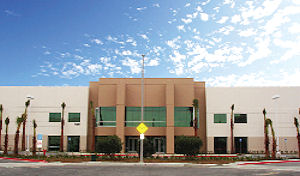
Seattle-based cancer drug developer Dendreon Corp. plans to start hiring hundreds of workers later this year for a plant being built in Seal Beach, according to its chief financial officer.
Dendreon expects to have some employees in place by year’s end with more hiring in 2011, Financial Chief Greg Schiffman said.
Although the company hasn’t said exactly how many people it plans to hire, Schiffman said it would be “several hundred.”
Dendreon is building the plant to produce Provenge, its prostate cancer drug candidate that awaits an expected Food and Drug Administration approval in about six weeks.
Last year, the drug developer signed a 10.5-year lease valued at $13.6 million for 184,000 square feet of space in the Pacific Gateway Business Center off the Garden Grove (22) Freeway.
The company expects to have its plant finished by the end of 2010, said Schiffman, who was in Dana Point last week at Newport Beach-based Roth Capital Partners LLC’s stock conference.
Dendreon needs to “substantially complete the construction” and get an FDA inspection before it begins full-scale hiring, he said.
Plans call for 36 workstations and the capability to make $375 million to $750 million worth of Provenge a year, Schiffman said.
“The Seal Beach plant is a very important one for us on the West Coast,” Schiffman said. “When you look at Seal Beach, you’ve got several choices in airports around there.”
Most on Wall Street expect Provenge to be approved by the FDA on May 1. Regulators already have looked at Provenge and have indicated it could be approved.
Provenge is designed for men whose prostate cancer has spread and is resistant to what’s known as chemical castration hormone therapy, which is used because prostate cancer feeds off of testosterone.
Chemical castration is the conventional way to fight advanced forms of prostate cancer. But it comes with unpleasant side effects, including the development of menopausal-like symptoms.
Dendreon makes Provenge from white blood cells harvested from individual patients. After each patient’s cells are taken, they are sent to Dendreon’s plants, which convert them to Provenge and then return them to the doctor’s office for treatment.
Provenge works by spurring white blood cells to attack cancerous cells in the prostate gland.
Dendreon hasn’t given an estimate on how much the Provenge treatment will cost, Schiffman said.
Analysts Peter Hellman, Christopher Raymond and Blake Arnold of Milwaukee-based investment bank Robert W. Baird & Co. estimated in a research report that Provenge will cost $70,000 per treatment.
The analysts said they expect the government’s Medicare health plan for seniors “to be a major part of the (payer) mix for Provenge,” considering most clinical trial participants were 70 or older.
“The Dendreon story is now one of execution,” said Joseph Pantginis, a Roth analyst, in a recent report initiating coverage on the company.
Dendreon’s “made significant investment in Provenge, especially on building out the extensive manufacturing infrastructure needed to bring the treatment to prostate cancer patients,” Pant-ginis said.
Besides Seal Beach, Dend-reon is building a plant in Atlanta and is expanding its New Jersey facility, which is now only at 25% capacity.
Dendreon got money to speed up the plant expansion in December when it raised $356 million in a stock sale.
If Provenge is approved and commercialized, Dendreon insists that it will remain independent despite the belief of some analysts that it is an acquisition target.
Pantginis wrote that Dendreon could be a candidate for a deal based not only on Provenge’s potential, but Dendreon’s drugs in development.
Dendreon’s pipeline includes Neuvenge for metastatic bladder cancer, or bladder cancer that has spread to other parts of the body, and CA9, which is being developed for kidney, colon and cervical cancers.
“Our goal is to build a large platform oncology company,” Schiffman said.
Dendreon is in talks with potential partners to market Provenge internationally, Schiffman said..
