

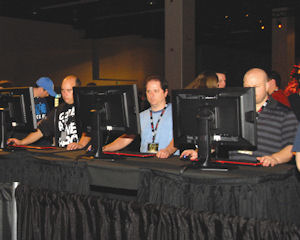

Two weeks of free play apparently isn’t enough for prospective “World of Warcraft” buyers to venture deep into its virtual labyrinth.
Irvine-based online game maker Blizzard Entertainment Inc. has lifted a 14-day cap on a trial period for a starter edition of the game that is free up to the first 20 levels.
“By eliminating the 10- or 14-day time limit, players can enjoy ‘World of Warcraft’ at their leisure,” said a Blizzard spokesman.
Some 12 million people worldwide play “World of Warcraft,” facing off in epic virtual battles between two fictional races fighting for control of a fantasy world. Gamers pay about $40 to start and a $15 monthly subscription fee.
“It’s excellent bait to hook players onto an experience that’s been already proven addictive,” said Evan Narcisse, a well-known techie who writes reviews and blogs for the The Independent Film Channel among others. “If you’re going to invest your time to play all the way to level 20, you’re not going to stop.”
Level 20 gets gamers about a quarter of the way through the game.
The starter edition does have some restrictions, including caps on skills and trades with other players, according to gamespot.com, a division of CBS Interactive Inc.
The move by Blizzard comes as online games that skip video consoles and carry better profit margins continue to grow fast.
Blizzard is more than holding its own. It saw first-quarter sales of $357 million, up 17% from a year earlier. It had operating profit of $170 million, up nearly 8%, for the period.
That drove much of the growth for Santa Monica-based parent company Activision Blizzard Inc., which posted a 7.6% rise to $1.4 billion in sales and a $503 million profit.
Record sales of the latest version of “World of Warcraft” and downloads of the “Call of Duty” console game drove gains.
The company’s subscriptions—made up largely of “World of Warcraft” and “Call of Duty” downloads—rose 27% to $395 million in the quarter.
Blizzard Entertainment is the largest software company based in Orange County with yearly sales of about $1.4 billion.
The company ultimately is part of France’s Vivendi SA, which bought Activision in 2008 and combined it with Blizzard in a deal valued at about $10 billion.
Western Digital as Witness
Mark Longoria, a former employee at Irvine-based disk drive maker Western Digital Corp., told a New York judge late last month that he was paid $200,000 by a consulting firm to provide insider information about the company’s business.
Longoria, who worked at Western Digital from 2000 to 2006, said he provided information to Mountain View’s Primary Global Research LLC about Western Digital’s business with Dell Inc.
He also said he passed along the details to four hedge funds, including New York-based Barai Capital Management whose founder, Samir Barai, pleaded guilty to federal charges in May.
Western Digital is cooperating with the government and has been advised by the U.S. Attorney’s office it is a witness. The company and its employees are not targets of the investigation, according to company spokesman Steve Shattuck.
Longoria’s statement was a part of plea agreement in the District Court in Manhattan, where he admitted to two counts of conspiracy, one count of securities fraud and one count of making false statements to prosecutors and Federal Bureau of Investigation agents.
During court proceedings, which began in December after an investigation led by the U.S. Attorney’s Office and the FBI, Longoria implicated several other hedge fund managers.
Longoria also admitted to providing company secrets about Northern California chipmaker Advanced Micro Devices Inc.
Besting Broadcom
Qualcomm Corp. topped Irvine-based Broadcom Corp. as the top GPS integrated circuit maker, according to the latest vendor rankings by New York-based ABI Research.
Companies were assessed on two major criteria: innovation and implementation.
The innovation category included market share, consumer, professional, industrial and military market focus, fabrication and key customer wins.
Implementation included radio frequency, baseband and single-chip solutions, wireless assistance data and satellite-based system support.
Broadcom and San Diego-based Qualcomm are longtime rivals and compete in numerous segments, including mobile phone chips, connectivity chips and application processors.
