

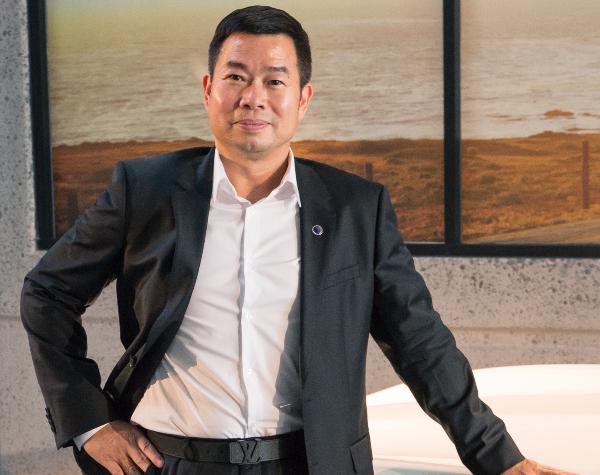
Another year, another CEO.
That’s been the case for Anaheim-based Phoenix Motor Inc. (Nasdaq: PEV) since 2020.
The commercial EV truck maker last month maintained its yearly CEO streak when it replaced Chief Executive Liang (Lance) Zhou with Chairman Xiaofeng (Denton) Peng, on June 6, effective immediately.
Phoenix in filings did not provide a reason for Zhou’s sudden departure, though Chief Marketing Officer Jose Paul Plackal told the Business Journal that Zhou left his post for personal reasons.
Zhou, the former CEO of Irvine-based luxury vehicle maker Karma Automotive, ran Phoenix for a year and three months.
His fate follows that of his predecessor, Joseph Mitchell, who also led Phoenix for a little over a year before he left the local maker of electric passenger vans, school buses, forklifts and heavy-duty pickup trucks in 2022.
The company’s current CEO, Peng, has served as chairman since 2020. This marks Peng’s second stint as chief executive of Phoenix. He first led the business three years ago, when parent company SPI Energy Co. (Nasdaq: SPI) bought the EV maker, just before Mitchell took the helm. Peng is also the CEO of SPI Energy.
Although Phoenix has undergone several shifts in leadership over the past year, “our strategy hasn’t really changed,” Plackal said.
“The focus for Phoenix right now is on improving profitability and improving quality in this very, very nascent market.”
Since the leadership change, Phoenix’s stock has been off about 10% at 73 cents a share and a $15 million valuation as of last week.
Shares in the company, which went public last June at $7.50 apiece, are off some 90% from its IPO price.
Karma Lawsuits
Zhou’s tenure at Phoenix was shorter than his time at Karma; he ran Karma for nearly 4 years. Until the recent emergence of Irvine’s Rivian Automotive Inc. (Nasdaq: RIVN), Karma had been the area’s largest auto maker by local employee count.
During his tenure, the company became embroiled in two lawsuits involving allegedly stolen vehicle plans.
In 2020, VLF Automotive accused Zhou of breaching a non-disclosure agreement and contacting its manufacturing partners with VLF’s designs for an electric Humvee, which the company previously shared with Karma for a potential partnership. Karma planned to bring the Humvee to market without VLF’s involvement out of financial desperation, VLF alleged in the lawsuit.
The same year, Karma sued Lordstown Motors Corp. (Nasdaq: RIDE).
The company claimed that Lordstown stole trade secrets for its entertainment system and poached Karma’s project managers and engineers. Karma later added allegations of conspiracy, fraud and violations of the Racketeer Influenced and Corrupt Organizations Act to the suit.
Lordstown has an operational base in Irvine, not far from Karma’s headquarters. Lordstown filed for bankruptcy protection in late June; officials said in court filings it plans job cuts to its workforce (see story, page 5).
Young Public Company
Zhou left Karma in 2021 and joined Phoenix the following year.
During his tenure, Zhou led the relatively small EV maker through some modest revenue growth and an IPO.
The company nearly tripled its first quarter revenue this year to $1.8 million, up 165% from the year prior.
The growth came from an increase in EV deliveries from three to five units, the company said in filings.
As for annual revenue, Phoenix topped $4 million last year, up 45% from the year prior.
That uptick stems from a rise in electric forklift sales, filings indicate.
Despite Phoenix’s revenue growth, its potential for becoming profitable remains up in the air.
“Our results have not resulted in profitability, and we may not be able to achieve profitability going forward,” the company said in recent regulatory filings.
Phoenix’s accumulated deficit totaled nearly $29 million as of the end of last year.
The company also said in regulatory filings it anticipates maintaining negative cash flow throughout this year as it invests in research and development, sales and marketing and other expenses to “increase sales and ramp up operations.”
“The goal is to ramp up production on our Gen 4 electric drive system, but also expand capacity through sales or partnerships across the nation,” Plackal said.
Triple Duty
Peng, Phoenix’s current CEO, inherited from Zhou a company with a questionable route to profitability and shares that have plunged since their IPO.
As he tackles Phoenix’s challenges, Peng must also juggle the other two companies under his lead: SPI Energy and solar product maker LDK Solar Co. Ltd.
Peng, who received his MBA from Peking University Guanghua School of Management, counts over 20 years in the renewable energy industry.
